DD
MM
YYYY

PAGES

DD
MM
YYYY

spot_img

PAGES

Home Blog Page 813

African Tech Merger And Acquisition Hits Record High in H1 2025 as Fintech Leads Strategic Acquisitions

0
CREATOR: gd-jpeg v1.0 (using IJG JPEG v80), quality = 82

Merger and acquisition (M&A) activity in Africa’s tech ecosystem surged to record levels in the first half (H1) of 2025, underscoring the sector’s growing maturity and appetite for consolidation.

According to “The State of Tech in Africa” report by Tech Cabal Insights, a total of 29 M&A deals were recorded in H1 2025, the highest ever for any first-half period, representing a 45% increase from the 20 deals logged in H1 2024 and a 53% rise compared to H1 2023.

The sharp growth highlights that strategic acquisitions are becoming a key pathway for established companies to expand market share, acquire technology, and access talent. As the funding environment stabilizes, well-capitalized startups and corporations alike are increasingly relying on acquisitions to accelerate growth and solidify market leadership.

Fintech continued to dominate as the most active sector, accounting for 13 of the 29 deals (45%). E-commerce followed with six deals, as larger players moved to acquire innovative startups to quickly onboard new technologies and customers. The deals reflected a mix of acquisitions for market entry and takeovers of struggling companies seeking a lifeline.

Speaking on this, Matthew Davis, CFA co-CEO and Managing Partner Renew Capital said, “Many good, early-stage fintechs will struggle to raise larger rounds and become good
acquisition targets for larger VC-backed companies as they focus on aggressive expansion”.

Since early 2023, M&A activity has been broadly distributed across Africa’s key regions. West Africa and Southern Africa each recorded 24 deals over this period, while North and East Africa followed closely with 20 apiece. Notably, eight of the 29 H1 2025 deals involved acquisitions outside of Africa, underscoring the global ambitions of African startups.

North Africa emerged as the most active region in H1 2025, recording eight deals, followed by East Africa with seven and West Africa with six. Egypt led as the top acquisition target, with eight Egyptian startups acquired during the period. Kenya and Nigeria followed with seven and five deals respectively, reinforcing their positions as dynamic startup markets.

Prominent transactions included Stitch’s acquisition of ExiPay to expand into in-person payments, Moove’s acquisition of Brazil’s Kovi to further global ambitions, and LemFi’s acquisition of Irish currency exchange Bureau Buttercrane to strengthen its European presence. Other notable deals saw Peach Payments acquire West African payments gateway PayDunya, Moniepoint expand into Kenya with the acquisition of Sumac Microfinance Bank, and MaxAB-Wasoko acquire Egypt’s Fatura to enhance its e-commerce footprint.

Industry observers noted that both aggressive expansion and market clean-up are likely to drive future M&A activity. As funding gaps persist from pre-seed to later-stage rounds, many early-stage fintechs may struggle to secure growth capital, making them attractive acquisition targets for larger, VC-backed firms seeking licenses, customer bases, and alternative datasets.

Notably, South Africa and Egypt remain the continent’s top M&A hotspots, and experts expect these markets to retain their dominance. While some African startups are venturing abroad for acquisitions, the primary focus is anticipated to remain within Africa, given the continent’s untapped opportunities and competitive advantages. Nigeria and Kenya bolstered by significant early-stage investment over the past five years, are also projected to experience rising cross-border acquisition activity, particularly between startups in these two ecosystems.

The record-breaking M&A activity in H1 2025 reflects a maturing African tech ecosystem, where strategic acquisitions are increasingly viewed as essential tools for scaling, diversifying revenue streams, and consolidating market power.
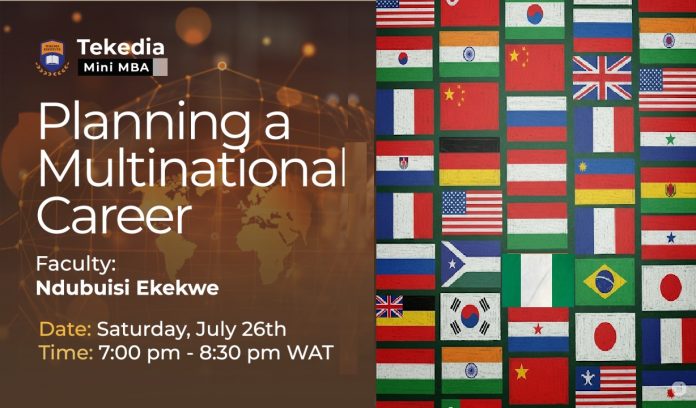
Planning a Multinational Career in our Contemporary Interconnected World

0

Planning a multinational career in our contemporary interconnected world demands a strategic approach focused on deepening our personal economy and global relevance. Tekedia Institute emphasizes that building a “personal economy” is crucial, and increasingly the architecture of that development could transcend national economies. The implication is that we must acquire skills and knowledge that are universally applicable and in demand across diverse markets.

To truly thrive in a multinational career, individuals must embrace continuous learning and adaptability. Tekedia’s insights suggest that success hinges not merely on academic credentials, but on one’s ability to be anticipatory and adaptive in a rapidly evolving global economy. This includes understanding emerging technologies like AI and their impact on business, as well as developing strong leadership and human capital management skills. By focusing on excellence, building a robust personal brand, and actively seeking opportunities for cross-border engagement, professionals can position themselves for impactful and expansive careers on the world stage.

In this Tekedia Mini-MBA’s Personal Economy module, lead faculty, Ndubuisi Ekekwe, will share a case study on how that trajectory could be formulated, using simple elements like requesting for your World Education Services credentialing, and in the process decouple your transcripts from delays, school strikes, etc, so that you can apply for scholarships, schools, jobs, etc on time.

Of course, building a multinational career is not about having multinational jobs because careers and jobs are not the same things. You can be in Lagos and execute a multinational career that is agnostic of geography in this knowledge age. Join me and register for the Sept edition of Tekedia Mini-MBA.


Sat, July 26 | 7pm-8.30pm WAT | Planning a Multinational Career – Ndubuisi Ekekwe | Zoom link in board

DX CTO Says Companies Should Rethink Corporate Documentation, Write Things AI Can Easily Read

0

The era of poorly organized memos, scattered slide decks, and screen-recorded webinars could soon be over. Companies are being urged to overhaul their internal documentation to make it legible for artificial intelligence systems, with developer productivity experts like Laura Tacho, CTO of the platform DX, sounding the warning on what she calls a hidden efficiency crisis.

Speaking with Business Insider and on The Pragmatic Engineer podcast hosted by Gergely Orosz, Tacho said many firms are already shifting toward what she described as “AI-first” documentation practices—writing and structuring company knowledge so that large language models (LLMs) can easily consume and act on it.

“Documentation is a huge point of friction for nearly every organization,” Tacho told BI. “There’s a lot of efficiency gain to be had when documentation is more fit for purpose. This is an area where what’s good for the human is also good for the LLM.”

According to Tacho, engineers lose over 30 minutes a week searching for information buried in cluttered or inaccessible documents—a problem that LLMs could solve if they were simply given structured text to read. But video trainings, screenshots, and visually reliant content block AI tools from accessing essential knowledge.

From Human-First to AI-Literate

Human-friendly documentation often leans heavily on visual design, relying on screenshots, diagrams, and interfaces to convey information. But these visuals, Tacho warns, are mostly illegible to AI. She recommends that every image be paired with textual descriptions, borrowing a principle from web accessibility standards, such as alternative text and captioning used by social platforms for the visually impaired.

“It is so important for people who are not using their eyes to access the screen,” she said, emphasizing that practices that improve accessibility also unlock AI comprehension.

The concept, she says, is not just about helping LLMs. “The venn diagram is a circle,” Tacho noted, highlighting that clear, structured documentation improves productivity for both humans and machines.

Beyond that, companies are being advised to centralize their documentation, avoiding the fragmented sprawl that forces users to navigate multiple internal portals to complete a single task.

“Documentation is made piecemeal, a little here, a little there,” she said. “You have to hop between different pages in order to put together the complete instruction of what you’re supposed to do.”

The solution? Tacho calls it a “defrag” of internal policies—borrowing the term from computing to suggest restructuring for efficiency.

Code-Ready Language and Real-World Examples

For software companies in particular, making documentation LLM-compatible could soon be non-negotiable. Developers are already plugging documentation directly into AI code editors like Cursor, which allow them to generate code snippets and explanations instantly. The catch: the documentation has to be in readable, structured text.

Some companies are already adapting. In May, Lee Robinson, former VP of Developer Experience at Vercel, revealed changes to the company’s documentation strategy on X (formerly Twitter).

“We’re starting to add cURL commands to Vercel’s documentation wherever we previously said ‘click,’” he wrote.

Robinson suggested that in the near future, AI agents might not just read documentation, but act on it—performing tasks, logging in, and executing commands on behalf of users.

That’s a future Tacho also envisions—but it won’t happen unless businesses start writing for both people and machines. She cited technical standards like using semantic HTML markup to help LLMs better parse and understand online documentation.

A New Corporate Priority

What might sound like a marginal improvement in productivity could have significant implications for company performance. With LLM tools like OpenAI’s ChatGPT or Anthropic’s Claude becoming common in enterprise workflows, the quality and accessibility of internal documentation could directly impact how much return companies see from their AI investments.

“When you think about how much time is being wasted due to poor documentation, it becomes actually a very critical business problem,” Tacho said.

As AI systems continue to evolve, companies still stuck with scattered training videos and PDF slide decks may find themselves not just inefficient, but incompatible with the next wave of workplace automation. The age of screen-recorded onboarding is waning, and text, it seems, is the new code.

SEC DG Announces Nigeria’s Readiness to Embrace Stablecoins

0

Nigeria’s financial markets regulator has formally declared the country’s readiness to accommodate stablecoin businesses, provided they align with a clear regulatory framework designed to protect market integrity and empower its citizens.

The announcement was made by the Director-General of the Securities and Exchange Commission (SEC), Dr. Emomotimi Agama, at the inaugural Nigeria Stablecoin Summit held in Lagos.

The summit, the first of its kind on the African continent, brought together policymakers, developers, and digital finance players to map out the future of regulated stablecoin adoption across Africa’s largest economy.

In a keynote address titled “Building a Regulatory Framework for Stablecoin Innovation: The Nigerian Perspective,” Dr. Agama declared that Nigeria is open to stablecoin enterprises—but only on terms that prioritize financial integrity and long-term national development.

“When history documents Africa’s financial revolution, today will be remembered as the moment we moved from potential to action,” Agama said.

He emphasized that the SEC’s position is not merely about embracing digital assets for their novelty, but ensuring they serve Nigeria’s broader economic goals, especially in improving financial inclusion, reducing remittance costs, and stabilizing value for users exposed to the volatile naira.

Stablecoins As A Hedge Against Volatility

Agama noted that stablecoins are increasingly being used by Nigerian freelancers, traders, and tech-savvy youth to escape inflationary pressures and carry out cross-border transactions efficiently. As Nigeria’s digital economy grows more decentralized, stablecoins have emerged as a reliable means of securing and transferring value.

“The Nigerian digital economy is youthful, dynamic, and increasingly decentralized. Stablecoins are playing a central role in facilitating secure, borderless transactions,” he stated.

He acknowledged, however, that the lack of local regulation has allowed some bad actors to flourish. With the rollout of new legal frameworks, the government hopes to separate genuine innovation from fraud.

ISA 2025: The Legal Backbone of Nigeria’s Digital Finance Future

Central to Nigeria’s new stablecoin policy is the Investment and Securities Act (ISA) 2025, a legislative upgrade that Dr. Agama described as “forward-looking.” The law grants the SEC wide-ranging powers to oversee digital assets, including stablecoins, cryptocurrencies, and decentralized finance platforms.

“The ISA 2025 strengthens our ability to manage innovation responsibly. It provides the legal clarity the industry needs,” Agama said.

The Act also gives regulatory backing to the SEC’s regulatory sandbox, a controlled environment where startups can test financial technologies under supervision. According to Agama, the sandbox has seen increasing interest from international stablecoin ventures seeking regulatory clarity on African soil.

Dr. Agama offered a bold vision of Nigeria not only becoming a stablecoin hub for Africa but also positioning Lagos as the “stablecoin capital of the Global South.” He called on developers, investors, and financial institutions to think beyond national boundaries and tap into regional trade.

“Five years from now, I want to see a Nigerian stablecoin powering cross-border trade from Dakar to Dar es Salaam. This is not just finance—it’s nation-building,” he said.

Industry leaders praised the SEC’s proactive stance. Nathaniel Luz, President of the Africa Stablecoin Network, called the summit and the regulatory posture a landmark moment.

“This is a pivotal moment for digital finance in Africa. Friendly regulation and strategic vision are exactly what emerging markets need,” Luz remarked.

He emphasized that clear policies help weed out fraudulent actors while attracting credible players who can contribute to economic growth and financial stability.

What Lies Ahead: ‘Crypto Smart, Nigeria Strong’

To bolster its efforts, the SEC is launching the ‘Crypto Smart, Nigeria Strong’ initiative—a public engagement program focused on building blockchain literacy and regulatory awareness among Nigerian youth. The project will target schools, universities, and online platforms, aiming to teach the basics of digital finance, how to spot scams, and promote a culture of long-term investing.

This move signals Nigeria’s intent to not only regulate from the top but to co-create policies with its tech community, offering startups a seat at the table in shaping the country’s digital finance future.

TAJ Bank’s System Glitch Triggers N957.4m Unauthorized Transfers—Court Rejects Prayer to Freeze Accounts, Bank Withdraws Case

0

TAJ Bank Ltd has suffered another major system failure, resulting in the unauthorized transfer of nearly N957.4 million to customer accounts across 26 commercial banks and fintech platforms, a development that echoes a similar incident last year.

However, in a surprising legal twist, the bank has withdrawn its lawsuit against the affected institutions after the Federal High Court in Abuja declined its request for interim freezing and reversal orders.

This latest glitch occurred in March 2025, marking the second time in under a year that TAJ Bank’s internal systems were compromised. In 2024, a separate system error saw N139.6 million wrongly credited to multiple accounts—a matter which at the time received a favorable interim ruling from Justice Peter Lifu of the Federal High Court, who ordered the reversal of funds from institutions like FairMoney Microfinance Bank.

Court Declines Freeze Request, Bank Backs Down

In court filings dated June 11, 2025 (Suit No: FHC/ABJ/CS/1132/2025), TAJ Bank had argued that the affected financial institutions were obligated under the CBN Regulatory Framework for Banking Verification (BVN) Operations and Watchlist for the Nigerian Banking Industry (2017) to freeze the disputed funds and reverse them to TAJ Bank.

The bank claimed that unless its applications for post-no-debit orders, freezing directives, and fund reversals were granted, it would face “untold hardship and dire financial loss.” According to the suit, the N957.4 million was traced directly to customers’ accounts with the 26 institutions following a “system glitch in the Plaintiff’s server” on March 9 and 10, 2025.

However, during a session on June 27, Justice Muhammad Umar rejected the motion for an ex-parte freezing order, stating that the financial institutions must first be put on notice and properly served with TAJ Bank’s legal documents.

TAJ’s lawyer, Rilwanu Idris, argued passionately for the order, saying, “The money had already been deducted… and if you ask them to produce this money, they will,” warning the court that the funds might otherwise disappear. The court disagreed, instead scheduling the case for a full hearing on July 21, 2025.

But at the resumed hearing, TAJ Bank abruptly backed down. Represented by T.O. Nworie, the bank filed a Notice of Discontinuance dated July 17, 2025, withdrawing its request for fund recovery and abandoning the case without explanation.

Justice Umar accepted the withdrawal and struck out the matter.

Previous Incident and Legal Precedent

TAJ Bank’s 2024 case had ended quite differently. That earlier incident involved a Federal High Court order instructing fintechs to freeze and return N139.6 million mistakenly sent to multiple customers due to a similar system error. Then, the court approved the motion, provided that the bank would indemnify affected institutions in case facts later contradicted the basis of the reversal.

In contrast, the 2025 ruling signaled a shift, with the court choosing not to issue any interim relief unless all parties were heard, reflecting a more cautious stance amid the rising number of digital transaction disputes.

Rising Threat of Digital Banking Frauds

The TAJ Bank saga underscores the growing fragility of digital financial infrastructure in Nigeria’s banking sector. According to data from the Nigeria Interbank Settlement System (NIBSS) cited by Nairametrics, Nigerian banks lost a staggering N52.26 billion to fraud across 70,000+ transactions in 2024—a fivefold jump from N11.61 billion in 2023.

The spike is attributed largely to vulnerabilities in electronic payment channels, where fraudsters often use social engineering tactics, including phishing, fake websites, and malware. Insiders also reportedly enable some of the institutional-level fraud.

Dr Tope Fasoranti, a banking expert and consultant on digital transformation, noted that collusion, weak cybersecurity protocols, and reactive response systems have worsened the threat. “Banks need stronger frameworks, deeper inter-institutional collaboration, and proactive risk-monitoring to curb this trend,” he said.

The Challenge This Exposes

TAJ Bank’s quiet withdrawal raises serious questions about enforcement capacity, responsibility sharing, and legal remedies in Nigeria’s financial ecosystem, especially when glitches result in large-scale unauthorized debits.

The incident also puts pressure on regulators and stakeholders to tighten banking system protocols, ensure traceability of electronic funds, and review legal processes that govern digital fraud disputes.

While the CBN’s existing regulatory framework empowers banks to flag and block suspicious accounts, enforcement remains murky in practice, especially when courts demand due process over urgent intervention.