DD
MM
YYYY

PAGES

DD
MM
YYYY

spot_img

PAGES

Home Blog Page 830

Trump to Unveil AI Action Plan, Scrapping Biden-Era Mandates and Pushing America-First Innovation Agenda

0

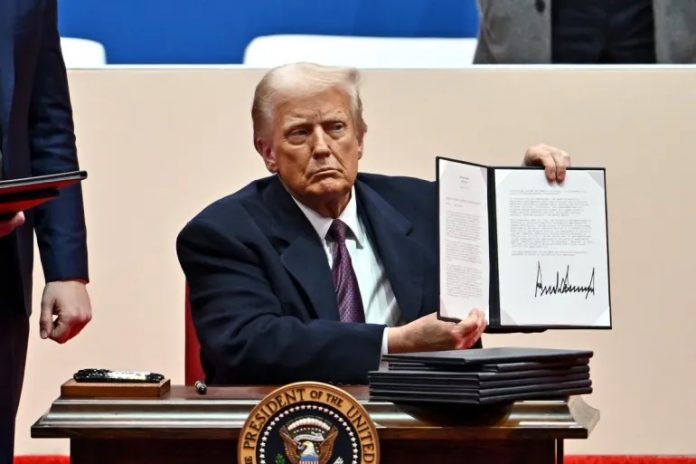
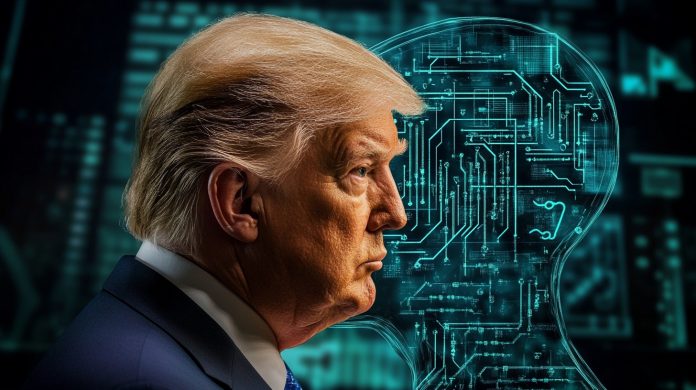
U.S. President Donald Trump is set to reveal his administration’s long-anticipated AI Action Plan on Wednesday in Washington, D.C., marking his most sweeping address yet on artificial intelligence since returning to office in January.

The announcement, which will take place at the “Winning the AI Race” summit, hosted by The Hill and Valley Forum and the All-In Podcast, is expected to outline a new framework for how the United States will build, govern, and globally deploy AI — with Trump aiming to reclaim American dominance in a sector he sees as central to the country’s future.

Three Pillars: Infrastructure, Innovation, and Global Influence

According to a report by Time Magazine, Trump’s AI Action Plan is built on three pillars: infrastructure, innovation, and global influence. The President is expected to propose a sweeping overhaul of permitting rules to fast-track the construction of AI data centers — massive computing hubs that power today’s most advanced language models and algorithms but also strain the energy and water grids of surrounding communities.

The plan includes efforts to modernize America’s aging electrical grid and expand energy production, particularly to support AI’s soaring power demands. Without immediate upgrades, experts have warned that energy shortages tied to these data centers could emerge before the end of the decade.

Under the innovation pillar, Trump aims to revive the effort to preempt state-level AI legislation that could complicate the regulatory landscape for tech firms. A previous federal bill that would have blocked such state initiatives recently failed in Congress, but the Trump administration reportedly plans to pursue executive action to ease regulatory burdens for American AI companies and shield them from what it views as “innovation-stifling” mandates.

The third pillar — global influence — targets the export and adoption of American AI technology abroad. Federal officials are reportedly concerned about the rise of Chinese AI developers like DeepSeek, Qwen, and Moonshot AI. The Action Plan seeks to position American companies like OpenAI, xAI, and Google as the global gold standard in AI development and deployment.

Repealing Biden’s AI Rules

Trump’s plan effectively replaces the Biden administration’s AI executive order, which emphasized safety, transparency, and non-discrimination. Biden’s order had required AI companies to submit reports on security risks and algorithmic bias. Trump repealed it almost immediately after taking office for the second time, saying the rules placed “unnecessary burdens” on American tech companies and risked slowing innovation.

The Pushback: People’s AI Action Plan

The announcement comes amid growing criticism from labor unions, civil rights groups, and consumer advocates, who argue that Trump’s plan favors corporate interests over public safety and accountability. On Tuesday, more than 90 organizations, including labor and environmental justice groups, released an alternative roadmap — dubbed the People’s AI Action Plan. The plan urges the government to prevent Big Tech and fossil fuel lobbyists from dictating AI policy.

“We can’t let Big Tech and Big Oil lobbyists write the rules for AI and our economy at the expense of our freedom and equality, workers and families’ well-being,” the coalition said in a statement, highlighting concerns that the energy demands of Silicon Valley’s AI ambitions may come at a steep cost to American communities.

Executive Orders and the Crackdown on “Woke AI”

Alongside the policy framework, Trump is expected to sign a series of executive orders. One of the most controversial will require companies with federal AI contracts — including OpenAI, Anthropic, Google, and Elon Musk’s xAI — to ensure that their models produce “neutral and unbiased language,” an effort to stamp out what the administration calls “woke” AI.

This move reflects a broader campaign by Trump and the Republican party to confront perceived political bias in Silicon Valley. In the past, Republicans accused social media platforms of censoring conservative voices. Now, the same scrutiny is being directed at AI models, with critics alleging they reflect left-leaning worldviews.

However, defining “neutral” AI remains murky. A recent ruling by a Florida judge found that AI chatbots are not protected by the First Amendment, suggesting the government could impose content-related requirements. Still, some observers point out that setting rules for how AI should respond contradicts Trump’s stated advocacy for free speech.

Tech Giants’ Wishlists

Ahead of the plan’s release, the White House reportedly received more than 10,000 public comments, many from tech giants such as OpenAI, Meta, Amazon, and Google. These companies lobbied the Trump administration to:

Declare training on copyrighted material to be “fair use,” shielding them from growing legal challenges from publishers, artists, and authors.

Protect open-source AI models like Meta’s LLaMA from restrictions. Meta believes open models are key to competing with the closed systems of rivals like OpenAI and Google.

Increase research investment into non-commercial AI efforts, a plea notably ignored by Trump’s Department of Energy, which has already slashed university research funding.

Meanwhile, national security voices have raised concerns that open AI models could leak advanced capabilities to foreign adversaries — particularly China. Anthropic and others have argued that without sufficient oversight, open-source models risk global misuse.

The Global Stakes and America’s AI Arms Race

Trump’s plan comes amid intensifying competition with China over AI supremacy. Chinese labs have accelerated AI development across multiple fronts, prompting unease among U.S. officials. Trump’s strategy appears tailored to assert American dominance by ensuring that U.S.-made models and chips — particularly those from Nvidia, AMD, and AI startups — remain the global standard.

To that end, some of the executive orders are expected to clear red tape around exporting AI-related technologies, potentially helping U.S. firms gain further access to emerging markets.

While Trump’s AI Action Plan promises to supercharge U.S. innovation and reshape global tech leadership, its critics warn that prioritizing deregulation and private sector expansion may undermine much-needed safeguards.

Wall Street Unleashes Tokenized Money Market Funds as Trump-Backed Stablecoin Law Spurs Digital Shift

0

Goldman Sachs and Bank of New York Mellon have teamed up in a landmark move to introduce tokenized money market funds for institutional investors—an initiative they say is the next evolution of digital finance, coming just days after President Donald Trump signed the GENIUS Act into law to formally regulate U.S.-based stablecoins.

Under the new system, clients of BNY Mellon, the world’s largest custody bank, will be able to invest in money market funds with ownership recorded directly on Goldman Sachs’ private blockchain platform. This innovation will allow faster and more frictionless transactions compared to traditional settlement processes.

The pilot program already has heavyweight backers including BlackRock, Fidelity Investments, Federated Hermes, and the asset management divisions of both Goldman Sachs and BNY Mellon. These institutions collectively manage trillions of dollars and are now pushing tokenization as a game-changing breakthrough for finance.

“We have created the ability for our clients to invest in tokenized money market share classes across a number of fund companies,” said Laide Majiyagbe, BNY’s global head of liquidity, financing, and collateral. “The step of tokenizing is important, because today that will enable seamless and efficient transactions, without the frictions that happen in traditional markets.”

Tokenized money market funds differ fundamentally from stablecoins. While stablecoins are typically pegged to fiat currencies and used for payments, tokenized money market funds generate yield, offering a compelling place for hedge funds, pensions, and corporations to park idle capital.

Money market funds themselves are low-risk investment vehicles that hold short-term securities like U.S. Treasuries, repurchase agreements, and commercial paper. These funds are considered among the safest options for short-term investing, and they allow for relatively quick redemptions. Since the U.S. Federal Reserve began hiking interest rates in 2022, investors have poured approximately $2.5 trillion into the asset class, drawn by rising yields.

Now, Wall Street sees tokenization as a way to modernize that $7.1 trillion industry. By putting money market fund ownership on a blockchain, trades can be executed in real time, around the clock, without needing to go through banks or clearinghouses that traditionally settle transactions during market hours.

Mathew McDermott, global head of digital assets at Goldman Sachs, said tokenized assets offer far more than just speed. They could potentially eliminate the need to liquidate assets when transferring between intermediaries.

“The sheer scale of this market just offers a huge opportunity to create a lot more efficiency across the whole financial plumbing,” McDermott said. “That is what’s really powerful, because you’re creating utility in an instrument where it doesn’t exist today.”

President Trump’s signing of the GENIUS Act has accelerated momentum behind blockchain-based financial infrastructure. The law officially recognizes and regulates U.S. stablecoins, encouraging mainstream institutions to move beyond pilot programs and into production-scale deployment of blockchain solutions.

Major banks including JPMorgan Chase, Citigroup, and Bank of America are also exploring stablecoins for global payment applications. While those projects are ongoing, the move by Goldman and BNY focuses on capital markets and treasury management—areas with deep liquidity needs and the potential for significant cost savings.

The shift hints at a future where digital assets form the backbone of global financial infrastructure. In that world, stablecoins may power real-time payments, while tokenized money market funds anchor short-term liquidity management and serve as collateral in complex transactions.

For Wall Street, the digitization of cash-like instruments is more than a tech upgrade. It’s a strategic overhaul of the $7.1 trillion money market industry—and the race to dominate that space is now in full gear.

Trump’s Japan Trade Pact Signals Shift Across Asia as Countries Rethink US Alliances

0

President Donald Trump has declared the new trade agreement with Japan the “largest trade deal in history,” touting it as a landmark achievement in his administration’s ongoing bid to reset global commerce on terms favorable to Washington.

Though the scale of the deal may fall short of Trump’s hyperbole, its implications across Asia are already reverberating.

The agreement, finalized after months of tense negotiations, drastically reduces US tariffs on Japanese automobiles—from a steep 27.5% to 15%—and paves the way for Tokyo to pour $550 billion into the US economy. In return, Japan will lift restrictions on US agricultural exports, especially rice and beef, allowing American farmers greater access to the world’s third-largest economy.

But while this deal brings immediate benefits for both nations, it is also triggering broader consequences throughout Asia, where countries are reassessing their trade strategies, bargaining positions, and geopolitical alignments.

A New Benchmark for Asian Trade Negotiations

The 15% US tariff on Japanese cars now serves as a critical benchmark for other major Asian economies currently negotiating trade deals with Washington. Countries like South Korea and Taiwan, both major exporters of vehicles and electronics, are under pressure to extract similar or better terms. South Korea’s industry minister, preparing for crunch talks in Washington, said Seoul will study the Japan deal carefully, noting that “fairness and reciprocity” will guide Korea’s approach.

South Korea and Japan are long-time competitors in global markets—especially in automobiles, steel, and semiconductors. A more favorable deal for Japan may compel South Korea to accelerate negotiations to avoid being outcompeted in the American market.

Likewise, Taiwan, heavily reliant on exports to the US, particularly in semiconductors, is now expected to seek concessions similar to Japan’s—especially around market access and tariffs. Analysts believe the Japan-US agreement gives Taiwan a stronger case to negotiate lower duties on key goods like computer chips and electrical equipment.

Dividing Asia: Winners and Losers

While major Asian economies like Japan, South Korea, and Taiwan prepare to adjust, the Trump-Ishiba pact threatens to leave smaller nations behind.

Countries such as Cambodia, Laos, and Sri Lanka—largely dependent on low-cost textile exports—offer little strategic value to the US in terms of high-tech supply chains or investment opportunities. With Washington now prioritizing deals that support critical industries like semiconductors, pharma, and autos, these smaller economies may find themselves increasingly sidelined in a new trade order.

Indonesia and the Philippines, which had earlier been seen as potential victims of Trump’s tariff regime, have since raced to the negotiating table. Preliminary agreements with Washington have already been announced, with both countries hoping to build deeper industrial links with the US in exchange for greater trade access.

But their window is narrowing. Trump’s administration has set a self-imposed August deadline to lock in as many bilateral deals as possible, prompting fears among Asian policymakers that they could be boxed out unless swift action is taken.

Strategic Supply Chains, Not Just Tariffs

Beyond trade in goods, Japan’s commitment to invest $550 billion in the United States marks a clear shift in the future of Asia-US relations. The bulk of that money is expected to flow into high-tech sectors like pharmaceuticals, semiconductors, and clean energy — areas where the US has sought to reduce dependency on China.

That investment strategy is not lost on other Asian countries. South Korea and Taiwan, already dominant players in semiconductors, are likely to propose similar investment partnerships to ensure their access to the US market is not undermined by Japan’s first-mover advantage.

Singapore, another technology hub, is also watching the developments closely. A senior official from Singapore’s trade ministry said the country is exploring ways to offer joint R&D projects with US firms, in hopes of aligning with Washington’s new supply chain priorities.

Japan’s Strategic Gain, China’s Strategic Loss?

There is also a broader strategic layer to the deal. Japan’s enhanced trade status with the US sends a clear message to China, whose own trade relationship with Washington remains clouded by distrust, sanctions, and security concerns.

As Japan secures lower tariffs, expanded exports, and a stronger position in the US market, China faces increasing isolation — particularly as the U.S. government has doubled down on restricting Chinese access to critical American technologies.

Trump’s Japan deal is not just a trade agreement. It’s a calculated effort to redraw Asia’s economic map in a way that favors US allies and penalizes rivals, particularly Beijing.

EU-Japan Alignment Raises US Stakes

While the US-Japan deal is positioned as a bilateral win, it has also pushed Tokyo closer to the European Union. On the same day the agreement was signed, Japan and the EU pledged to deepen cooperation against “economic coercion and unfair trade practices” — a thinly veiled swipe at China’s tactics and possibly Trump’s own earlier tariffs.

European Commission President Ursula von der Leyen emphasized that global trade must benefit everyone, not just a select few, hinting at growing European concerns over bilateralism and protectionism.

In sum, the US-Japan trade agreement, while lauded by Trump as the “largest in history,” has triggered a far broader realignment across Asia. From South Korea and Taiwan to Indonesia and Singapore, countries are racing to preserve their positions in the global value chain before Trump’s deadline resets the terms once again.

What started as a bilateral deal may end up reshaping trade priorities across Asia, redrawing alliances, and deepening divides — not just economically, but geopolitically.

The Trump Redesign on America-First Capital in Global Markets

0

That was massive: “President Donald Trump on Tuesday night announced what he called “the largest trade deal in history” between the United States and Japan — a sweeping agreement that slashes auto tariffs, boosts U.S. exports, and unlocks a massive $550 billion Japanese investment in the American economy…

“The announcement sent Japanese markets surging to a one-year high. Automaker shares led the rally, with Toyota rising nearly 12%, Honda and Nissan each gaining over 8%, and Mazda soaring 17%. Mitsubishi Motors climbed more than 13%. South Korean carmakers Hyundai and Kia also gained on expectations of similar tariff relief.”

So, Japan has $550 billion to invest in America alone? Nigeria needs to take a trip to Tokyo immediately. We just need $50 billion. That said, the America First playbook is working as America sucks all the best global capital to itself. Hello….I read risks across many economies as they struggle to attract capital.

Besides the disruptions from AI, I am looking at how America-First Capital will distort markets from next year as companies restructure investments. This week, we are reading that a big pharma is pulling funds from other markets and will be putting $50B into the United States.

Business leaders: evaluate the impact of America-First Capital on local market and see how to mitigate the risks ahead. This $550b from Japan possibly would have been distributed in at least 4 countries. Now it is going to one country. How does the imbalance affect global markets? Trump is rewiring global markets and that means business models must adjust. You must have exposure in the American economy because the party is converging therein!

Trump Strikes Landmark Trade Deal with Japan, Slashes Auto Tariffs and Unlocks $550bn Investment

0

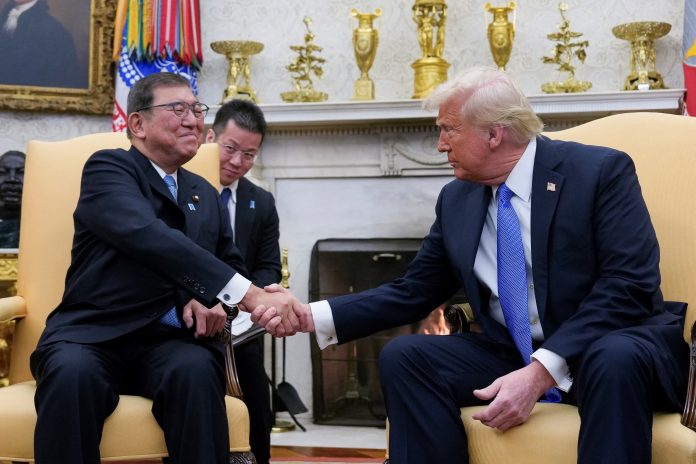
President Donald Trump on Tuesday night announced what he called “the largest trade deal in history” between the United States and Japan — a sweeping agreement that slashes auto tariffs, boosts U.S. exports, and unlocks a massive $550 billion Japanese investment in the American economy.

Speaking at a reception with Republican lawmakers at the White House, Trump declared, “I just signed the largest trade deal in history; I think maybe the largest deal in history with Japan… It’s a great deal for everybody.” He later added on Truth Social that the agreement would “create hundreds of thousands of jobs” and open Japan’s market to American cars, trucks, and agricultural products, including rice.

Under the agreement, the United States will impose a “reciprocal” 15% tariff on Japanese goods — a rate that notably applies to automobiles and auto parts. That marks a significant drop from the 25% levy Japan had faced since April. In return, Japan will inject $550 billion into the U.S. economy through a mix of equity and loans to Japanese businesses expanding into strategic sectors such as pharmaceuticals and semiconductors.

“This is a very exciting time for the United States of America, and especially for the fact that we will continue to always have a great relationship with the Country of Japan,” Trump said.

Key Terms of the Deal

  • Automobiles: Japan becomes the first country to receive reduced tariffs (15%) on auto and parts exports to the U.S. without volume restrictions, giving it a sharp edge over rivals like Germany and South Korea.
  • Agriculture: Japan will open its market further to U.S. rice and other farm products, a sticking point that had long stalled talks.
  • Investment: Japan will channel $550 billion into U.S. industries, including energy and tech. Trump claimed the U.S. would retain 90% of the profits from these investments.
  • Future talks: Both countries will continue negotiations on sectors left out of this agreement, including steel and aluminum, which remain subject to a steep 50% tariff.

Japanese Prime Minister Shigeru Ishiba called the deal “the lowest figure to date for a country that has a trade surplus with the United States.” In Tokyo, Ishiba said the government would “carefully” study the deal but hailed it as beneficial to Japanese jobs and innovation.

Ryosei Akazawa, Japan’s chief negotiator, posted a photo of himself pointing at an image of Trump and Ishiba in earlier talks, captioned “Mission accomplished.” He emphasized that the deal protects Japanese agriculture while providing new access for U.S. rice. “This agreement does not sacrifice Japanese farmers,” Akazawa told reporters.

Markets React

The announcement sent Japanese markets surging to a one-year high. Automaker shares led the rally, with Toyota rising nearly 12%, Honda and Nissan each gaining over 8%, and Mazda soaring 17%. Mitsubishi Motors climbed more than 13%. South Korean carmakers Hyundai and Kia also gained on expectations of similar tariff relief.

Auto exports make up over 28% of Japan’s shipments to the U.S. But Japanese carmakers had suffered steep declines in recent months: a 26.7% plunge in June and 24.7% in May, according to Japan’s trade ministry. Ed Rogers, CEO of Rogers Investment Advisors, said the new deal delivers “very needed short-term assurance” to Japan’s auto industry, though he warned that competition from China and South Korea remains intense.

The deal comes after months of strained negotiations, with Trump earlier threatening a 25% tariff on Japanese imports if a deal wasn’t reached by August 1. In a July letter to Prime Minister Ishiba, Trump had accused Japan of unfair trade practices, especially in rice and automotive imports.

“They won’t take our rice, and yet they have a massive rice shortage,” Trump posted recently. The U.S. sold $298 million worth of rice to Japan in 2024 and another $114 million between January and April this year, but critics had long pointed to Japan’s opaque rice import system.

Similarly, Trump repeatedly criticized Japan’s reluctance to import American cars. “We didn’t give them one car in 10 years,” he claimed earlier this month — though Japan imported over 16,000 U.S.-made vehicles in 2024, according to the Japan Automobile Importers Association.

Treasury Secretary Scott Bessent helped pave the way for the agreement with a high-level meeting in Tokyo last week.

“A good deal is more important than a rushed deal,” Bessent said, expressing optimism after talks with Ishiba.

Other Deals Unfolding

Beyond trade, Trump hinted that the U.S. and Japan are nearing a joint venture to develop a gas pipeline in Alaska — part of his broader push to shift Asian investment from China to U.S.-friendly projects.

“They’re all set to make that deal now,” Trump told lawmakers Tuesday.

Japan holds over $1.1 trillion in U.S. Treasury bonds — the largest foreign holder — giving it significant leverage in trade talks. The deal also comes at a delicate geopolitical moment, with the Trump administration pressuring allies to curb trade with China in exchange for deeper U.S. economic ties.

While Japan remains China’s largest trading partner, Tuesday’s agreement positions Tokyo more closely with Washington on trade alignment, especially in sectors where Beijing’s dominance has grown — like semiconductors and EVs.

The agreement builds on the 2019 bilateral trade pact between Japan and the U.S., which allowed greater duty-free access to some agricultural and industrial goods. However, the scale of this latest deal — particularly the $550 billion investment commitment and the slashing of auto tariffs — makes it the most consequential agreement between the two countries in recent memory.

With Trump’s August 1 deadline for sweeping tariffs still looming over other trading partners — including the EU, Mexico, and Brazil — Japan’s early compromise may serve as a model or a warning.