DD
MM
YYYY

PAGES

DD
MM
YYYY

spot_img

PAGES

Home Blog Page 859

NCC Unveils New Licensing Framework to Foster Innovation and Digital Expansion in Nigeria

0

The Nigerian Communications Commission (NCC) has introduced a sweeping licensing overhaul aimed at accelerating digital innovation and unlocking the country’s full technological potential.

Unveiled on Thursday by NCC Executive Vice Chairman Dr. Aminu Maida, the new General Authorisation Framework represents a fundamental departure from traditional telecom licensing models, offering a more adaptive approach to accommodate emerging technologies and services.

Maida, while speaking at a stakeholders’ engagement forum in Abuja, said the framework was crafted to support experimentation, encourage investment in novel technologies, and ensure Nigeria keeps pace with global trends.

“This reform introduces a flexible and responsive regulatory licensing approach,” he said. “It is structured to embrace new and emerging services that fall outside the existing license structure.”

Three-Pronged Innovation Model

At the core of the new framework are three key instruments:

  1. Proof-of-Concept (PoC) Pilots: These pilots allow innovators to test new products or services in live environments, helping determine real-world feasibility, technical performance, and market viability before full deployment.
  2. Regulatory Sandbox: A controlled testing space where startups, service providers, and other industry players can pilot advanced technologies—such as Open Radio Access Networks (Open RAN), dynamic spectrum sharing, or edge computing—under NCC supervision and regulatory guidance.
  3. Interim Service Authorization: This provides temporary operational approval to novel services that do not yet fall under Nigeria’s existing license categories, ensuring innovation isn’t stifled by outdated regulatory bottlenecks.

Maida noted that the design is meant to lower the barrier to entry for startups while simultaneously giving established players a way to test cutting-edge ideas with regulatory backing.

“It creates a platform for innovators of various sizes to demonstrate feasibility, assess risk, and measure outcomes before deployment,” he said.

Responding to Global Shifts

The licensing shift comes amid rapid evolution in the global digital ecosystem, where artificial intelligence, Internet of Things (IoT), and software-defined networking are challenging legacy regulatory structures.

Mr. Usman Mamman, Director of Licensing and Authorization at the NCC, emphasized that Nigeria’s previous license framework had struggled to keep up with the pace of technological change.

He explained that the Commission has witnessed the emergence of new technologies, novel business models, and innovative services, many of which do not fit neatly into its traditional licensing structures.

According to him, the General Authorization Framework was developed after months of cross-departmental collaboration, analysis of international best practices, and internal review of service applications and proposals that could not be accommodated under current licensing norms.

“Recognizing this shift, the Commission deemed it necessary to critically re-evaluate and retool our regulatory toolkit.

“One of the key outcomes of this review is the development of the draft General Authorization Framework (GAF), a flexible, forward-looking approach to licensing that promotes innovation while ensuring regulatory oversight, consumer protection, and market integrity,” he said.

Mamman stressed that the new regime is closely aligned with Nigeria’s broader digital economy ambitions. The framework supports key policies such as:

  • The Nigerian Data Protection Act 2023, which provides a legal basis for privacy and data innovation.
  • The National Broadband Plan, which aims to achieve 70% broadband penetration by 2025.
  • The Nigerian Communications Act (NCA) 2003, which mandates the NCC to promote fair competition, protect consumer rights, and foster innovation in the sector.

The new licensing model aims to provide a strong foundation for Nigeria’s ambitions to become a digital innovation hub in Africa by ensuring regulatory oversight, consumer protection, and market integrity.

Maida made it clear that successful implementation will depend on collaboration. He called on mobile operators, infrastructure companies, equipment manufacturers, startups, academia, and civil society to actively participate in shaping the framework.

The new framework is expected to create room for services that involve artificial intelligence, immersive communication, space-based internet delivery (such as Starlink), fintech-layered telecom solutions, and cloud-native software deployment—all areas where Nigerian startups and innovators have begun to make notable strides.

With this move, the NCC is positioning Nigeria’s regulatory environment as an enabler rather than a hindrance to the next wave of digital transformation.

China Says Success of Trade Talks with The U.S. Makes Tariffs Unnecessary

0

China’s Commerce Minister, Wang Wentao, has called on the United States to step back from escalating trade tensions and return to a path of mutual cooperation, warning that the two countries must act responsibly to preserve global economic stability.

His remarks come amid a critical countdown to August 12 — the deadline for finalizing a lasting tariff agreement aimed at averting the return of a disruptive trade war.

Wang, speaking to reporters on July 18, said recent negotiations in Geneva and London demonstrated that dialogue was still possible and preferable, emphasizing that the “ups and downs” in U.S.-China relations only highlighted the depth of their economic interdependence.

“Major countries should act like major countries. They must shoulder their responsibilities,” Wang said, while reiterating China’s commitment to protecting its national interests if tensions escalate. “China does not want a trade war, but it is not afraid of one.”

The renewed urgency comes after the U.S. and China reached a preliminary agreement in June to halt weeks of retaliatory tariffs. But with duties on hundreds of billions of dollars’ worth of goods still technically active and the average tariff level imposed by the U.S. on Chinese products standing at 53.6%, the risk of renewed escalation remains significant.

Rare Earths Flowing Again, Hinting at Easing Tensions

There are some signs of thawing. China’s rare earth exports rose by 32% in June compared to May, customs data revealed on July 14. The spike is widely attributed to the tentative agreements reached during the London talks, where both sides reportedly agreed to ease restrictions on the flow of critical minerals, especially rare earths essential to the electronics and defense industries.

In a development tied to those negotiations, Nvidia CEO Jensen Huang confirmed during a recent event in Beijing that the company would resume sales of its H20 AI chips to China. The announcement followed Huang’s meeting with Commerce Minister Wang in Beijing, where both sides discussed ongoing chip cooperation. U.S. Commerce Secretary Howard Lutnick, addressing the matter in Washington, suggested the deal was part of broader concessions linked to the rare earths supply chain agreement.

“This meeting [with Nvidia’s CEO] shows that as the dust settles, everyone – especially the U.S. side – realizes that forced decoupling is impossible,” Wang said. He added that both countries are beginning to understand the consequences of severing ties in key industries like semiconductors, which underpin future technological competition.

Tariff Impact Could Undermine Manufacturers on Both Sides

Analysts warn that if no resolution is reached by August 12, both sides could reimpose duties exceeding 100% on certain goods, which would severely disrupt global supply chains. Chinese manufacturers are already operating under thin profit margins, and additional tariffs above 35% could push many out of U.S. markets entirely.

“Both sides have come to understand that they need each other, as lots of the goods and services that we exchange are irreplaceable, or at least difficult to exchange in the short term,” Wang noted.

Despite the hostility that has characterized trade relations in recent years, particularly under previous U.S. administrations, Beijing appears keen to reset the tone. Wang emphasized the importance of dialogue and high-level engagement, asserting that agreements reached through negotiation offer a realistic path to “healthy, stable, and sustainable development” in the U.S.-China trade relationship.

As the clock ticks toward the August deadline, the outcome of talks will determine whether the two largest economies continue walking back from the brink or descend once again into a full-blown trade conflict that could ripple across global markets.

Well Done Mr. President for Launching the South-East Investment Company, Nigeria

0

Let me congratulate Mr. President for launching the South-East Investment Company (SEIC): “President Bola Ahmed Tinubu has approved the establishment of the South-East Investment Company (SEIC), a federally backed investment vehicle under the newly formed South East Development Commission (SEDC), in what is being described as a critical step toward closing decades-long economic gaps in Nigeria’s South-East region. With a projected capital base of N150 billion, the SEIC is tasked with mobilizing private sector funds, boosting industrialization, and driving inclusive growth in the zone”.

This is commendable. Largely, SEIC could be a management company that will work with technical partners to execute catalytic and pivotal projects in SE Nigeria. We hope to see Southeast Railways to link all the states in the region. Also, we should have Southeast Post to ensure that we have an efficient supply chain system. Finally, SEIC must invest in gas pipelines that will link all major cities in the Southeast as without energy, there will not be development. Leave marginal domains like real estate, hospitals, telecoms, etc as if you deal with the anchors like railways, postal services and energy, private investors will converge and develop those areas.

Developing the Southeast can only happen this way as the individual states do not have capacities to execute major projects.  Nigeria developed fastest when it was structured regionally!

At Abia State Diaspora Commission, we are exploring the concept of unveiling Abia Diasporas Corporation Plc, a vehicle to drive development through private investments, with the understanding that all citizens of the world are Abians, since Abia is the God’s Own State (and God’s Own People!). The Commission will explore strategic partnerships with SEIC/SEDC as the playbooks advance. In Abia, we have noted that linking all LGA headquarters with rail tracks will drive the development of rural communities since access to markets, efficient logistics, etc will accelerate economic outputs.

Tinubu Launches N150bn South-East Investment Company to Drive Industrialization and Unlock Private Sector Growth

0

President Bola Ahmed Tinubu has approved the establishment of the South-East Investment Company (SEIC), a federally backed investment vehicle under the newly formed South East Development Commission (SEDC), in what is being described as a critical step toward closing decades-long economic gaps in Nigeria’s South-East region.

With a projected capital base of N150 billion, the SEIC is tasked with mobilizing private sector funds, boosting industrialization, and driving inclusive growth in the zone.

According to the Presidency, the SEIC will initially be wholly owned by the SEDC but will later transition into a public-private partnership, incorporating capital from state governments, private investors, development finance institutions, and diaspora contributors. Its mandate includes overseeing targeted investments in key areas such as infrastructure, education, entrepreneurship, and other development-focused interventions.

“The SEIC represents a bold step forward in regional development. It is more than a financial vehicle. It is a long-term strategy to unlock private capital, de-risk investment, and deliver sustainable economic growth for the South-East,” said Mr. Mark Okoye, Managing Director of the SEDC, during a presentation at the State House in Abuja.

The approval comes just months after President Tinubu signed into law the South East Development Commission Act—a bill that had lingered for several years in the National Assembly before finally gaining traction in 2024. The law was touted not merely as a development tool but as a policy response aimed at addressing the deep-seated sense of marginalization that has festered in the South-East since the aftermath of the Biafran War. The region, often underfunded and underrepresented in national development initiatives, has for decades pointed to the lack of federal infrastructure projects and investment as evidence of a sustained economic exclusion.

The SEIC, inspired by the legacy of the defunct Eastern Nigeria Development Corporation (ENDC) under Dr. Michael Okpara in the 1960s, seeks to rekindle that era’s industrial growth by leveraging modern financial instruments. According to the Presidency, the company will raise funds through hybrid bonds, equity participation, and callable capital, with pilot fundraising and investments slated to begin in Q4 of 2025.

However, while the initiative has been widely welcomed, concerns about its sustainability, transparency, and scale are already being raised.

It is believed that the N150 billion capital projection is far too meagre to produce tangible transformation across the five South-East states. Some analysts suggest that the sum may not be enough to drive significant change in just one state, let alone the entire region, given the depth of infrastructural decay and youth unemployment.

There is also concern that the SEIC may end up like many other government-backed interventions—bogged down by bureaucracy, political infighting, or worse, looted by vested interests. Already, concerns are swirling that the funds could be spread thinly across multiple concurrent projects with no central focus, leading to little or no measurable impact on the region’s economy.

There’s also apprehension about whether the federal government’s commitment will remain consistent, especially if political tides shift or fiscal conditions worsen. Some believe the company’s promise of transitioning into a public-private partnership is critical, but note that success will depend heavily on investor confidence and real guarantees that funds won’t be mismanaged.

Nevertheless, the federal government insists that SEIC will undergo full regulatory and compliance vetting to ensure it operates within global standards. The Presidency said the initiative will be supported by clear governance structures, annual audits, and independent performance reviews to ensure it remains accountable and impact-driven.

CoinFutures Review: CoinPoker’s Crypto Futures Trading Platform Explained

0

CoinPoker, a popular cryptocurrency poker platform, has taken a massive step towards a gamified way of crypto futures trading through CoinFutures.

With its sleek design and unique approach to helping veteran and novice traders interact with the cryptocurrency market, CoinFutures offers multiple features, but without the added complexities of KYC.

This article explores the different features of CoinFutures and deciphers how it can potentially onboard new people into crypto, especially at a time when the market has entered its bull cycle.

CoinFutures: An Overview

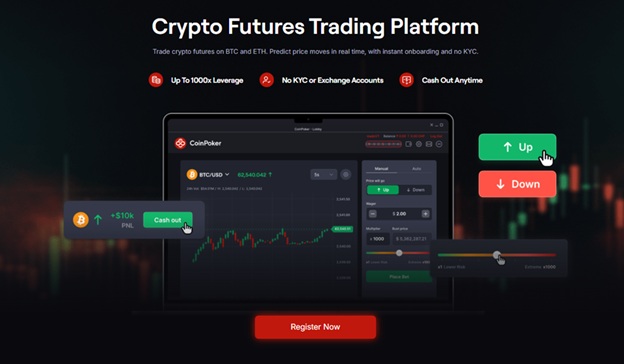
CoinFutures, also known as CoinPoker Crypto Futures, is referred to as a trading game where users can predict whether the asset of their choice will rise or fall in real time. The chart it provides simulates the volatile market conditions in real time, giving users a quasi-real experience with added complexities.

The platform clearly specifies that it is not an on-chain crypto futures trading platform. It is only a game that lets users get the feel of the market without actual exposure.

Getting started is simple, and the only requirement is downloading CoinPoker beforehand. In terms of the assets the platform supports, only five are available so far: Bitcoin, Ethereum, Litecoin, Dogecoin, and Tron. However, there are plans for more assets to be added.

Simulated Trading with All the Core Features

The entire CoinFutures ecosystem has been built around mirroring real market conditions, but within a virtual space. The cryptos one can use are real, but there is no actual trading. The process to “trade” crypto futures on CoinFutures consists of the following steps.

First Step is to Choose a Cryptocurrency

The very first step is to choose the cryptocurrency that users want to predict the price movement of. There are five options available right now, but more will be added in the future. CoinFutures offers live price charts of each asset to give users an idea about the market’s volatility.

Predicting the Price Direction

Once the crypto has been selected, users should predict whether the price will go up or down. The buttons are clearly provided, and all users need to do is select by clicking an option.

Predicting the Price

Once investors have predicted the direction in which an asset’s price will move, they add more details to it, such as what the price of the crypto will be. They can also select a multiplier to increase their potential rewards.

Afterward, users can monitor the price chart and see how the asset is performing. Profit-seekers can cash out early if they feel the market has moved against them.

Gamification and Strategic Crypto Interactions – The USPs of CoinFutures

CoinFutures has been designed to provide users with a simple layout and give them a taste of crypto futures trading. Since there are no assets being traded, there are no crypto trading-related risks involved. All they must watch out for is the asset they deposited in order to bet on the price movements, which is one of the reasons why CoinFutures has generated the level of buzz it enjoys today.

Other factors that have contributed to making CoinFutures popular are as follows:

Focus on Real-Time Action

Users get access to a crypto live price chart as soon as they select the cryptocurrency. These charts simulate real crypto volatility, essentially copying what’s accessible on TradingView. The addition of multipliers up to 1000x leverage can potentially enhance investors’ rewards, and being able to cash out at any time makes CoinFutures suitable for all kinds of investors.

Strategic Approach to Gaming

While the essence of betting tends to be luck, the amount of information available when it comes to predicting an asset’s price action makes crypto futures game-trading a matter of research. This gives a strategic style to how the games are played on CoinFutures.

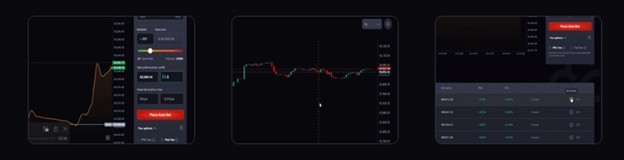
Players who are confident about their prediction but still want to hedge their bets can set stop-losses as a way to manage the risk and take profit. And those who want to revel in the minute-to-minute price action can go with the manual mode.

Potential to Evolve During Gameplay

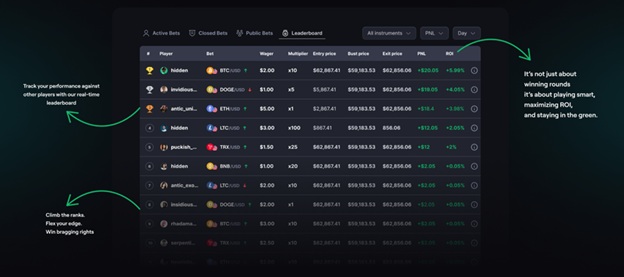
The presence of a leaderboard gives players two things. One, it lets them check where they stack up against other players. Secondly, it gives them insight into how the top players are betting.

Furthermore, CoinFutures also lets players check the prediction history to refine their gaming approach. There is also an ROI calculator available, which can be used to engage in smarter plays.

CoinFutures UI – Simplified Gameplay Systems

While many of the features of CoinFutures focus on giving users a familiar ecosystem that feels like a crypto trading platform, simplicity is still the key here. There are no exchange-style complexities, and instead of a spot trading module, a betting system runs alongside a crypto’s price chart.

The desktop app through which users can access CoinFutures is clean and easy to navigate, making it fit for all types of players.

Payment Options Available on CoinFutures

CoinFutures takes a standard and inclusive approach when it comes to payment options. In other words, both fiat and crypto methods of payment are available. For fiat users, the options include debit/credit cards, Google Pay, Apple Pay, and PIX. Cryptocurrency enthusiasts can choose between Solana, Bitcoin, Ethereum, Tether, Polygon, and BNB.

What Are the Pros and Cons of CoinFutures?

The crypto trading + gaming paradigm that CoinFutures implements is one that could lead to more people becoming interested in crypto. The indirect exposure to the cryptocurrency market makes this game exciting. However, it does have its fair share of pros and cons:

Pros

  • Users are exposed to simulated volatility of the cryptocurrency market
  • Multiple deposit methods are available
  • Top cryptocurrencies can be wagered on
  • Up to 1000x leverage available
  • Features a simplified interface and a leaderboard

Cons

  • Not a crypto futures trading platform; only a game
  • Not directly accessible via the website; users must download the app

How to Start Using CoinFutures

Here are the three steps to get started with CoinFutures:

  1. Register and download the CoinPoker app from the CoinFutures.io website
  2. Make a deposit using the available options
  3. Open the Crypto Futures tab
  4. Start playing the game

Conclusion

CoinFutures presents crypto trading as a game, offering users indirect exposure to the thrills of trading digital assets. Thanks to its simple UI, robust systems, and straightforward wagering module, most traders, as well as players wanting to get a taste of crypto trading, can check it out. Although it could add more options, what’s presented here is more than enough for most players.