DD
MM
YYYY

PAGES

DD
MM
YYYY

spot_img

PAGES

Home Blog Page 884

Tinubu Launches N150bn South-East Investment Company to Drive Industrialization and Unlock Private Sector Growth

0

President Bola Ahmed Tinubu has approved the establishment of the South-East Investment Company (SEIC), a federally backed investment vehicle under the newly formed South East Development Commission (SEDC), in what is being described as a critical step toward closing decades-long economic gaps in Nigeria’s South-East region.

With a projected capital base of N150 billion, the SEIC is tasked with mobilizing private sector funds, boosting industrialization, and driving inclusive growth in the zone.

According to the Presidency, the SEIC will initially be wholly owned by the SEDC but will later transition into a public-private partnership, incorporating capital from state governments, private investors, development finance institutions, and diaspora contributors. Its mandate includes overseeing targeted investments in key areas such as infrastructure, education, entrepreneurship, and other development-focused interventions.

“The SEIC represents a bold step forward in regional development. It is more than a financial vehicle. It is a long-term strategy to unlock private capital, de-risk investment, and deliver sustainable economic growth for the South-East,” said Mr. Mark Okoye, Managing Director of the SEDC, during a presentation at the State House in Abuja.

The approval comes just months after President Tinubu signed into law the South East Development Commission Act—a bill that had lingered for several years in the National Assembly before finally gaining traction in 2024. The law was touted not merely as a development tool but as a policy response aimed at addressing the deep-seated sense of marginalization that has festered in the South-East since the aftermath of the Biafran War. The region, often underfunded and underrepresented in national development initiatives, has for decades pointed to the lack of federal infrastructure projects and investment as evidence of a sustained economic exclusion.

The SEIC, inspired by the legacy of the defunct Eastern Nigeria Development Corporation (ENDC) under Dr. Michael Okpara in the 1960s, seeks to rekindle that era’s industrial growth by leveraging modern financial instruments. According to the Presidency, the company will raise funds through hybrid bonds, equity participation, and callable capital, with pilot fundraising and investments slated to begin in Q4 of 2025.

However, while the initiative has been widely welcomed, concerns about its sustainability, transparency, and scale are already being raised.

It is believed that the N150 billion capital projection is far too meagre to produce tangible transformation across the five South-East states. Some analysts suggest that the sum may not be enough to drive significant change in just one state, let alone the entire region, given the depth of infrastructural decay and youth unemployment.

There is also concern that the SEIC may end up like many other government-backed interventions—bogged down by bureaucracy, political infighting, or worse, looted by vested interests. Already, concerns are swirling that the funds could be spread thinly across multiple concurrent projects with no central focus, leading to little or no measurable impact on the region’s economy.

There’s also apprehension about whether the federal government’s commitment will remain consistent, especially if political tides shift or fiscal conditions worsen. Some believe the company’s promise of transitioning into a public-private partnership is critical, but note that success will depend heavily on investor confidence and real guarantees that funds won’t be mismanaged.

Nevertheless, the federal government insists that SEIC will undergo full regulatory and compliance vetting to ensure it operates within global standards. The Presidency said the initiative will be supported by clear governance structures, annual audits, and independent performance reviews to ensure it remains accountable and impact-driven.

CoinFutures Review: CoinPoker’s Crypto Futures Trading Platform Explained

0

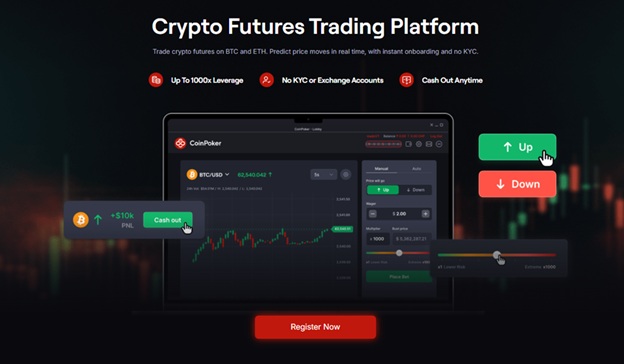
CoinPoker, a popular cryptocurrency poker platform, has taken a massive step towards a gamified way of crypto futures trading through CoinFutures.

With its sleek design and unique approach to helping veteran and novice traders interact with the cryptocurrency market, CoinFutures offers multiple features, but without the added complexities of KYC.

This article explores the different features of CoinFutures and deciphers how it can potentially onboard new people into crypto, especially at a time when the market has entered its bull cycle.

CoinFutures: An Overview

CoinFutures, also known as CoinPoker Crypto Futures, is referred to as a trading game where users can predict whether the asset of their choice will rise or fall in real time. The chart it provides simulates the volatile market conditions in real time, giving users a quasi-real experience with added complexities.

The platform clearly specifies that it is not an on-chain crypto futures trading platform. It is only a game that lets users get the feel of the market without actual exposure.

Getting started is simple, and the only requirement is downloading CoinPoker beforehand. In terms of the assets the platform supports, only five are available so far: Bitcoin, Ethereum, Litecoin, Dogecoin, and Tron. However, there are plans for more assets to be added.

Simulated Trading with All the Core Features

The entire CoinFutures ecosystem has been built around mirroring real market conditions, but within a virtual space. The cryptos one can use are real, but there is no actual trading. The process to “trade” crypto futures on CoinFutures consists of the following steps.

First Step is to Choose a Cryptocurrency

The very first step is to choose the cryptocurrency that users want to predict the price movement of. There are five options available right now, but more will be added in the future. CoinFutures offers live price charts of each asset to give users an idea about the market’s volatility.

Predicting the Price Direction

Once the crypto has been selected, users should predict whether the price will go up or down. The buttons are clearly provided, and all users need to do is select by clicking an option.

Predicting the Price

Once investors have predicted the direction in which an asset’s price will move, they add more details to it, such as what the price of the crypto will be. They can also select a multiplier to increase their potential rewards.

Afterward, users can monitor the price chart and see how the asset is performing. Profit-seekers can cash out early if they feel the market has moved against them.

Gamification and Strategic Crypto Interactions – The USPs of CoinFutures

CoinFutures has been designed to provide users with a simple layout and give them a taste of crypto futures trading. Since there are no assets being traded, there are no crypto trading-related risks involved. All they must watch out for is the asset they deposited in order to bet on the price movements, which is one of the reasons why CoinFutures has generated the level of buzz it enjoys today.

Other factors that have contributed to making CoinFutures popular are as follows:

Focus on Real-Time Action

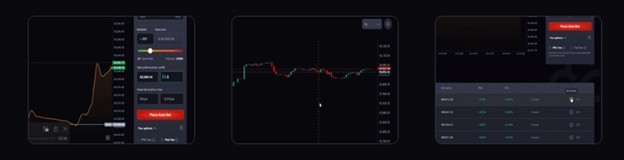
Users get access to a crypto live price chart as soon as they select the cryptocurrency. These charts simulate real crypto volatility, essentially copying what’s accessible on TradingView. The addition of multipliers up to 1000x leverage can potentially enhance investors’ rewards, and being able to cash out at any time makes CoinFutures suitable for all kinds of investors.

Strategic Approach to Gaming

While the essence of betting tends to be luck, the amount of information available when it comes to predicting an asset’s price action makes crypto futures game-trading a matter of research. This gives a strategic style to how the games are played on CoinFutures.

Players who are confident about their prediction but still want to hedge their bets can set stop-losses as a way to manage the risk and take profit. And those who want to revel in the minute-to-minute price action can go with the manual mode.

Potential to Evolve During Gameplay

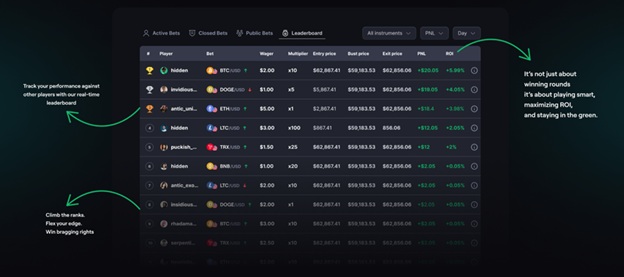
The presence of a leaderboard gives players two things. One, it lets them check where they stack up against other players. Secondly, it gives them insight into how the top players are betting.

Furthermore, CoinFutures also lets players check the prediction history to refine their gaming approach. There is also an ROI calculator available, which can be used to engage in smarter plays.

CoinFutures UI – Simplified Gameplay Systems

While many of the features of CoinFutures focus on giving users a familiar ecosystem that feels like a crypto trading platform, simplicity is still the key here. There are no exchange-style complexities, and instead of a spot trading module, a betting system runs alongside a crypto’s price chart.

The desktop app through which users can access CoinFutures is clean and easy to navigate, making it fit for all types of players.

Payment Options Available on CoinFutures

CoinFutures takes a standard and inclusive approach when it comes to payment options. In other words, both fiat and crypto methods of payment are available. For fiat users, the options include debit/credit cards, Google Pay, Apple Pay, and PIX. Cryptocurrency enthusiasts can choose between Solana, Bitcoin, Ethereum, Tether, Polygon, and BNB.

What Are the Pros and Cons of CoinFutures?

The crypto trading + gaming paradigm that CoinFutures implements is one that could lead to more people becoming interested in crypto. The indirect exposure to the cryptocurrency market makes this game exciting. However, it does have its fair share of pros and cons:

Pros

  • Users are exposed to simulated volatility of the cryptocurrency market
  • Multiple deposit methods are available
  • Top cryptocurrencies can be wagered on
  • Up to 1000x leverage available
  • Features a simplified interface and a leaderboard

Cons

  • Not a crypto futures trading platform; only a game
  • Not directly accessible via the website; users must download the app

How to Start Using CoinFutures

Here are the three steps to get started with CoinFutures:

  1. Register and download the CoinPoker app from the CoinFutures.io website
  2. Make a deposit using the available options
  3. Open the Crypto Futures tab
  4. Start playing the game

Conclusion

CoinFutures presents crypto trading as a game, offering users indirect exposure to the thrills of trading digital assets. Thanks to its simple UI, robust systems, and straightforward wagering module, most traders, as well as players wanting to get a taste of crypto trading, can check it out. Although it could add more options, what’s presented here is more than enough for most players.

Google’s Android Chief Says Computer Science Degree Needs a ‘Rebrand’ as AI Reshapes Industry Expectations

0

Sameer Samat, President of Android Ecosystem at Google, is calling for a fundamental shift in how computer science is taught and perceived in the age of artificial intelligence.

Speaking at a Google education summit on July 18, Samat argued that the traditional framing of computer science as a coding-centric discipline is outdated and no longer meets the needs of today’s students—or the companies that will eventually employ them.

While many universities and prospective students still treat the degree as a gateway to learning how to code, Samat believes this view misses the point.

“If what you want to do is write Java code, you don’t need a computer science degree,” he said. “That’s not what computer science is.”

Instead, he emphasized the discipline as the art of abstraction—of breaking complex problems into solvable components, designing systems to address them, and collaborating across disciplines to build long-lasting solutions.

His comments come as the influence of generative AI tools, such as GitHub Copilot and Google’s own Gemini, continues to expand. These systems can already auto-generate code snippets, optimize scripts, and suggest full-function logic, prompting fears that human coders might soon become obsolete. But Samat disagrees with the idea that AI will replace the value of a computer science education. Instead, he believes AI will force the field to evolve—and in the process, highlight the deeper value of system-level thinking and architectural design that machines can’t easily replicate.

Samat, who studied computer science at the University of California, San Diego, reflected on how foundational courses in assembly language helped him grasp what’s happening under the hood of modern software. He said this deeper understanding of computing systems is what distinguishes a true computer scientist from someone who merely writes code. It also explains why companies like Google increasingly look for engineers who can integrate technical knowledge with domain-specific expertise.

He also warned against choosing the major purely for job security. “Too many students are selecting computer science because it’s seen as a safe, high-paying field, not because they’re passionate about solving hard problems,” he said. “That doesn’t work anymore.”

Employers now seek individuals who not only possess technical skills but also bring unique perspectives from other disciplines—whether it’s design, psychology, economics, or education.

Drawing from his own experience, Samat described how founding two startups in his twenties taught him more about technology and product development than formal classroom settings. One of those ventures led to a meeting with Google co-founder Sergey Brin, ultimately paving the way for his career at the company.

“When you’re passionate about solving problems, you find ways to go deeper,” he said, urging aspiring students to strive to be in the top 5% of their chosen domain.

Samat’s call to rebrand computer science education comes amid ongoing industry debates about how schools can keep up with the pace of technological change. As AI continues to automate low-level programming tasks, he believes universities must shift their focus toward teaching students how to build systems, think critically, and design for complexity.

He ended his talk with a clear message for students considering the major: Don’t just study computer science because it’s in demand—do it because you’re genuinely interested in how technology can solve real-world problems. And if you do, “go deep.”

Meta Deepens AI Poaching Spree, Grabs More Apple Researchers for Superintelligence Push

0

Meta is not slowing in its aggressive talent grab in the artificial intelligence race, as the company has hired two more high-profile researchers from Apple, strengthening its ambition to lead the next wave of AI innovation.

According to Bloomberg, the two Apple engineers—Mark Lee and Tom Gunter—are the latest additions to Meta’s recently launched Superintelligence division, joining their former colleague Ruoming Pang, who left Apple in July.

Lee has already begun work at Meta, while Gunter is expected to start soon. Both had worked closely with Pang in Apple’s secretive Foundation Models team, which focused on developing in-house large language models. Their defection is another blow to Apple’s internal AI ambitions, which are now facing visible cracks as more talent exits despite Apple’s recent push to integrate AI features into iOS and macOS.

Meta, under Mark Zuckerberg’s direction, is pouring enormous resources into what it calls Superintelligence Labs—a new arm of the company focused on building systems that surpass current AI capabilities and mimic human-level reasoning. The initiative, announced in June, is being spearheaded by Scale AI founder Alexandr Wang as Chief AI Officer and GitHub’s former CEO, Nat Friedman. Their goal is to engineer what insiders describe as “agentic AI”—systems that can not only interpret language, but autonomously reason, plan, and use tools in complex environments.

But building such systems doesn’t only require computing power—it demands elite human capital. And Meta is leaving no stone unturned in securing that. The company is now widely viewed as Silicon Valley’s most aggressive recruiter of top AI researchers. In addition to Pang, Lee, and Gunter, Meta has also poached leading scientists from Google DeepMind, OpenAI, and academic labs. The firm is reportedly offering mind-boggling compensation packages, in some cases exceeding $100 million, to convince key figures to jump ship.

Sources familiar with the deals told Reuters that the offers are structured like contracts for star athletes—multi-year agreements that include equity, bonuses, and large upfront signing incentives. Pang’s deal, for instance, was rumored to exceed $200 million, a sum that dwarfs even the most generous compensation offers at Apple, where stock-based rewards are more conservative and tied to long-term retention.

Apple, meanwhile, has scrambled to contain the damage. Following Pang’s exit, the company began issuing raises to select engineers working on its AI systems. But Meta’s compensation packages are in a league of their own, making it difficult for rivals to compete. Apple’s recent partnerships with OpenAI and Anthropic to power Siri and iPhone AI features have also sparked speculation that the company is shifting its strategy away from building its own foundational models toward licensing them, possibly a result of internal attrition.

Meta’s spree doesn’t look like it will stop anytime soon. Zuckerberg has pledged tens of billions of dollars to build up the company’s AI infrastructure, including data centers and proprietary silicon chips, to support training at a scale that could rival or surpass OpenAI and Google. Internally, the company is also working on “Behemoth,” a massive new LLM intended to leapfrog existing models like GPT-4 and Claude.

Industry analysts believe Meta’s intense recruitment drive and commitment to frontier AI positions it as one of the few serious contenders in the race to develop artificial general intelligence (AGI), or at the very least, agentic systems capable of performing autonomous tasks without direct human supervision.

At the core of this transformation is a belief that AI is not merely a feature but the future of computing, and whoever leads in agentic AI could control the operating system of tomorrow’s digital economy. Meta is betting big on that future, one superstar recruit at a time.

UBA Targets Additional N157bn in Rights Issue, Extends Recapitalization Push Amid Strong Q1 Earnings

4

United Bank for Africa (UBA) Plc is intensifying efforts to shore up its capital base, announcing a fresh plan to raise over N157 billion through a rights issue as part of a broader strategy to meet the Central Bank of Nigeria’s (CBN) recapitalization mandate.

The move underscores the urgency among Nigerian banks to comply with the apex bank’s directive, which aims to fortify the country’s financial sector against economic shocks and currency volatility.

In a notice to trading license holders, the Nigerian Exchange Limited (NGX) disclosed that UBA, through its stockbroker United Capital Securities Limited, has filed an application for the approval and listing of 3,156,869,665 ordinary shares of 50 kobo each. The rights issue, priced at N50.00 per share, will be offered on the basis of one new share for every thirteen ordinary shares held by shareholders as of July 16, 2025.

This latest offering is the second capital raise by UBA within a year. In November 2024, the lender had initiated a rights issue to raise N239.4 billion through the sale of over 6.8 billion shares at N35.00 each. That offering was oversubscribed, with bids exceeding N251 billion. However, in line with its cap, UBA accepted N240 billion, bringing its capital base to N355.2 billion — well on its way to meeting the new regulatory minimum.

The latest effort will further bridge the capital gap as UBA aims to fully comply with the CBN’s recapitalization deadline of March 31, 2026. Under the policy introduced by the CBN in March 2024, commercial banks with international licenses are required to raise their minimum capital to N500 billion, while national banks must raise N200 billion and regional banks N50 billion. The capital computation excludes retained earnings, share premium, and revaluation reserves, meaning banks must raise fresh equity to meet the threshold.

The policy, described by the CBN as a move to “strengthen the resilience of Nigeria’s banking system,” was driven by concerns over the depreciation of the naira, high inflation, and increased macroeconomic risks. Many banks, including UBA, have since adopted phased recapitalization strategies combining rights issues, public offers, and in some cases, mergers or acquisitions to meet the target.

UBA’s recapitalization journey has been reinforced by its strong financial performance. For the first quarter of 2025, the bank posted a pre-tax profit of N204.27 billion — a 30.65% rise from N156.3 billion in the same period last year. Net profit hit N189.84 billion, reflecting a 33.15% growth year-on-year. These earnings were fueled by robust interest income, which climbed to N599.83 billion, up 36% from Q1 2024. The bulk of this came from loans and advances (N260.56 billion) and investment securities (N291.86 billion).

Non-interest income also surged, with electronic banking generating N47.84 billion and account maintenance fees contributing N10.39 billion. The bank’s balance sheet continues to reflect operational strength, with strategic investments in technology and expansion into key African markets paying off.

UBA’s continued capital raise reaffirms its commitment to maintaining its international banking license and supporting its pan-African footprint. For shareholders, the latest rights issue offers another opportunity to deepen their equity in one of Nigeria’s leading financial institutions, even as the industry braces for a new era of capital adequacy and competition.

As the recapitalization deadline inches closer, UBA — like many of its peers — appears to be racing against time. Already, several banks, including Zenith, GTCO, Access Holdings, and FBN Holdings, have unveiled similar plans, issuing public and rights offers, pointing to a sector-wide scramble to meet the CBN’s demands.