DD
MM
YYYY

PAGES

DD
MM
YYYY

spot_img

PAGES

Home Blog Page 90

The Hidden Workforce Crisis Behind America’s Industrial Expansion

0

The United States is experiencing one of its biggest industrial growth cycles in decades. New semiconductor plants, battery factories, renewable-energy facilities, data centers, and major manufacturing hubs are breaking ground everywhere. Billions of dollars in investment are flowing into industrial construction, and companies are reshoring production at a pace few expected.

It’s an exciting moment for the sector—but behind the progress is a challenge that’s becoming impossible to ignore: there simply aren’t enough skilled workers to build all of these projects.

Industrial construction has always relied on tradespeople with deep, hands-on expertise. But the demand for electricians, welders, pipefitters, millwrights, and other skilled professionals has skyrocketed just as the availability of those workers has dropped. As a result, the very projects meant to drive America’s economic future are now facing delays and staffing bottlenecks that threaten to slow everything down. And with new industrial incentives encouraging even more megaprojects, this problem isn’t temporary—it’s growing.

The Growing Imbalance Between Industrial Growth and Skilled Labor

The mismatch between the number of projects underway and the number of qualified workers ready to fill those roles is widening quickly. These are not jobs that can be filled overnight. Most require years of training, apprenticeship, and real-world experience—not to mention certifications, safety knowledge, and technical skill.

Meanwhile, companies building these massive facilities face tight timelines, strict quality standards, and financial incentives that depend on staying on schedule. When a project doesn’t have enough workers, the consequences can be immediate and expensive. That’s why many contractors are turning to partners who can provide industrial construction staffing solutions that bring in vetted, experienced workers who can get on-site quickly.

This shift isn’t just a convenience—it’s a necessity. Traditional hiring alone can’t keep up with the pace of today’s industrial expansion, especially as demand grows in multiple regions at once.

Why the Workforce Shortage Is Getting Worse

The skilled-trades shortage isn’t new, but several powerful trends are pushing it into crisis territory:

1. An Aging Workforce

A large portion of the existing trades workforce is nearing retirement, and younger workers aren’t stepping in fast enough to replace them. Years of experience are leaving the industry with no one ready to pick up the torch.

2. Fewer Young People Pursuing Trade Careers

For years, schools have emphasized four-year degrees over trade education. As a result, many young adults don’t realize the construction trades offer solid pay, benefits, job security, and advancement opportunities.

3. Too Many Large Projects at the Same Time

Industrial megaprojects aren’t spaced out like they once were. Now, multiple massive facilities are being built simultaneously in the same regions. This creates fierce competition for the same limited pool of skilled workers.

4. Increasing Job Specialization

Modern industrial facilities rely on advanced technology, automation, and precision instrumentation. Workers need greater technical knowledge than ever before, which makes trained specialists even harder to find.

5. Higher Safety and Compliance Requirements

Industrial jobs demand strict safety training and certification. Even if a worker has the right skills, they may not meet all requirements for a particular site—making the qualified pool even smaller.

How Labor Shortages Affect Industrial Construction Projects

The effects of the skilled labor shortage are becoming clearer with every new project:

Schedule Delays

Projects stall when the right people aren’t available. Missing even a few key trades can delay entire phases of construction.

Higher Labor Costs

More companies competing for fewer workers naturally drives wages higher. Many contractors are forced to pay premium rates or add incentives just to attract talent.

Lower Productivity

Short-handed teams can’t hit expected productivity levels. That leads to inefficiencies, rushed work, and increased stress on existing crews.

More Safety and Quality Risks

Industrial construction demands accuracy and consistency. When teams are stretched thin or less experienced workers are rushed into roles, mistakes become more likely.

How Contractors Are Adapting to the New Workforce Reality

Since the shortage won’t resolve itself anytime soon, companies are adopting new strategies to keep projects moving:

1. Partnering with Skilled Staffing Providers

Staffing partners who specialize in industrial construction can provide pre-vetted, certified workers who are ready to mobilize. This gives contractors the flexibility to respond quickly to workforce gaps without sacrificing quality.

2. Investing in Apprenticeships and Training Programs

Some companies are taking workforce development into their own hands, creating training programs or partnering with trade schools to help build a stronger pipeline of new talent.

3. Improving Workforce Forecasting

Contractors are becoming more proactive about planning labor needs far ahead of time, using better forecasting models and manpower planning tools.

4. Using Technology to Boost Efficiency

Tools like digital project management, AR training, and automation can help reduce labor strain and improve overall jobsite productivity.

A Challenge That Will Shape the Future of Industrial Construction

Industrial growth in the U.S. isn’t slowing down—in fact, it’s expected to accelerate. But the success of this growth depends on having enough skilled workers to build the facilities driving this new era of domestic production. If the shortage continues unchecked, it could reshape schedules, budgets, and the way companies compete for talent.

The skilled labor shortage is no longer a side issue. It’s one of the industry’s most pressing challenges, and it will play a major role in how future projects are planned and delivered. Companies that adapt early—through better training, smarter planning, and strong staffing partnerships—will have a clear advantage.

America has the momentum. Now it needs the workforce to match it.

Apple to Use Intel for M-Series Chips in 2027, Supply Chain Analyst Predicts

0

Apple may be shifting part of its chip production to the United States as early as 2027, according to prominent supply chain analyst Ming-Chi Kuo.

On Friday, Kuo suggested on X that Intel’s chances of becoming a supplier for Apple’s M-series processors “have improved significantly” in recent weeks, potentially marking a major shift in Apple’s chip supply strategy.

Currently, Apple relies heavily on Taiwan-based TSMC to supply silicon chips for its iPhone, iPad, and Mac products. A move to Intel would be historically significant. Intel famously missed out on supplying its own processors for the original iPhone, a setback that shaped the early mobile chip market. Kuo’s report indicates that Apple has signed a non-disclosure agreement with Intel to acquire the 18AP PDK 0.9.1GA chips. At present, Apple is waiting for Intel to deliver the next-generation PDK 1.0/1.1 kit, expected in the first quarter of 2026.

If the process goes smoothly, Intel could begin shipping Apple’s entry-level M-series processor, built on the 18AP advanced node, in the second or third quarter of 2027. However, Kuo emphasized that the timeline depends on the successful delivery and implementation of the PDK 1.0/1.1 kit, which is critical for chip production at scale.

Kuo also theorizes that Apple’s potential partnership with Intel may serve a political purpose: demonstrating commitment to “buying American.” In the context of the Trump administration’s broader push for reshoring and supporting U.S.-based suppliers, sourcing chips domestically could bolster Apple’s image in Washington, while potentially insulating the company from political scrutiny over reliance on foreign suppliers.

For Intel, landing Apple as a customer would be a notable win. Kuo notes that future orders, especially for Intel’s 14A node and beyond, could include Apple as well as other tier-one clients. This could improve Intel’s long-term outlook, helping the company recover from years of production challenges and strategic setbacks in the high-end chip market.

Implications for Apple’s M-Series Line

Using Intel’s 18AP processors for Apple’s lowest-end M-series could have several effects. Firstly, it would diversify Apple’s supply chain, reducing overreliance on TSMC. Secondly, producing in the U.S. could offer benefits in terms of logistics, potential cost efficiencies for certain products, and alignment with political pressures favoring domestic sourcing.

However, the transition comes with risks. Advanced-node chip production is highly complex, and Intel must meet Apple’s rigorous performance and quality standards. Delays in PDK kit delivery or unforeseen manufacturing challenges could push back launch timelines.

Additionally, Intel has limited experience delivering large-scale, high-volume advanced-node processors to third-party clients, making this a test case for the company’s manufacturing capabilities.

A Broader Shift in the Semiconductor Industry

An Apple-Intel partnership would also signal a subtle but important shift in the semiconductor industry. While TSMC dominates advanced-node manufacturing globally, Intel has been aggressively investing in manufacturing technology and capacity expansion in the U.S. Over the next decade, Intel could position itself as a credible alternative supplier for major clients seeking to diversify production and mitigate geopolitical risk.

In short, a deal to supply the 18AP processors for Apple’s entry-level M-series would represent more than a single product supply agreement; it could become a benchmark for Intel’s resurgence in advanced-chip manufacturing and reflect Apple’s broader strategy of supply chain diversification and domestic investment.

However, the key milestone remains Intel’s delivery of the PDK 1.0/1.1 kit in early 2026. Apple’s ability to scale production using the 18AP node will determine whether the second- and third-quarter 2027 target for entry-level M-series chips is realistic. Analysts will also be watching closely for indications of how Apple plans to balance TSMC and Intel supply, and whether the move prompts further reshoring of critical components to the U.S.

While nothing is finalized, the eyes of both investors and the tech community will be on the rollout of Intel’s PDK 1.0/1.1 kit in early 2026, which will set the clock for potential shipments in 2027. If successful, Apple’s collaboration with Intel could reshape the competitive dynamics of the global chip market while reinforcing domestic manufacturing initiatives in the U.S.

Canada’s GDP Records 2.6% Q3 Bounce, A Reprieve Amid a Growing U.S.-Tariff Storm

0

Canada avoided a technical recession this quarter after GDP rebounded by 2.6 percent annualized. But behind the numbers lies a deeper tension: a country straining to shield itself from a sweeping U.S. tariff campaign that has already shaken exporters, households, and investor confidence.

The shock came from broad government action and a surge in crude oil exports. Crude oil and bitumen shipments jumped 6.7 percent, while government capital investment rose 2.9 percent — reflecting spikes in spending on weapon systems and large non-residential projects such as hospital infrastructure. Residential resale activity and renovations also added to demand.

Thanks to that boost, Canada’s economy managed to escape the downturn that followed a revised 1.8 percent contraction in the previous quarter. Monthly GDP growth, based on industrial output, matched expectations in September with a 0.2 percent rise, largely on a 1.6 percent manufacturing expansion.

Still, signs of fragility remain as business capital investment flat-lined in the quarter. Household consumption — the usual backbone of growth — slipped 0.1 percent. New residential construction fell 0.8 percent. And early estimates for October point to a possible 0.3 percent GDP decline, hinting that the fourth quarter may begin on uncertain footing.

Statistics Canada cautioned that the third-quarter numbers may be revised when foreign merchandise trade data becomes available, delayed by the recent U.S. government shutdown.

Economists such as Doug Porter of BMO Capital Markets believe the rebound may be temporary.

“This should quash recession chatter for now,” he wrote.

But he added that the broader economic landscape remains fragile, especially under the weight of trade uncertainty.

The strength of the report has already strengthened expectations that the Bank of Canada will not cut interest rates when it meets on December 10, after having held its key rate at 2.25 percent.

The U.S.–Canada Tariff War: A Shockwave Still Rippling Through the Economy

To understand the fragility behind Canada’s rebound, one must see it against the backdrop of an escalating trade confrontation with the United States. Revived in early 2025 under new U.S. leadership, tariffs of 25 percent on most Canadian goods and 10 percent on energy imports have disrupted decades of tightly integrated commerce between the two neighbors.

Canada is among the most exposed nations in the world: in 2023, roughly 77 percent of its merchandise exports went to the U.S., and trade-sensitive industries accounted for a meaningful share of GDP.

Industries such as automotive, manufacturing, oil and gas, metals, and agriculture have taken the hardest hits. The tariff shock threatens supply chains that span multiple border crossings just to complete a single product. Analysts warn that a sharp disruption to exports could reduce national GDP by as much as 1.5 percent below baseline in 2026, along with substantial job losses in manufacturing and export-heavy provinces.

Metal producers, auto-parts manufacturers, plastics, chemical, and equipment suppliers — all tied to cross-border supply chains — are scrambling to absorb higher costs, rework sourcing, or risk shuttering operations.

Sectors such as agriculture, forestry, and energy are also vulnerable. In many cases, Canada relies heavily on U.S. markets for exports or imported inputs — meaning the tariff war risks raising domestic costs even while reducing export income.

Beyond the direct cost pressures, the tariff environment has injected pervasive uncertainty. Firms reluctant to commit to expansion or new hiring, households uncertain about job security and income, lenders growing cautious — the macroeconomic ripple remains under the surface even if headline GDP grew this quarter.

What the Q3 Surge Reveals — and What It Masks

The rebound shows two things clearly: first, Canada retains structural buffers — diversified income streams beyond manufacturing exports, a robust energy sector, and the capacity for government-led fiscal support. Second, it reveals how precarious the recovery remains when core drivers of long-term growth, business investment, consumer spending, and construction, are still under pressure.

The increase in oil export revenue and government capital spending helped boost headline growth this quarter. But such support is, by nature, temporary and tied to global commodity prices and political will.

Business investment remains flat, suggesting firms remain wary of long-term commitments until trade uncertainty clears. Household consumption shrinking hints at caution among consumers who face inflationary pressures from tariffs and rising costs of goods. Falling residential construction suggests the housing market is not immune either.

Economists note that the rebound may not be enough to change the underlying structural risks posed by an aggressive and geo-politically driven tariff war. A revised trade flow, weakened industrial base, and fragile consumer confidence could keep GDP growth volatile.

Where Canada Goes from Here — A Tightrope Between Resilience and Risk

At least for now, the Q3 data gives the government and the central bank breathing room. With the Bank of Canada unlikely to cut rates soon, there is some stability in financial conditions. The Canadian dollar responded positively, strengthening to 1.3982 against the U.S. dollar, while two-year government bond yields jumped as markets repositioned.

But structural fixes are not easy. To avoid slipping back into economic contraction, economists expect Canada to:

  • Find new export markets and reduce over-dependence on the U.S.
  • Incentivize domestic manufacturing and supply-chain diversification to shield vulnerable sectors.
  • Support households and businesses coping with inflation and tariff-related cost pressures.
  • Ensure that public spending — which helped this quarter — is sustainable and not a one-off fix.

Some in Ottawa believe the tariff war may accelerate long-discussed shifts: deeper trade ties with Europe and Asia, new investment in energy and resources, and rebuilding manufacturing around new global supply chains.

Still, many warn that the risks remain high. Tariffs on steel, aluminum, autos, and other sectors continue to bite. Private investment remains cautious, and consumer and business sentiment remain under pressure.

While the 2.6 percent rebound defuses recession talk for now, it leaves Canada on a tightrope. Some analysts believe that unless trade tensions ease or Canada succeeds in reorienting its economy quickly, future quarters could deliver more shocks than rebounds.

Palantir Struggles Amid AI Selloff as Valuation Fears and Michael Burry’s Bet Stir Investor Anxiety

0

November has been an unforgiving month for Palantir Technologies, the Denver-based analytics powerhouse that has become a poster child for the artificial intelligence boom.

Shares of the software company dropped 16%, marking their steepest decline since August 2023, as investors fled AI-linked equities amid soaring valuation concerns. Yet the selloff tells only part of the story. Behind the numbers lies a clash of market sentiment, contrarian investing, and the precarious balance between hype and fundamentals in the AI sector.

Palantir entered November on a high. The company reported third-quarter revenue of $1 billion for the second consecutive quarter, surpassing Wall Street expectations. It had a strong earnings beat, showcasing a growing roster of government and commercial clients, and continued momentum in its AI offerings. But the celebrations were short-lived. Despite the robust performance, the stock’s post-earnings selloff reflected investor anxiety over Palantir’s sky-high valuation—trading at roughly 233 times forward earnings, far above peers like Nvidia at 38 times or Alphabet at 30 times.

Wall Street analysts didn’t hold back talking about this backdrop. Jefferies described Palantir’s valuation as “extreme,” warning clients that other AI-linked names like Microsoft or Snowflake offered a better risk-reward profile. RBC Capital Markets highlighted the company’s “increasingly concentrated growth profile,” a nod to its reliance on a relatively narrow base of contracts. Deutsche Bank added that the stock’s multiple was “very difficult to wrap our heads around.” Collectively, these warnings amplified fears that Palantir’s meteoric rise could collide with market reality.

Then came the high-profile short. Michael Burry, famed for calling the 2008 housing crisis and later immortalized in The Big Short, revealed positions against Palantir and AI chipmaker Nvidia. Burry, known for contrarian bets and dramatic predictions, criticized AI hyperscalers for inflating earnings, sending ripples through an already jittery investor base.

But appearing twice in one week on CNBC, Palantir CEO Alex Karp called Burry’s actions “egregious” and accused him of market manipulation, famously declaring, “The idea that chips and ontology is what you want to short is bats— crazy.”

Amid the turbulence, Palantir continued to rack up wins. The company inked a multiyear deal with consulting giant PwC to accelerate AI adoption in the U.K., and secured an agreement with aircraft engine maintenance firm FTAI. These contracts underscore that, on the ground, Palantir is executing its strategy and expanding its footprint. Yet, in a market obsessed with multiples and momentum, even tangible achievements struggle to offset valuation anxieties.

The selloff at Palantir mirrors broader turbulence across AI stocks in November. Nvidia fell more than 12%, while Microsoft and Amazon dropped roughly 5% each. Even the quantum computing sector, long touted as the next frontier, saw significant declines: Rigetti Computing and D-Wave Quantum shed over a third of their market value. Only tech giants like Apple and Alphabet emerged unscathed among the so-called “Magnificent 7.”

The message from the market is understood to be that investors are recalibrating expectations, seeking evidence that hype is translating into sustainable profits.

Palantir’s predicament also highlights a generational tension in technology investing. On one hand, the company positions itself as a democratizer of advanced analytics, giving ordinary investors and companies access to tools that were once the exclusive domain of elite venture capitalists in Silicon Valley.

Karp framed this mission in a recent letter to shareholders: “Please turn on the conventional television and see how unhappy those that didn’t invest in us are. Enjoy, get some popcorn. They’re crying. We are every day making this company better, and we’re doing it for this nation, for allied countries.”

On the other hand, the market is demanding discipline and predictability, wary of valuations untethered from short-term profitability.

Palantir’s revenue growth and contract wins suggest a company executing on strategy, yet its extreme valuation and exposure to AI hype make it highly sensitive to investor sentiment, underlining a juxtaposition. The presence of a contrarian investor like Burry—one who has historically shaken markets with prescient bets—adds a layer of uncertainty few stocks experience. For Palantir, every earnings report, deal announcement, or executive commentary now carries amplified significance.

Looking ahead, Palantir’s challenge is not technological but psychological, prompting questions such as: Can it sustain growth and continue executing contracts while navigating a market that has grown increasingly skeptical of AI exuberance? Will valuation pressures force a period of consolidation, or can the company’s expanding product suite and government ties justify the lofty multiple?

For investors, the situation is a study in contrasts: a company at the cutting edge of AI and analytics, yet tethered to a stock price that has become a lightning rod for debate over the future of tech investing.

In many ways, November’s turbulence is emblematic of the AI market itself—a sector filled with promise and peril, innovation and speculation, growth and scrutiny. Palantir may have the technology, contracts, and ambition to shape the AI landscape, but it also faces the humbling reality that in today’s market, perception is just as powerful as performance.

Dogecoin Price News: Bulls Eye Breakout as Little Pepe (LILPEPE) Builds Toward 18361% Price Explosion

0

DOGE is back in focus as it tests a crucial support zone near $0.17. This is an area traders believe could determine whether the original meme coin reignites a fresh bullish phase. Bulls are eyeing a breakout that will send DOGE to new highs. But there is a new meme coin, Little Pepe (LILPEPE) that is gaining momentum. It’s building meme infrastructure that could transform the meme narrative. Analysts believe its momentum is building toward an 18,361% rally.

Dogecoin Price Update: Bulls Target Key Breakout Zone

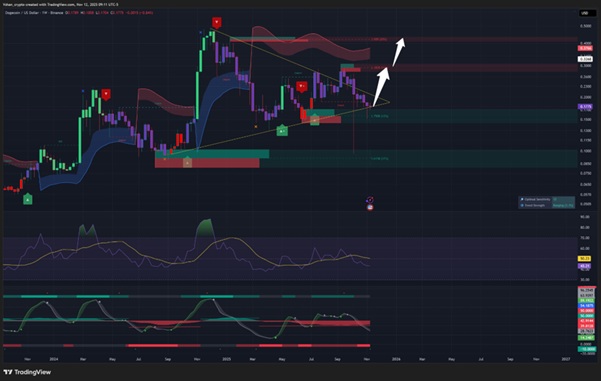
DOGE’s current technical posture is drawing heavy scrutiny. Support???????????????? at $0.17 has been a major turning point for trend reversals in the past. Thus, analysts suggest that a strong defence at this level might reignite bullish momentum.  Many believe that the main event that will trigger a larger run to $0.28 and then $0.40 will be a clear break beyond $0.20. Eventually, DOGE may hit the widely anticipated $1 ????????????????mark. Crypto analyst Shan Specter recently highlighted a descending triangle on the daily timeframe, which he believes mirrors previous DOGE setups that preceded explosive rallies.

Source: Shan Specter on X

Specter notes that once DOGE reclaims $0.20 with solid volume, “the path to $1 becomes structurally viable.” This cites past triangle breakouts that delivered 50%–100% short-term gains. Despite its near-term choppiness, DOGE’s long-term charts look increasingly familiar to seasoned traders. Multi-year consolidation channels from 2017 and 2021 are repeating almost beat for beat.  Several analysts have shared long-range projections showing DOGE’s fractal structure as it prepares for another vertical expansion. Some models suggest $2 targets if momentum aligns. However, more aggressive fractals indicate a focus on the $5 region, based on prior deviation-to-rally patterns.

Little Pepe (LILPEPE): The Next High-Velocity Meme Rocket

Little Pepe distinguishes itself from typical meme tokens by anchoring its brand around a purpose-built Layer 2 architecture. Instead of relying solely on hype, the project is constructing a high-throughput environment optimized for low-cost transactions, fair launches, and frictionless trading. Its zero-tax model removes the usual cost burden on traders. Meanwhile, its anti-sniper and anti-bot mechanics ensure that exploitative bots don’t hijack early liquidity.  The upcoming Pump Pad adds another layer of utility by serving as a launch platform for new microcaps within the LILPEPE ecosystem. This gives the token an expanding base of real usage and creates natural demand inflows each time a new project uses the platform.  In short, LILPEPE isn’t just a meme. It’s a meme ecosystem with infrastructure, an integrated launchpad, and built-in trader protections. This is precisely the blend that multiplies meme-cycle performance.

Presale Momentum & Market Validation

The presale has been one of the strongest in the market this cycle. It’s now moving through Stage 13 at a price of $0.0022. The team has raised more than $27.4 million so far and sold  16.6 billion tokens. This level of funding places LILPEPE in a tier few meme projects ever reach before launch, signaling real demand. Market visibility has also exploded. The project is already listed on CoinMarketCap and CoinGecko during its presale phase. With its strong CertiK security score and confirmed Tier-1 exchange listings lined up for launch, the picture becomes clear.

Community Growth & Viral Mechanics

LILPEPE’s community engine is firing at full speed, and it’s one of the biggest reasons analysts believe this token could deliver an explosive upside. The project launched a massive $777,000 community giveaway designed to pull in new holders and accelerate social traction across X, Telegram, and Discord.  For bigger buyers, stages 12–17 include an additional 15 ETH mega-prize pool. It encourages whales and mid-tier traders to accumulate aggressively before listings. As engagement compounds, the social footprint expands, giving the token continuous visibility. This type of organic, incentive-driven expansion is exactly how meme rockets achieve escape velocity.

Why Analysts Project an 18,361% Surge for LILPEPE

The 18,361% projection isn’t random hype. It’s based on straightforward valuation math, supply and demand mechanics, and historical patterns of meme cycle behavior.  With its current presale price of $0.0022, LILPEPE has the advantage of an asymmetric upside, where even modest liquidity inflows can trigger big price moves. An 18,361% increase will bring the price to $0.40. Its Layer-2 framework adds real utility. This gives it a stronger long-term growth curve than traditional meme coins that rely solely on sentiment. If?????????? the listing goes smoothly, the ecosystem grows, and the launchpad gains traction, Little Pepe might stun the crypto space with a huge rally.

Conclusion

Dogecoin is poised for a potential surge to a new price level. However, its uptrend is limited by its current size. Meanwhile, Little Pepe is still in its early stages and is backed by real infrastructure. With analysts eyeing an 18,361% runway, LILPEPE offers a growth potential that DOGE simply can’t match. For pure explosive potential, Little Pepe is the clear leader.


For more information about Little Pepe (LILPEPE) visit the links below:

Website: https://littlepepe.com

 Whitepaper: https://littlepepe.com/whitepaper.pdf

 Telegram: https://t.me/littlepepetoken

 Twitter/X: https://x.com/littlepepetoken

 $777k Giveaway: https://littlepepe.com/777k-giveaway/