DD
MM
YYYY

PAGES

DD
MM
YYYY

spot_img

PAGES

Home Blog Page 933

United Nations Criticizes Germany’s Deportations of Afghan Nationals

0

The United Nations has criticized Germany’s plan to resume deportations of Afghan nationals, particularly those convicted of crimes, to Afghanistan. On July 4, 2025, German Interior Minister Alexander Dobrindt announced intentions to establish direct agreements with the Taliban to facilitate these deportations, prompted by rising anti-immigrant sentiment and recent violent incidents involving migrants.

Germany had halted deportations to Afghanistan in 2021 due to human rights concerns following the Taliban’s takeover. However, the UN Human Rights Office, through spokesperson Ravina Shamdasani, stated that it is “not appropriate to return people to Afghanistan” due to ongoing human rights violations, including denial of women’s rights and executions.

The UN’s refugee agency (UNHCR) in Kabul also urged countries not to forcibly return Afghans, citing a non-return advisory due to the dire security and humanitarian situation. Critics, including Amnesty International, argue that such deportations risk violating international law and could make Germany complicit in Taliban abuses.

Germany’s push for deportations reflects domestic pressures to address crime and public sentiment against migration, especially after high-profile incidents. However, the UN’s stance underscores the priority of protecting human rights, given Afghanistan’s ongoing crisis under Taliban rule, including documented abuses like executions and severe restrictions on women. This creates a tension between national security priorities and international humanitarian obligations.

Forcibly returning Afghans could violate the principle of non-refoulement, a cornerstone of international refugee law that prohibits returning individuals to places where they face persecution or serious harm. Critics, including Amnesty International, warn that Germany risks complicity in Taliban abuses, potentially facing legal challenges or international condemnation.

Germany’s proposed direct negotiations with the Taliban to facilitate deportations raise concerns about legitimizing a regime not formally recognized by most countries. This could complicate diplomatic relations and set a precedent for other nations to engage with non-recognized governments, potentially undermining global human rights standards.

The plan responds to growing anti-immigrant sentiment in Germany, fueled by far-right movements and recent violent incidents. However, rejecting the plan could intensify domestic backlash, while proceeding could alienate progressive voters and human rights advocates, polarizing German politics further.

Deportations would place returned Afghans at risk of persecution, especially women, minorities, and those with criminal records who may face harsh Taliban punishments. This could also deter Afghan asylum seekers from seeking refuge in Europe, potentially redirecting migration flows to less stable routes or countries.

Germany’s government, driven by domestic political pressures, prioritizes deportations to deter migration and address crime. In contrast, the UN, UNHCR, and human rights groups emphasize the humanitarian crisis in Afghanistan, advocating against returns due to the Taliban’s oppressive regime. This creates a clash between state sovereignty and global human rights norms.

The plan reflects a split within Germany itself. The ruling coalition faces pressure from conservative and far-right groups to tighten migration policies, while left-leaning groups and activists align with the UN, opposing deportations on moral and legal grounds. This mirrors broader European debates on migration.

The controversy highlights a broader divide where wealthier nations like Germany seek to control migration flows, often at the expense of refugees from conflict zones like Afghanistan. Meanwhile, countries in the Global South, or those hosting larger refugee populations (e.g., Pakistan, Iran), may view such policies as shifting burdens unfairly.

Germany’s proposal to negotiate with the Taliban reflects a pragmatic approach to migration control, while the UN’s rejection is rooted in principled adherence to human rights law. This divide underscores differing approaches to balancing immediate political needs with long-term ethical commitments.

The rejection of Germany’s deportation plan reveals a complex interplay of domestic politics, international law, and human rights, with significant implications for refugee treatment and global migration policy. The divide between national interests and humanitarian obligations will likely continue to shape debates on this issue.


Gen Zs Shift Toward Crypto, Driven By Distrust In Traditional Finance

0

Posts on X and recent articles highlight a significant shift among Gen Z toward cryptocurrencies like Bitcoin, driven by distrust in traditional financial systems. Factors such as massive student debt, inflation eroding purchasing power, and an AI-disrupted job market are cited as reasons for this shift. For instance, a post from @MissCryptoGER on July 1, 2025, explicitly mentions over 63% of Gen Z investing in crypto due to these economic pressures.

A 2025 Gemini report notes that more than half of Gen Z owns crypto, emphasizing their tech-savvy nature and openness to digital financial systems. A YouGov study from 2025 indicates 42% of Gen Z investors own crypto, significantly higher than the 11% with retirement accounts, suggesting a preference for digital assets. Another report from 2023 by FINRA and CFA Institute found 55% of Gen Z investors in the U.S. hold cryptocurrencies, reinforcing their inclination toward alternative assets.

Economic challenges like inflation, government debt, and unreliable pensions push Gen Z toward decentralized assets like Bitcoin, seen as hedges against inflation. As the first fully digital generation, Gen Z is comfortable with platforms like Robinhood and Coinbase, which make crypto investing accessible. Social media platforms, including YouTube and TikTok, are primary sources of financial information for Gen Z, with 48% relying on them for investing advice, though trust in these sources is lower compared to family or professionals.

About 41% of Gen Z investors cite “fear of missing out” (FOMO) as a motivator, and their youth allows them to tolerate the volatility of crypto markets. While the trend is evident, the crypto market’s volatility and regulatory uncertainties pose risks. Experts caution that Gen Z’s enthusiasm, fueled by social media hype and influencer endorsements, may lead to overexposure to risky assets. Additionally, the claim of 89% of Gen Z and Millennials planning to leave banks for DeFi platforms, as mentioned in several X posts, lacks primary source verification and should be treated as inconclusive.

Not all Gen Z investors are abandoning traditional investments. Some still prioritize retirement accounts or stocks when they have stable income, and financial advisors recommend balancing crypto with more stable assets like ETFs or mutual funds. Moreover, the crypto market’s infancy (starting in 2009) means it lacks the historical track record of traditional investments, which could deter risk-averse investors.

Gen Z’s preference for crypto over traditional investments like stocks or retirement accounts could redirect significant capital into decentralized markets. This may reduce liquidity in traditional financial systems, potentially impacting banks and pension funds. Increased crypto investment could drive up demand for digital assets, influencing their prices and market volatility.

Banks and financial institutions may face declining engagement from younger generations, pushing them to innovate by integrating blockchain or offering crypto-related services (e.g., custody or trading platforms) to remain competitive. Posts on X suggest that up to 89% of Gen Z and Millennials might shift to DeFi platforms, potentially disrupting traditional banking models if verified.

Crypto’s high volatility could exacerbate wealth inequality within Gen Z. Those who invest successfully may gain significant wealth, while others face substantial losses, particularly if driven by FOMO or unreliable social media advice. Limited financial literacy among some Gen Z investors (48% rely on social media for advice) heightens the risk of poor investment decisions. Gen Z’s embrace of crypto reflects a broader cultural rejection of centralized authority, favoring decentralized, transparent systems. This could foster a generation more skeptical of traditional institutions, influencing future economic policies.

The reliance on social media platforms like TikTok and YouTube for financial education (48% of Gen Z use these) may normalize speculative investing, potentially creating a culture of risk-taking. While some Gen Z investors are drawn to crypto’s potential for high returns, others may remain cautious, sticking to traditional assets. This could create a divide between risk-tolerant and risk-averse groups within the generation.

Social media-driven FOMO (41% of Gen Z cite this as a motivator) may amplify herd behavior, leading to market bubbles or crashes. Gen Z’s tech-savvy nature and crypto enthusiasm could drive broader adoption of blockchain technologies beyond finance, such as in supply chain, healthcare, or digital identity verification. Increased demand for user-friendly crypto platforms (e.g., Coinbase, Robinhood) may spur innovation in fintech, improving accessibility and security.

The shift toward crypto may prompt governments to accelerate regulatory frameworks for digital assets to protect investors, combat fraud, and ensure financial stability. This could either legitimize crypto further or stifle its growth if regulations are overly restrictive. X posts highlight debates around DeFi’s potential to bypass traditional systems, which may push regulators to address decentralized platforms specifically.

Gen Z’s heavy reliance on digital platforms increases exposure to crypto scams, hacks, and phishing attacks. The 2023 FINRA report notes 55% of Gen Z hold crypto, but many lack the experience to navigate risks like wallet security or fraudulent projects. The rise in crypto adoption could spur investment in cybersecurity solutions tailored to blockchain technologies. If Gen Z’s crypto adoption continues, decentralized finance (DeFi) could challenge traditional banking, potentially leading to hybrid financial systems where crypto and fiat coexist.

Bitcoin and other cryptocurrencies may solidify as alternative stores of value, especially if inflation and economic instability persist. As Gen Z ages, their crypto holdings could influence wealth distribution, with early adopters potentially amassing significant assets if crypto markets mature. However, losses from volatility or scams could hinder wealth accumulation for some, impacting their long-term financial stability.

Governments and educational institutions may need to prioritize financial literacy programs focusing on crypto and blockchain to equip Gen Z with the tools to navigate these markets safely. Policymakers might face pressure to address economic root causes (e.g., student debt, inflation) driving Gen Z’s distrust in traditional systems.

Gen Z’s shift toward crypto, driven by distrust in traditional finance, could reshape economic systems, accelerate technological innovation, and influence social attitudes toward money and risk. However, it also introduces risks of financial loss, regulatory hurdles, and cybersecurity threats. To mitigate risks, Gen Z investors should diversify portfolios and seek reliable financial education, while institutions must adapt to this generational shift.

The Transformative Potential of the Aba Export Growth Lab: Empowering Aba Enterprises for Global Market Access

0

On July 8th, Governor Alex Otti of Abia State is set to launch the Aba Export Growth Lab, a strategic initiative poised to revolutionize the economic landscape of Aba and, by extension, Nigeria. This visionary undertaking is not merely another government program; it represents a critical pivot towards unlocking the immense, yet often untapped, export potential of Aba’s vibrant enterprise ecosystem. By providing crucial support, resources, and market linkages, the Growth Lab is designed to empower local businesses to transcend domestic limitations and confidently access the lucrative global market, heralding a new era of prosperity for the “Japan of Africa.”

At its core, the Growth Lab will function as a comprehensive support system for aspiring exporters. It is expected to offer a suite of services including, but not limited to, training on international trade regulations, quality control and standardization, product certification, branding and packaging solutions, and access to market intelligence.

By demystifying the complexities of international trade and providing practical, hands-on assistance, the lab will equip Aba entrepreneurs with the tools and knowledge necessary to produce goods that are not only competitive but also compliant with global benchmarks. This proactive approach will significantly reduce the entry barriers that have long stifled export ambitions.

Beyond immediate economic gains, the Growth Lab holds the key to elevating the “Made in Aba” brand on the global stage. By ensuring that products meet rigorous international standards, the initiative will instill confidence in foreign buyers and consumers, enhancing the reputation of Aba-made goods for quality and reliability.

This week, I spent three days working with His Excellency and I can say that Abia’s future is amazing. Nigerian builders and makers, attend this program and understand how to unlock global opportunities, and together, we will advance the nation. I commend His Excellency for making this a reality.

Ndubuisi Ekekwe

Member, Abia State Global Economic Advisory Council

Co-Chair, Abia Economic Transformation Committee

Shiba Inu Price Prediction: SHIB to Stay Rangebound Longer While Little Pepe (LILPEPE) Is Primed for a 40x Jump

0

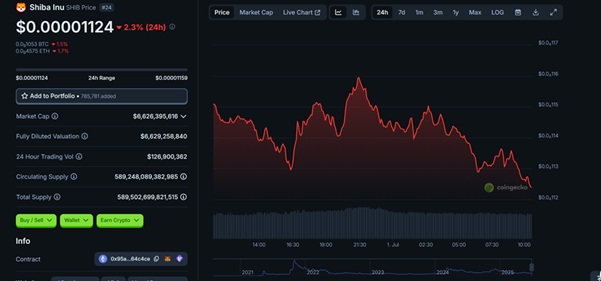
Despite a brief stint that yielded a 10% rebound, Shiba Inu (SHIB) has failed to break past its long-standing consolidation range of $0.000012 to $0.000017. Technical analysis paints a far gloomier picture: SHIB may need to remain within this range for an extended period.  Meanwhile, Little Pepe ($LILPEPE) is leaping ahead with unmatched momentum, raising over $3 million in presale and gathering steam for what many believe could be a 40x run post-launch. Let’s take a closer look at why SHIB may remain rangebound and why Little Pepe might be your next moonshot.

SHIB’s Resistance Wall Is Getting Stronger

SHIB has been locked between $0.000011 and $0.000017 for weeks, failing to break the $0.000020 mark. IntoTheBlock data shows a supply wall of 130,000 wallets that bought SHIB for $0.000015 to $0.000019. Many of these holders are underwater, and if the price rises, they might sell their bags, which would maintain the sell pressure.

Shiba Inu Price Chart | Source: CoinGecko

This kind of psychological and technical resistance often caps price growth unless accompanied by strong fundamentals or breaking news, neither of which SHIB currently enjoys. Without a game-changing catalyst, SHIB will likely remain in this tight range. Moreover, the Relative Strength Index (RSI) and Awesome Oscillator (AO) both indicate a lack of bullish conviction. SHIB simply doesn’t have the momentum to escape its current bracket, making it a waiting game for holders and traders alike.

Presale Frenzy Proves LILPEPE’s Market Fit

While SHIB slows down, LILPEPE is catching fire. Since the start of its multistage presale, the project has already sold over 2.6 billion tokens, raising more than $3 million, an impressive feat in today’s crowded market. Stage 4 is currently live at $0.0013, marking a 30% increase from its Stage 1 price of $0.001. The presale hasn’t just attracted volume—it’s created a movement. With a quirky narrative, meme-first branding, and actual Layer 2 utility, LILPEPE hits all the right notes for today’s crypto crowd. Adding even more fuel to the momentum, the team announced a $777,000 reward pool, with $77,000 prizes for 10 top community contributors. With over 15,000 entries, this strategic community-building campaign is converting hype into long-term holders.

Why $LILPEPE’s Meme Utility and Chain Innovation Is Stealing the Spotlight

In stark contrast to SHIB’s stagnation, Little Pepe ($LILPEPE) is bursting out of the presale gate with actual utility—and that’s rare in memecoins. As the native token powering a custom Layer 2 chain, $LILPEPE goes beyond the meme with zero gas taxes, sniper bot-resistant mechanics, and lightning-fast transaction speeds. What sets it apart? The upcoming Meme Launchpad. This feature enables users to launch their own meme tokens on the LILPEPE chain effortlessly. This adds real demand for the token, as every project born on the chain strengthens its ecosystem. While SHIB continues to rely on historical hype, Little Pepe is building an actual meme economy from the ground up. Backed by a team of meme veterans who’ve helped launch and scale several top meme coins, Little Pepe is shaping up to be the next big thing in the crypto market.

The Next 40x Meme Star? LILPEPE’s 2025 Setup Looks Bulletproof

Looking ahead to 2025, several key catalysts could see $LILPEPE outperform much of the memecoin market. First, its clever tokenomics, zero tax, high staking rewards, deep liquidity, and a large reserve for ecosystem expansion create a solid base for growth. Second, the team is already lining up listings on two top-tier centralized exchanges at launch. This move will introduce LILPEPE to millions of potential users, increasing visibility and improving access. Even more exciting: plans are in motion to list on the world’s largest exchange, a move that could send prices soaring if confirmed. With its roadmap fully in motion, a thriving community, and increasing presale buzz, LILPEPE is shaping up to be more than just a 40x one-season wonder. It could be the top meme chain by the end of next year.

SHIB Looks Stuck, LILPEPE Is Ready to Leap

Shiba Inu’s price chart may offer hope to long-time holders, but the reality is apparent: it’s rangebound, and investors looking for explosive growth may need to look elsewhere. With rising resistance, lukewarm momentum, and no major catalyst in sight, SHIB is more likely to move sideways than skyrocket. Little Pepe, however, is blazing a different trail. With a successful presale, strong utility via the Meme Launchpad, major CEX listings lined up, and real meme power behind it, $LILPEPE offers everything SHIB once did—and more. If SHIB is the past of memecoins, LILPEPE is the future. And the door to Stage 4 is still open. Join the presale now at littlepepe.com. Over $3 million has been raised. Don’t miss the meme moonshot of the year.


For more information about Little Pepe (LILPEPE) visit the links below:

Website: https://littlepepe.com

Whitepaper: https://littlepepe.com/whitepaper.pdf

Telegram: https://t.me/littlepepetoken

Twitter/X: https://x.com/littlepepetoken

The Implications of U.S. House Designation of July 14-18 As Crypto Week

0

The U.S. House of Representatives has designated July 14–18, 2025, as “Crypto Week” to discuss and vote on three key cryptocurrency-related bills: the GENIUS Act, the CLARITY Act, and the Anti-CBDC Surveillance State Act. Announced by House Financial Services Committee Chair French Hill, House Agriculture Committee Chair GT Thompson, and Speaker Mike Johnson, this initiative aims to advance President Trump’s pro-crypto agenda and position the U.S. as a global leader in digital assets.

GENIUS Act (Guiding and Establishing National Innovation for U.S. Stablecoins Act): Establishes a regulatory framework for dollar-backed stablecoins, integrating them into the financial system to enhance liquidity and support U.S. dollar dominance. Passed the Senate with bipartisan support in June 2025 and awaits a House vote. The House is prioritizing this over its own STABLE Act, though amendments may be proposed, potentially requiring Senate reconciliation.

The GENIUS Act could drive institutional investment and increase stablecoin adoption, with companies like Tether already investing heavily in Treasury bonds. Critics argue it favors fiat systems over decentralized finance (DeFi).

CLARITY Act (Digital Asset Market Clarity Act): Defines regulatory roles for the SEC and CFTC, classifying crypto assets as securities or commodities to reduce regulatory uncertainty. It requires crypto exchanges to register with the CFTC, mandates customer fund segregation, and exempts DeFi developers from some SEC oversight. Advanced by the House Financial Services (32-19) and Agriculture Committees (47-6) in June 2025, awaiting a full House vote. It still needs Senate approval.

The CLARITY Act aims to protect consumers and clarify token classification, potentially boosting market confidence. Some, including former CFTC Chair Tom Massad, criticize its flexible language for possible regulatory gaps. It prohibits the Federal Reserve from developing, testing, or issuing a central bank digital currency (CBDC), citing concerns over government overreach and surveillance. Passed the House Financial Services Committee in April 2025 (27-22) but awaits Senate approval.

Its favors cryptocurrencies by limiting CBDC competition, though some argue a digital dollar could modernize payments and maintain global competitiveness. Crypto Week follows the passage of Trump’s “Big Beautiful Bill,” signaling Republican momentum to deliver on crypto-friendly policies. The bills aim to provide regulatory clarity, encourage innovation, and protect consumers, potentially triggering a crypto market bull run, with Bitcoin recently trading at $110,128.

Regulatory clarity from the GENIUS and CLARITY Acts could attract institutional capital, driving development of blockchain infrastructure, such as faster consensus mechanisms, scalability solutions, and cross-chain bridges. Bitcoin’s recent price of $109,128 reflects market optimism, which could fuel funding for blockchain startups.

While the bills promote blockchain-based assets like stablecoins and cryptocurrencies, their focus on regulated entities (e.g., exchanges, stablecoin issuers) may favor centralized or semi-centralized blockchain solutions over fully decentralized ones, potentially stifling grassroots innovation.

If passed, these bills could position the U.S. as a hub for blockchain innovation by providing a clear legal framework, attracting developers and companies. However, opposition from some Democrats and potential Senate delays could temper this impact, especially if other nations (e.g., EU, Singapore) move faster on crypto regulation.

However, Democratic opposition, led by figures like Sen. Elizabeth Warren, cites concerns over Trump’s financial ties to crypto ventures (e.g., World Liberty Financial) and insufficient consumer protections. If passed, these bills could reduce regulatory uncertainty, attract institutional investors, and strengthen the U.S. position in global blockchain innovation, though challenges remain in reconciling House and Senate versions and addressing bipartisan concerns.