

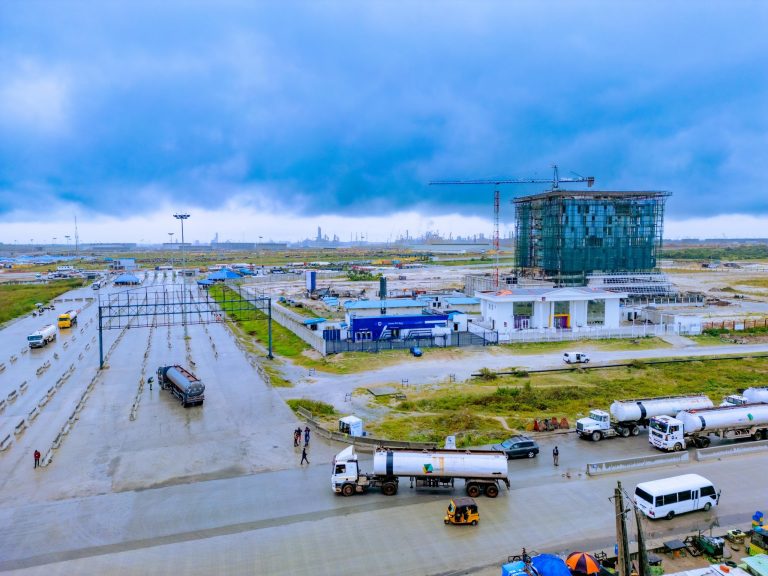
The Petroleum Products Retail Outlets Owners Association of Nigeria (PETROAN) has once again raised concerns over the growing influence of the Dangote Refinery in Nigeria’s downstream petroleum sector, warning that the company’s forward integration strategy could lead to monopolistic control, threaten thousands of jobs, and cripple small players across the fuel value chain.
On June 15, Dangote Refinery announced it would begin nationwide distribution of diesel and premium motor spirit (PMS), commonly known as petrol, starting August 15. With a daily refining capacity of 650,000 barrels, it is the largest refinery in sub-Saharan Africa, and many had initially welcomed the move as a long-awaited breakthrough in Nigeria’s fuel-sufficiency efforts.
But PETROAN, in a statement signed by its national public relations officer, Joseph Obele, said Dangote’s integration into the distribution end of the market is a dangerous overreach. The association accused the refinery of deploying tactics akin to market strangulation, including plans to cut prices aggressively in a bid to push out independent marketers and small-scale suppliers.
Register for Tekedia Mini-MBA edition 20 (June 8 – Sept 5, 2026).
Register for Tekedia AI in Business Masterclass.
Join Tekedia Capital Syndicate and co-invest in great global startups.
Register for Tekedia AI Lab.
“This could lead to a massive shutdown of filling stations across Nigeria, resulting in widespread job losses,” the statement said, adding that “the introduction of 4,000 compressed natural gas (CNG)-powered tankers by Dangote further threatens the livelihoods of existing truck owners and drivers.”
The association argued that the refinery should restrict its focus to upstream and midstream activities, rather than venturing into retail distribution, where its sheer size could distort competition and eliminate alternatives for consumers.
Stakeholders Caught Between Efficiency and Market Control
PETROAN has insisted that it is not opposed to refining at scale, but that fair competition must be preserved. It wants regulators, including the Nigerian Midstream and Downstream Petroleum Regulatory Authority (NMDPRA) and the petroleum ministry, to intervene by enforcing price control mechanisms and strengthening oversight to ensure no single player dominates the downstream sector.

The association also recommended that the government ensure reliable crude supply to smaller refineries, which are already struggling to survive without access to feedstock. It urged the administration to create alternative livelihood opportunities for stakeholders at risk of displacement.
However, critics of PETROAN’s position say Nigeria has struggled for decades under a dysfunctional and opaque import-dependent fuel supply model. They believe that if Dangote can cut costs, improve fuel quality, and guarantee local refining, that alone should not be vilified—especially in a sector long plagued by scarcity, subsidy fraud, and dependence on foreign supply chains.
PETROAN’s Argument ‘Not Grounded in Economics’
Energy analysts who had previously praised Dangote’s nationwide distribution plan say PETROAN’s concerns, while not entirely unfounded, ignore key realities of the energy sector.

Kelvin Emmanuel, an energy economist, dismissed the association’s logic, particularly its suggestion that modular and small-scale refineries can stand toe-to-toe with the technologically advanced Dangote plant.
“How can a commercial refiner compete with modular refineries that do not even have catalytic converters and reforming units to crack naphtha into PMS?” he said, pointing out that most local modular facilities lack the infrastructure and efficiency to refine to standard fuel quality.
He also rejected the suggestion that Dangote’s model would kill jobs, saying the reverse is true.
“The Dangote Refinery employs 30,000 people directly and indirectly — at least 90% are Nigerians. Please, what job is PETROAN speaking of?” Emmanuel asked.
According to him, the 4,000 CNG trucks are not a threat to employment but a boost to industrial logistics and energy transition goals.
“These trucks will employ 4,000 drivers directly and another 4,000 people indirectly as mechanics, station attendants, engineers at CNG mother and daughter stations deployed along the corridor. Do you know what it means to make payroll every month?” he said.
He argued that PETROAN’s opposition stems from a fear of losing market privileges rather than a concern for public interest or national energy sustainability.