


A Community Giant With Feet of Clay
Pi Network was never supposed to be a conventional cryptocurrency project. Since its 2019 launch as a mobile-mining app, it has grown to a base of over 19 million KYC-verified users — a figure most blockchain projects can only dream of.
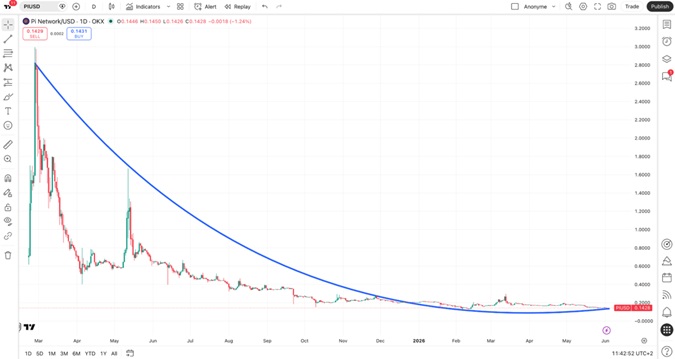
While many investors focused on established assets dominating the crypto heatmap, others turned to community-driven projects like Pi. When its Open Mainnet launched on February 20, 2025, the token briefly jumped to an all-time high of $2.99. For a moment, the vision of a decentralized, community-first cryptocurrency appeared to be gaining traction.
Then sixteen months passed, and Pi Coin is trading roughly 95% under that peak, hanging around $0.147. It’s only barely above its all-time low of $0.1312 from February 11, 2026.
The most structurally damaging problem is one built into the project’s design. Out of a maximum supply of 100 billion PI tokens, only around 9.7 billion are currently in circulation. So far, more than 90% of the entire supply is still waiting to reach the market.
The unlock schedule remains aggressive: there were 190 million tokens released in December 2025, then another 134 million in January 2026. Altogether, roughly 1.22 billion tokens are expected to unlock during 2026.
The math is a little unforgiving. Even a price of $1 would require a fully diluted market capitalization exceeding $100 billion, which already clears most well-established Layer 1 blockchains today. That supply overhang keeps outpacing real organic demand, and the demand stays thin: relatively few merchants or decentralised applications currently accept PI for real-world transactions.
A Community Going Quiet
Technical indicators are looking decisively bearish. According to Santiment data, Pi’s social volume score dropped from 31 on May 8 to just 1 by late May 2026, indicating a sharp decline in online discussion surrounding the project.
Also, the Smart Money Index dropped under its signal line, showing 0.9063 vs a reference level of 0.9157. That points to seasoned investors cutting back their exposure, not adding more.
Earlier this year, the Money Flow Index dropped from 83 to 43 in just ten trading sessions. Simultaneously, Pi’s correlation with major cryptocurrency pairs — such as BTCUSD, ETHUSD, SOLUSD, and — turned negative, meaning the token could no longer benefit from broader market rallies.
The project has not stood still. The team went ahead and completed the Protocol v23 upgrade, migrating infrastructure from Ubuntu 20 to 24 and PostgreSQL 12 to 16, and the founders also participated in Consensus 2026 in Miami, one of the industry’s largest annual conferences. In March 2026 there was also a Kraken listing, which expanded trading access and liquidity for U.S. investors.
Still, none of those steps seem to have turned into real price support. The key boundary to track remains the $0.145 level: if it decisively slips under it, then the market could start opening back up toward the all-time low at $0.1312, and maybe even move nearer to the $0.10 psychological mark. That last one could be interpreted by many market participants as a capitulation event.
A Window That May Be Closing
Pi Network still holds assets no competitor can replicate overnight: a massive verified user base and years of community investment. But the window in which ecosystem development can outrun selling pressure is narrowing fast.
With over 90% of total supply still to be distributed and real-world utility still largely absent, the forces working against PI are structural, rather than cyclical. The resilience the token has shown so far may only be delaying a broader test of investor confidence.