

A stolen password can be changed in a minute. A stolen face cannot. That simple asymmetry sits at the centre of Q-AmFatec, a biometric identity platform from Ameritec IPS. It pairs familiar anti-fraud tools with an unusual extra: post-quantum encryption for the face data itself.
“Security can’t be patched. It must be built.” A graphic from Q-AMCHAIN’s social media series. Image: Q-AMCHAIN.
The Fraud Has Moved On
Identity checks used to worry mostly about stolen passwords. The attacks Ameritec lists in its product catalogue look different. A printed photo or a video on another phone is held up to the camera. A silicone mask stands in for a real face. A face generated by Super Intelligence (SI) is injected straight into the camera feed. A forged ID card is used to open an account, or someone takes over a session after the real user has logged in.
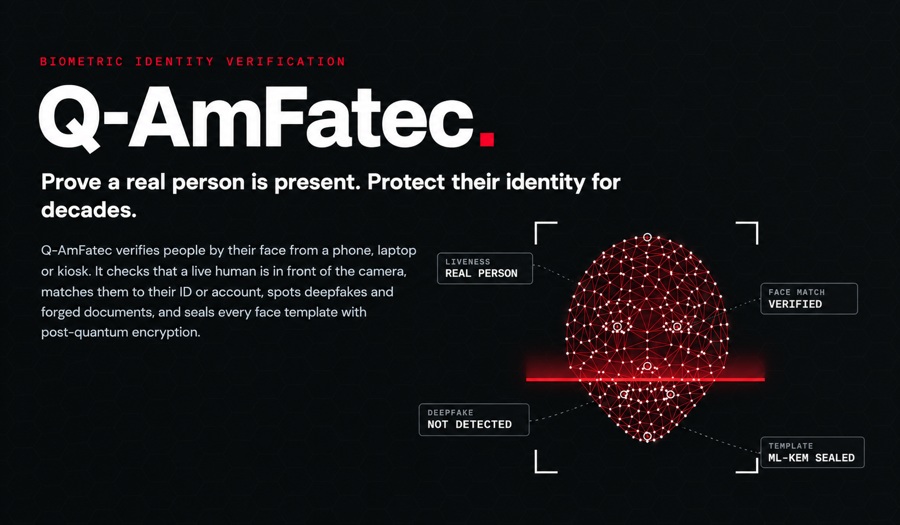
Q-AmFatec checks liveness, matches faces, detects deepfakes and seals face templates with post-quantum encryption. Image: Ameritec IPS product catalogue.
Q-AmFatec answers each with a separate layer. 3D liveness checks look for depth, texture and natural movement that flat images cannot fake. Deepfake and injection detection flags synthetic video and tampered camera streams. Document forensics checks ID cards for edits and photo swaps, then compares the ID photo with the live face. Behavioral biometrics and continuous authentication keep checking that the same person stays in control after login.
In total, the platform lists ten capabilities, including an identity graph and risk engine that links devices, documents and attempts to spot repeat fraudsters.
Four Steps, One Selfie
For the person being verified, the process is meant to be short. They look into a phone, laptop or kiosk camera. The system confirms a live person is present, matches the face to an ID document or an enrolled account, and returns a pass or fail with a risk score. The last step is the one Ameritec stresses most: the face template is sealed with ML-KEM.
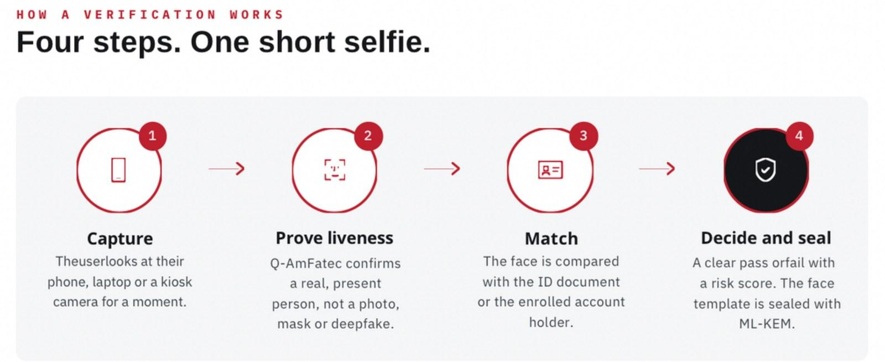
The four steps of a Q-AmFatec verification, from capture to sealing the face template. Image: Ameritec IPS product catalogue.
Why Encrypt a Face for the Quantum Era
Biometric data has a long shelf life. A face template stored today could still identify someone decades from now. Ameritec’s argument is that templates protected with today’s classical encryption could become a target for harvest now, decrypt later attacks. In those, data is stolen now and unlocked once quantum computers are strong enough. Q-AmFatec seals templates with ML-KEM-1024, the strongest parameter set of the post-quantum standard NIST published in 2024.
A Q-AMCHAIN illustration of quantum-era data protection. Image: Q-AMCHAIN.
The company describes Q-AmFatec as the first biometric quantum-encryption solution. That claim is hard to verify independently, but the combination is uncommon among identity products, many of which treat deepfake detection or document checks as add-ons from separate vendors.
Where It Fits
Ameritec is pitching the product to government services, borders and travel, banking and fintech onboarding, workforce access and healthcare. It can run as a cloud API, on premises so face data never leaves a client’s own data centre, or fully offline at remote sites and gates. The company’s materials cite the NSA’s CNSA 2.0 timeline as the reason it built around those algorithms from the start. That timeline expects new national security system purchases to be compliant from January 2027.

Q-AMCHAIN names banking, enterprises and internet infrastructure as the sectors preparing for post-quantum security. Image: Q-AMCHAIN.
The platform comes in tiers, from a 10-module core package to a 26-module enterprise version, and Ameritec says it is looking for pilot partners. The same mix of biometrics and post-quantum security is also planned for Q-Pay, a payment gateway on the roadmap of the company’s blockchain project, Q-AMCHAIN.
As with any biometric system, the real measures will be accuracy in the field, false rejection rates and resilience against attacks nobody has invented yet. Those figures have not been published. But the starting premise is hard to argue with: if a face is a password you can never change, it deserves stronger protection than most systems give it today.