

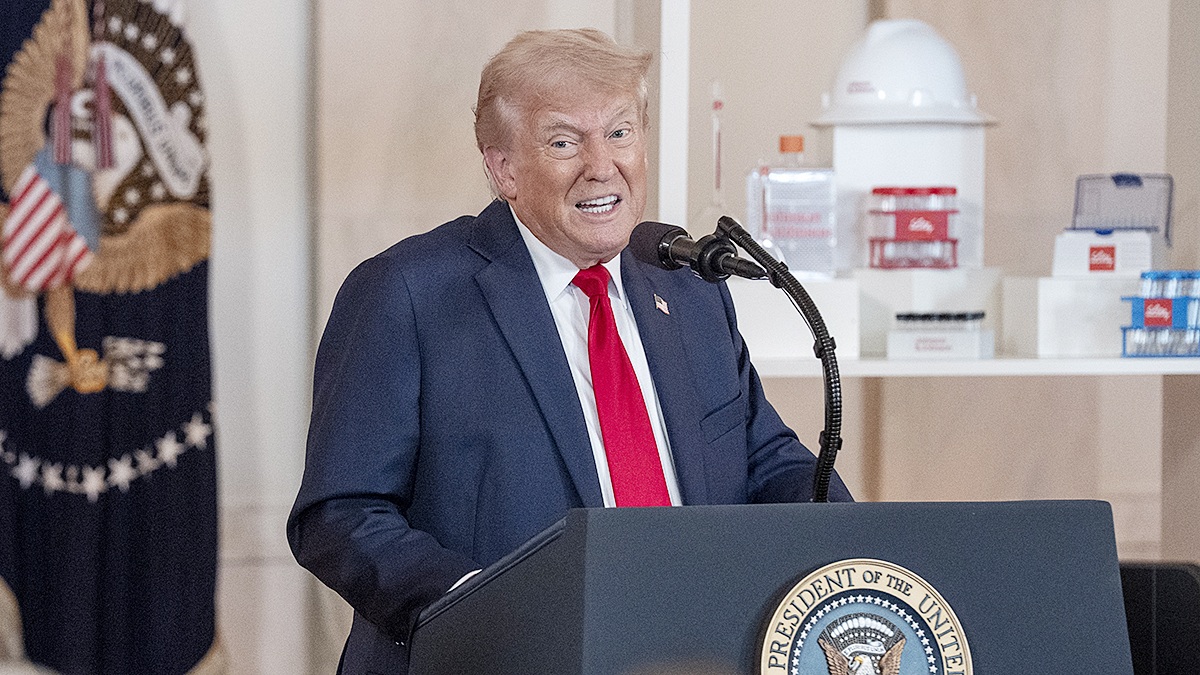
US President Donald Trump has publicly criticized German Chancellor Friedrich Merz over Germany’s reluctance to treat the ongoing US-Israel conflict with Iran as a shared priority, particularly regarding security in the Strait of Hormuz.
Trump made the remarks recently while speaking at a conference in Miami, Florida, and in other comments. He referenced Merz saying the Iran war is not our war and not NATO’s war. Trump responded by drawing a parallel to Ukraine: Well, Ukraine’s not our war. We helped, but Ukraine’s not our war. He called the German statement inappropriate and highlighted frustration with limited allied support for securing key shipping routes amid the conflict.
Chancellor Merz has stated that Germany is not part of the war and does not want to become involved militarily. He has expressed doubts about the effectiveness of US and Israeli military actions, saying he’s not convinced they will lead to success and noting that the US and Israel are becoming more deeply entangled daily.
Register for Tekedia Mini-MBA edition 20 (June 8 – Sept 5, 2026).
Register for Tekedia AI in Business Masterclass.
Join Tekedia Capital Syndicate and co-invest in great global startups.
Register for Tekedia AI Lab.
Merz has offered potential post-ceasefire cooperation but emphasized this is not a NATO matter. He reportedly told Trump in a call that he understands this stance, and Germany initially showed some alignment on goals like countering Iran’s regime but has grown more critical over strategy, lack of consultation, and escalation risks.
German President Frank-Walter Steinmeier went further, calling the Iran war a “disastrous mistake” and a breach of international law, warning of a profound rupture in transatlantic ties. Merz has been more measured, avoiding strong legal condemnations while pushing for an early end to hostilities due to economic and security concerns for Europe.
This stems from US and Israeli military actions against Iran reportedly involving strikes, with concerns over Iran’s nuclear program, regional stability, and disruptions to global energy shipping via the Strait of Hormuz. European allies, including Germany, have been reluctant to commit forces, leading to Trump’s irritation with NATO partners.

Earlier, Merz met Trump at the White House and expressed shared goals against Iran’s regime while hoping for a quick resolution.
Trump’s framingTrump has used the exchange to underscore his “America First” approach: if allies won’t fully back US efforts in the Middle East, the US may reconsider its level of involvement elsewhere.
This fits his pattern of pressing NATO members on burden-sharing. The exchange highlights ongoing transatlantic friction during Trump’s second term, with Germany balancing support for Israel/US goals against domestic caution, economic risks, and preference for diplomacy/ceasefires. Merz has faced criticism at home for his handling—some see it as too deferential to the US initially, others as insufficiently firm.
This remains a developing story amid the broader Iran conflict, with both sides signaling interest in de-escalation while disagreeing on roles and timelines. The Strait of Hormuz is the world’s most critical oil transit chokepoint. It handles the vast majority of energy exports from the Persian Gulf region, home to some of the planet’s largest oil and gas reserves.

In recent years roughly 20–21 million barrels per day (b/d) of crude oil, condensate, and petroleum products have flowed through the strait. This equates to: About 20% of global petroleum liquids consumption.
Roughly 25% or up to 27% of total global seaborne oil trade.
Rje Strait of Hormuz also carries significant liquefied natural gas (LNG), primarily from Qatar around 19–20% of global LNG trade. Additional traffic includes refined products, petrochemicals, and container ships. On a normal day, around 100 cargo vessels (60–70% of them oil/gas tankers) transit the strait.
About 80–84% of the oil heading through the strait goes to Asian markets especially China, India, Japan, South Korea, making Asia particularly exposed. The U.S. imports a smaller share directly around 400,000 b/d pre-conflict, or ~7% of its crude imports.