

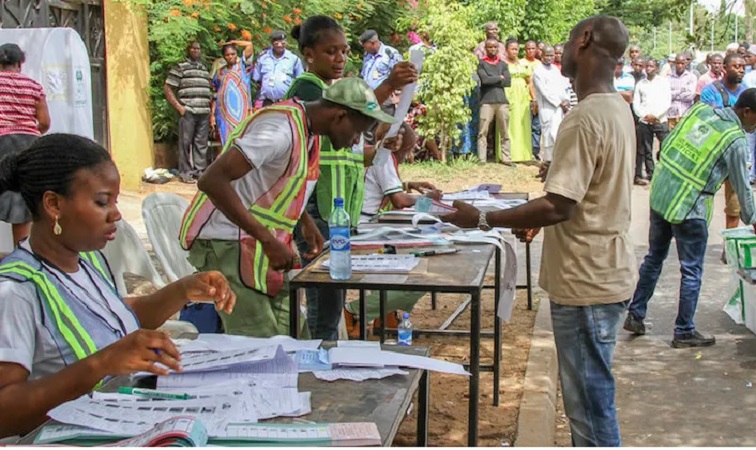
As Osun State approaches its August 15, 2026 governorship election, one of the most revealing indicators of the political mood may not be found in campaign rallies, newspaper headlines or the number of supporters gathered behind individual candidates. It may be found in the questions citizens are asking online. An analysis of Google search activity in Osun between August 1 and 10 provides an intriguing picture of an electorate whose attention is rapidly shifting toward the election itself. The data does not identify a clear candidate favourite. Instead, it reveals something potentially more important for campaigns, election administrators and political observers: the election has become an increasingly urgent information event for the public.
The Election Itself Is Becoming the Story
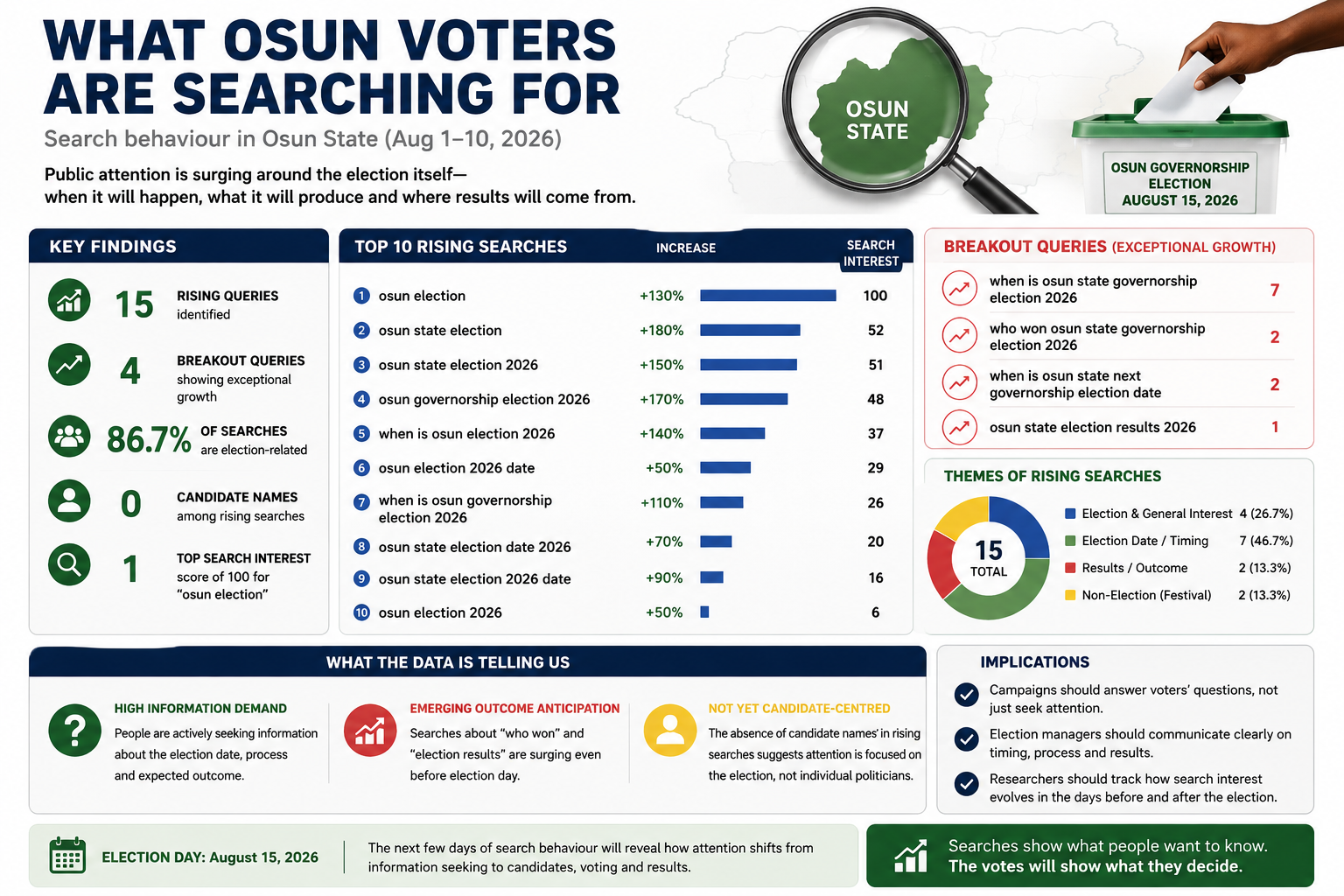
The strongest rising searches during the period are remarkably consistent in what they reveal. Searches for terms such as “Osun election,” “Osun State election,” “Osun State election 2026” and “Osun governorship election 2026” increased substantially, with some rising by more than 150 percent. Several searches asking when the election would take place also recorded exceptional growth. This pattern suggests that public attention is moving beyond general awareness of the contest toward a more immediate need to understand the electoral event itself.
Register for the next Tekedia Mini-MBA.
Register for Tekedia AI in Business Masterclass.
Join Tekedia Capital Syndicate and co-invest in great global startups.
That shift is significant because the final days before an election represent a different information environment from the months that precede it. Earlier in a campaign, citizens may encounter political messages incidentally through television, newspapers, social media or conversations with friends and family. As election day approaches, however, information becomes more consequential. Citizens want to know when voting will take place, what the process involves and what they should expect. The increase in searches about the election date therefore suggests that the contest is becoming more tangible in the everyday lives of people who are paying attention.
For political campaigns, this should be a warning against equating visibility with engagement. A campaign can dominate public conversation while still failing to answer the practical questions that voters need answered. The search behaviour emerging in Osun suggests that information itself has become part of the electoral competition.
From “When?” to “Who Won?”

The most intriguing searches are those concerned with the eventual outcome. Among the rapidly rising searches are phrases asking who won the Osun governorship election and searches for the 2026 Osun election results. These searches require careful interpretation because the election is scheduled for August 15, meaning they cannot be treated as evidence that the election has already produced a result. They may reflect anticipation, curiosity, searches for emerging information or reactions to online content about the forthcoming contest.
Nevertheless, their appearance alongside the strong growth in searches about the election date reveals an important progression in public attention. Citizens appear to be moving from questions about when the election will happen toward questions about what the election will produce. In information terms, this represents a movement from basic awareness toward outcome anticipation.
That distinction matters because political campaigns often focus heavily on communicating their own messages while paying insufficient attention to the questions that voters are actually asking. If citizens are increasingly interested in the outcome, campaigns need to consider not only how they present their candidates but also how effectively they provide credible information about policies, records, voting procedures and the issues that will shape electoral decisions.

The Candidates Are Surprisingly Absent
Perhaps the most interesting finding in the data is what it does not contain. None of the 15 rising searches in the dataset explicitly mentions Ademola Adeleke, Bola Oyebamiji or Najeem Salaam. This means the available search evidence cannot reasonably be used to claim that one of the major candidates is ahead of the others in public support.
This is an important distinction because online attention is often mistaken for political popularity. Someone searching for a candidate may be interested in that candidate’s achievements, allegations surrounding the candidate, campaign activities or simply a news story that has suddenly attracted attention. Search behaviour therefore tells us what people are trying to find out, but it does not automatically tell us what they intend to do in the polling booth.
The absence of candidate-specific rising searches is itself analytically useful. It suggests that, at least within this particular dataset, public search behaviour is currently more focused on the election as an event than on individual politicians. The dominant questions appear to concern the election, its timing and its eventual outcome rather than the personalities competing for the governorship.
That distinction could become increasingly important as the campaign enters its final days. If candidate-specific searches begin to rise sharply, the change could indicate that public attention is becoming more personalised. If general election searches continue to dominate, it may suggest that the electorate remains primarily concerned with the electoral process and its outcome rather than with any single candidate.
What This Means for Political Campaigns
The lesson for political campaigns is straightforward but easy to overlook: visibility is no longer enough. Campaigns have traditionally measured their strength through rallies, endorsements, media coverage, advertising and social media engagement. Those measures remain relevant, but they do not necessarily reveal what information voters are actively seeking at a particular moment.
The Osun search data suggests that voters are increasingly interested in practical and outcome-related information. This creates an opportunity for campaigns that can respond to those information needs clearly and consistently. A candidate who explains what they intend to do, how their record should be evaluated and what voters need to know about the election can potentially build a stronger information relationship with the electorate than a campaign that concentrates primarily on generating publicity.
This is particularly relevant in a competitive election where three major contenders are attracting substantial political attention. The race involving incumbent Ademola Adeleke, APC candidate Bola Oyebamiji and ADC candidate Najeem Salaam has generated considerable interest, while the wider field contains 14 candidates. The absence of strong candidate-specific signals in the current search dataset means that political observers should be cautious about assuming that public attention has already translated into a clear hierarchy of voter preference.