

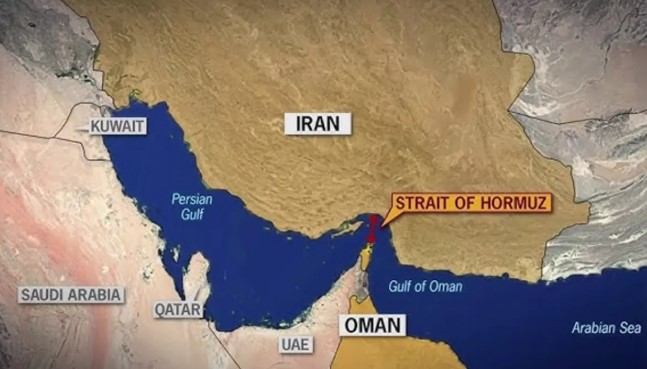
The Strait of Hormuz, briefly declared open to commercial shipping on Friday, has effectively been shut again, with Iranian naval warnings and reported gunfire forcing vessels to abort passage.
The abrupt reversal followed what had appeared to be a coordinated de-escalation. Iran’s Foreign Minister announced the strait was “completely open” to all commercial vessels, a move that prompted a swift response from Donald Trump, who publicly thanked Tehran and indicated cooperation was underway to stabilize the corridor. Within hours, however, those signals unraveled.
By Saturday, merchant vessels attempting to transit the strait reported receiving direct radio instructions from Iranian naval forces denying passage. Several ships said they picked up a VHF broadcast declaring: “Attention all ships, regarding the failure of the U.S. government to fulfil its commitment in the negotiation, Iran declares the Strait of Hormuz completely closed again. No vessel of any type or nationality is allowed to pass through the Strait of Hormuz.”
Register for the next Tekedia Mini-MBA.
Register for Tekedia AI in Business Masterclass.
Join Tekedia Capital Syndicate and co-invest in great global startups.
The warnings were reinforced by force. Shipping and maritime security sources said at least two vessels came under gunfire in waters between Qeshm and Larak islands. Both ships turned back without completing the crossing. In a separate report, the United Kingdom Maritime Trade Operations, operating under the Royal Navy, said a tanker captain described being approached by two gunboats linked to Iran’s Islamic Revolutionary Guard Corps, which fired on the vessel. The tanker and its crew were not harmed.
A container ship was also struck by gunfire, according to maritime security sources, indicating that the disruption has moved beyond warnings into direct interference with navigation.
The renewed closure has stranded hundreds of vessels in the Gulf, with industry estimates pointing to around 20,000 seafarers unable to proceed through the narrow passage. Given that the strait handles roughly 20% of global oil and liquefied natural gas shipments, the operational standstill introduces immediate risks to supply chains, freight pricing, and energy markets.

The sequence of political statements that preceded the shutdown highlights the scale of the disconnect between Washington and Tehran. After Iran’s initial announcement, Trump said the United States and Iran were working together to remove mines from the strait. He went further, stating that Iran had agreed to “never close the Strait again” and to “suspend its nuclear program indefinitely.”
Those claims were quickly rejected in Tehran. Iran’s parliamentary leadership responded that the U.S. president had made “seven claims in one hour, all seven of which were false,” effectively dismantling the narrative of a coordinated agreement.
The divergence is now playing out operationally. Shipping advisories issued on the assumption of a reopening have been overtaken by events, leaving vessel operators exposed to rapidly shifting conditions in a confined and strategically sensitive waterway.

Complicating matters further is the broader military posture in the region. The United States has imposed a blockade on Iranian ports and coastal areas, tightening control over maritime traffic. According to the U.S. military, 23 vessels have already complied with orders to turn back toward Iran, adding another layer of disruption to shipping routes.
From a market standpoint, the implications are immediate and far-reaching. The Strait of Hormuz is not just a transit corridor; it is a pricing lever for global energy markets. Any sustained disruption is likely to trigger volatility in crude benchmarks, as traders incorporate geopolitical risk premiums. Asian economies, which rely heavily on Gulf exports, are particularly exposed to prolonged instability.
Insurance markets are also likely to react. Repeated incidents involving gunfire and naval warnings increase the probability that underwriters will classify the area as high risk, driving up war risk premiums for vessels attempting passage. Such increases typically feed directly into higher shipping costs, with downstream effects on fuel prices and broader inflation dynamics.
What remains uncertain is whether the latest closure represents a tactical escalation or the beginning of a more sustained disruption. Iran has historically used the strait as a pressure point in geopolitical negotiations, but enforcing a prolonged shutdown carries economic consequences that extend beyond its adversaries.
However, the situation is currently defined by contradiction. Diplomatic signals point to cooperation, while actions at sea indicate confrontation. It is not clear what happens next. What is clear is that the Strait remains chaotic, with global markets adjusting in real time to each new development.