

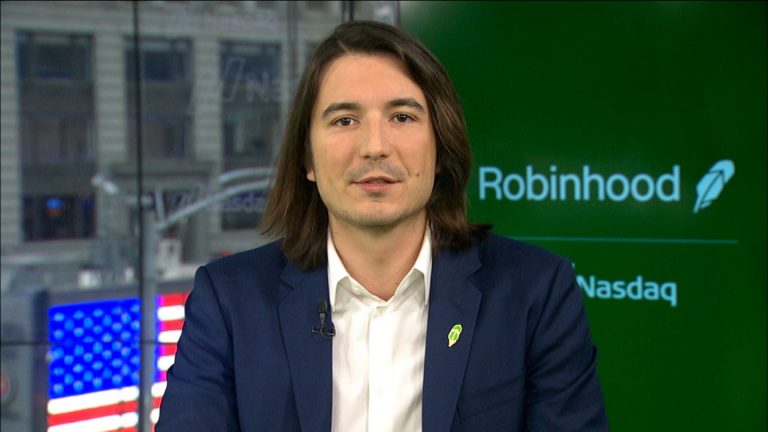
Robinhood CEO Vlad Tenev has expressed a strong belief that cryptocurrencies will significantly disrupt and potentially replace traditional finance. In a June 2025 statement on X, Tenev said, “We believe crypto will fundamentally reorganize the financial system,” highlighting this view in the context of Robinhood’s $200 million acquisition of cryptocurrency exchange Bitstamp. He reiterated this sentiment on CNBC, as reported by The Defiant, stating that Bitcoin and cryptocurrencies will replace traditional finance, reflecting growing institutional acceptance of digital assets.
Tenev’s optimism is tied to crypto’s potential to streamline financial systems, reduce costs, and increase accessibility. For instance, he noted in November 2024 that operating a cryptocurrency business costs “roughly an order of magnitude less” than traditional finance, calling this efficiency “undeniable.” He also emphasized tokenization, suggesting it could make private investments like shares in companies such as OpenAI or SpaceX accessible to retail investors, further blurring the lines between traditional and decentralized finance.
However, Tenev’s vision comes with caveats. Robinhood’s Q1 2025 earnings showed a 30% drop in crypto trading revenue, prompting him to stress diversification to reduce reliance on volatile crypto markets. Critics also point to regulatory hurdles and crypto’s volatility as barriers to fully replacing traditional finance. Despite these challenges, Tenev’s moves, like acquiring Bitstamp to expand into institutional crypto and enhancing Robinhood’s non-custodial wallet, signal a strategic bet on crypto’s long-term dominance.
Register for Tekedia Mini-MBA edition 20 (June 8 – Sept 5, 2026).
Register for Tekedia AI in Business Masterclass.
Join Tekedia Capital Syndicate and co-invest in great global startups.
Register for Tekedia AI Lab.
Skeptics might argue Tenev’s claims are self-serving, given Robinhood’s growing crypto business, which accounted for over 25% of Q1 2025 revenue. Yet, his perspective aligns with broader trends, like increasing blockchain adoption in finance, as seen with systems like Ripple’s XRP for cross-border payments. Whether crypto will fully replace traditional finance remains uncertain, but Tenev’s actions suggest Robinhood is positioning itself to lead in a hybrid financial future.
If crypto replaces traditional finance, centralized institutions like banks and clearinghouses could lose dominance. Blockchain-based systems, such as decentralized finance (DeFi) platforms, could handle transactions, lending, and asset management with lower fees, as Tenev noted with crypto’s cost efficiency being “an order of magnitude less” than traditional systems.
Crypto’s volatility, evidenced by Robinhood’s 30% Q1 2025 crypto revenue drop, suggests replacing traditional finance could introduce systemic risks. Stablecoins or central bank digital currencies (CBDCs) might mitigate this, but widespread adoption could still disrupt markets. Tokenization, as Tenev highlighted, could democratize access to high-value assets (e.g., SpaceX shares), potentially reducing wealth inequality. However, early adopters and crypto whales might consolidate wealth if regulatory oversight lags.
Crypto’s borderless nature could provide financial services to the unbanked, especially in regions with weak banking infrastructure. Yet, access to technology and education remains a barrier. Tenev’s vision would likely trigger stricter regulations to address money laundering, fraud, and consumer protection. Current U.S. regulatory uncertainty, with the SEC’s cautious stance, suggests a long road to mainstream crypto adoption.

Replacing traditional finance requires harmonized global regulations, as crypto operates across borders. Disparities, like the EU’s MiCA framework versus fragmented U.S. policies, could create arbitrage opportunities or regulatory havens. Governments reliant on traditional financial reporting for taxes may struggle to track decentralized crypto transactions, necessitating new compliance frameworks or blockchain analytics.
Replacing traditional finance demands scalable blockchain networks. Current limitations, like Ethereum’s high gas fees or Bitcoin’s slow transaction speeds, must be resolved, possibly through layer-2 solutions or newer protocols. A crypto-dominated system requires seamless interaction between blockchains and legacy systems. Projects like Polkadot or Chainlink could play a role, but standardization is critical.
Widespread crypto adoption increases the stakes for cybersecurity. Hacks, like the $600M Poly Network exploit in 2021, highlight vulnerabilities that could undermine trust if traditional finance is supplanted. Proof-of-work blockchains, like Bitcoin, face criticism for high energy use. Transitioning to proof-of-stake or greener alternatives, as Ethereum did in 2022, is essential for sustainability. Replacing traditional finance with crypto shifts trust from institutions to code and decentralized networks.

Public understanding of blockchain must improve to avoid reliance on intermediaries like exchanges, which Tenev’s Bitstamp acquisition suggests Robinhood aims to control. Traditional finance employs millions in banking, compliance, and brokerage roles. A crypto-based system could automate many functions, reducing jobs while creating demand for blockchain developers and auditors.
Crypto’s self-custody model, as seen in Robinhood’s non-custodial wallet, empowers users but requires greater financial literacy. Mismanagement, like lost private keys, could lead to significant losses. Crypto’s rise could normalize digital ownership and decentralized governance, influencing broader societal structures like voting or intellectual property management via NFTs or DAOs.
Tenev’s push, via acquisitions like Bitstamp and wallet enhancements, positions Robinhood as a hybrid broker bridging traditional and crypto finance. Success hinges on navigating volatility and regulatory risks. Banks and brokerages face existential risks if crypto gains dominance. Some, like JPMorgan with Onyx, are adopting blockchain, but slower movers could be sidelined.
Crypto’s low barriers to entry could spur startups offering DeFi, staking, or tokenized asset platforms, intensifying competition and potentially commoditizing financial services. Mass adoption requires user-friendly interfaces, regulatory clarity, and trust, which crypto currently lacks compared to traditional finance’s entrenched systems. A crypto-based financial system could amplify crises if smart contracts fail or markets crash, as seen in the 2022 Terra-Luna collapse.
Despite crypto’s decentralized ethos, centralized exchanges like Bitstamp or Coinbase could dominate, replicating traditional finance’s power structures. Tenev’s claim implies a transformative shift toward a more efficient, accessible, but riskier financial system. While crypto’s potential to disrupt is evident—seen in Robinhood’s strategic moves and blockchain’s growing use—replacing traditional finance entirely faces hurdles like regulation, scalability, and public trust. The most likely outcome is a hybrid system where crypto and traditional finance coexist, with Robinhood and others vying to lead the transition.