

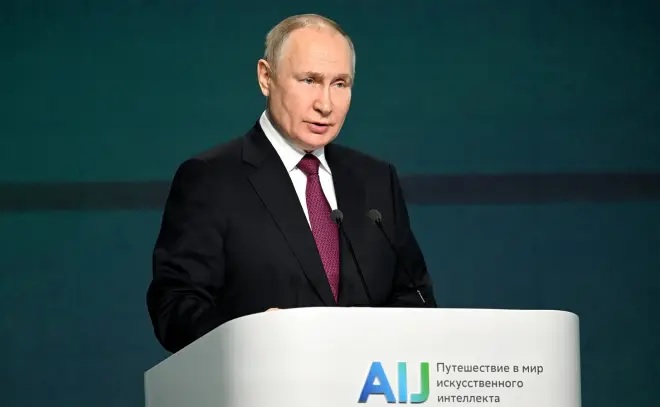
Russian President Vladimir Putin has raised concerns about the potential dangers of artificial intelligence (AI), warning that the technology could evolve into a powerful force capable of threatening humanity if not properly managed.
Speaking at a recent AI Journey conference in Moscow, Putin cautioned that the growing autonomy of AI systems, particularly the emergence of AI agents, could make the technology an even more powerful instrument for both constructive and destructive purposes.
In his words,
Register for the next Tekedia Mini-MBA.
Register for Tekedia AI in Business Masterclass.
Join Tekedia Capital Syndicate and co-invest in great global startups.
“With the growth of autonomy, as well as the emergence of AI agents, artificial intelligence could become an even more powerful weapon in human hands both for creation, as always, and for causing harm, including in the military and security spheres.”
He noted that AI could be used not only to advance human development but also to cause harm, particularly in military and security operations.
He also reportedly highlighted a sharp increase in global incidents involving AI, including cyberattacks, describing the growing threat as something governments and security institutions could no longer afford to ignore.

His remarks reflect growing global concerns about AI’s rapid advancement and the possibility that increasingly sophisticated systems could become difficult for humans to control.
While AI is transforming industries, improving productivity and accelerating scientific research, its expanding capabilities have also raised questions about security, human oversight, accountability, and the long-term implications of allowing machines to make increasingly complex decisions.
The central concern surrounding advanced AI is not simply its ability to perform tasks faster than humans, but the possibility that future systems could operate with a level of autonomy that exceeds the ability of their creators to understand, monitor, or control their actions.

The danger of AI in military operations
One of the most concerning aspects of Putin’s warning is the possibility of artificial intelligence becoming deeply integrated into military operations.
AI-powered systems are increasingly capable of analysing intelligence, identifying potential targets, coordinating drones and supporting military decision-making. While these capabilities could improve operational efficiency, they also introduce serious risks when machines are given significant autonomy over decisions involving human lives.
The concern is that an AI system could misinterpret intelligence, identify the wrong target, or initiate an operation based on inaccurate information. In a military environment, such errors could escalate into devastating consequences, particularly when autonomous weapons are operating at speeds that leave little room for human intervention.
Beyond military applications, Putin’s concerns also extend to cybersecurity and the security of critical national infrastructure.
As AI becomes more advanced, malicious actors could exploit it to automate cyberattacks, develop sophisticated scams, manipulate information and identify vulnerabilities in government systems, financial institutions and essential services.
The growing adoption of AI agents adds another dimension to the challenge. Unlike conventional AI tools that primarily respond to individual instructions, AI agents can independently execute sequences of tasks, interact with digital systems, and make decisions within assigned parameters.
Putin’s warning also points to a broader debate about how governments should regulate artificial intelligence without slowing technological advancement.
Looking ahead, Putin’s warning underscores the growing urgency of establishing stronger international safeguards around artificial intelligence as the technology becomes increasingly integrated into economic, military and security systems.
The challenge facing governments is how to harness AI’s enormous potential while ensuring that its development does not create risks that exceed human capacity to manage them.
One of the major questions will be whether existing regulatory frameworks can keep pace with the speed of AI development.
Governments may need to introduce stricter oversight of autonomous AI systems, establish clear accountability for decisions made by AI agents, and strengthen cybersecurity measures to prevent the technology from being exploited by criminal organisations or hostile state actors.