

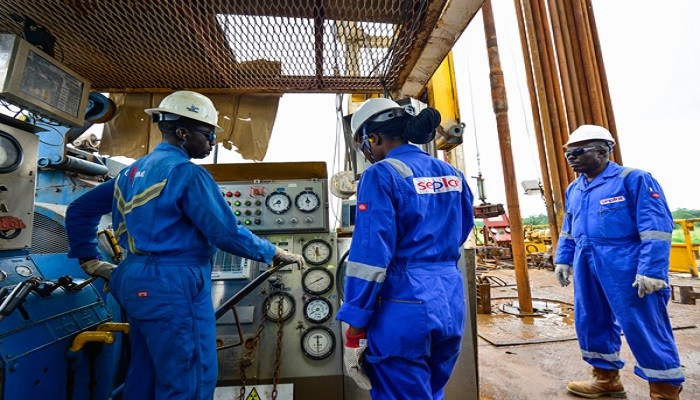
Seplat Energy Plc has unveiled a bold dividend framework anchored on a progressive policy that guarantees shareholders at least $120 million (N179 billion) annually, signaling confidence in its post-acquisition growth strategy despite the tough economic climate in Nigeria’s energy sector.
The commitment, announced at the company’s Capital Markets Day on September 18, 2025, is underpinned by projections following its takeover of Mobil Producing Nigeria Unlimited — now renamed Seplat Energy Producing Nigeria Unlimited (SEPNU). Management expects the new policy to deliver a cumulative $1 billion in dividends over the next five years, with the guaranteed $120 million payout serving as a minimum baseline.
As part of the rollout, Seplat increased its Q3 2025 dividend to 5.0 cents per share, up from 4.6 cents in Q1 and Q2, establishing a new benchmark for quarterly payouts. Between 2026 and 2030, the framework will return 40–50% of annual free cash flow to shareholders.
Register for Tekedia Mini-MBA edition 20 (June 8 – Sept 5, 2026).
Register for Tekedia AI in Business Masterclass.
Join Tekedia Capital Syndicate and co-invest in great global startups.
Register for Tekedia AI Lab.
Strong cash flow outlook despite profit drop
Seplat’s confidence in sustaining these dividends is supported by a marked improvement in financial performance. The company generated $486.9 million in operating cash flow in H1 2025, nearly 60% higher than its full-year 2024 figure. Over the last five years, Seplat has delivered $1.037 billion in free cash flow from $1.9 billion in total operating cash flow.
However, profitability has softened. Profit attributable to shareholders fell to $23.6 million in H1 2025, translating to earnings per share of $0.04 (N62.19), compared with $0.07 in H1 2024. Retained earnings also dropped by 21%, standing at N250.7 billion against N319 billion in December 2024.
Growth plan to 2030
Seplat outlined an ambitious five-year roadmap designed to support both shareholder returns and long-term expansion. Its goals include:

- Raising working interest production to around 200,000 boepd by 2030, from H1 2025 levels.
- Generating $5–6 billion in operating cash flow over five years.
- Committing $2.5–3 billion in capex, spanning 120–150 new wells and multiple gas projects.
- Driving down operating costs from $12.5/boe to $10/boe.
- Maintaining net leverage between 0.5x and 1.5x, provided oil prices remain above $50 per barrel.
- Roger Brown, Seplat’s CEO, said the company’s trajectory since listing underscored its ability to deliver on promises.
“Since our IPO in 2014, we have grown reserves and production fourfold while returning more than $700 million in dividends. Our roadmap to 2030 is focused on materially growing production, cash flow, and shareholder returns,” he said.
NNPC stake discussions
Seplat also disclosed ongoing discussions with the Nigerian National Petroleum Company Limited (NNPC) over a potential sale of a 10% interest in the SEPNU joint venture. If completed, Seplat’s equity stake would reduce to 30%, though it would retain operatorship. The company emphasized that its dividend policy would not be impacted by the talks.
Operating amid Nigeria’s economic headwinds
Seplat’s strategy comes at a time when Nigeria’s energy sector is struggling with multiple headwinds, from oil theft and pipeline vandalism to foreign exchange shortages, subsidy removal impacts, and delayed reforms in the petroleum industry.

However, the company has managed to sustain operations and grow production, positioning itself as Nigeria’s leading indigenous energy company. While multinationals like ExxonMobil, Shell, and TotalEnergies have been scaling back or divesting onshore assets due to insecurity and community unrest, Seplat has expanded by acquiring assets and investing in local capacity.
Gas, in particular, has become a growth engine. Seplat is investing heavily in gas processing infrastructure to meet Nigeria’s rising domestic demand for electricity and industrial energy. Gas projects under its capex plan are designed not only to diversify revenues but also to reduce exposure to the volatility of global oil markets.
Energy analysts say this focus aligns with Nigeria’s broader energy transition plans. With international oil companies exiting onshore operations, indigenous firms like Seplat are expected to play a greater role in sustaining Nigeria’s production and bridging investment gaps in oil and gas.
Despite a consistent dividend record and the upgraded outlook, Seplat’s stock performance has lagged. The share price closed last week at N5,379.30, showing a year-to-date decline and little movement since mid-August. Analysts suggest the market could soon reprice the stock as Seplat’s new strategy and dividend commitments begin to resonate with investors.