

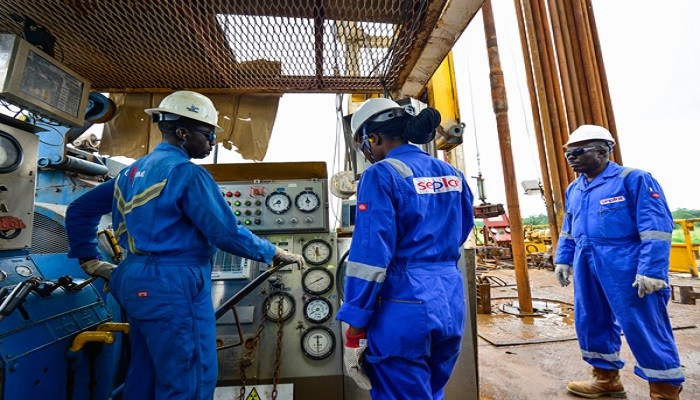
Seplat Energy Plc, Nigeria’s foremost indigenous energy company listed on the Nigerian Exchange and London Stock Exchange, has posted a blockbuster unaudited financial result for the six months ended June 30, 2025.
The company’s revenue rose sharply to N2.167 trillion, a nearly 277% surge from N575.1 billion recorded in the same period last year, reflecting strong production growth, strategic offshore expansion, and disciplined cost management.
The energy giant’s gross profit tripled year-on-year to N751.2 billion from N247.5 billion, while operating profit rose to N601.2 billion, up from N285.2 billion. Cash generated from operations hit N1.188 trillion, almost quadrupling from N308.2 billion in the prior year period. These figures underscore Seplat’s sharp financial and operational turnaround, boosted by its expanded offshore footprint and rising gas infrastructure investments.
Register for Tekedia Mini-MBA edition 20 (June 8 – Sept 5, 2026).
Register for Tekedia AI in Business Masterclass.
Join Tekedia Capital Syndicate and co-invest in great global startups.
Register for Tekedia AI Lab.
Seplat’s earnings before interest, taxes, depreciation, and amortization (EBITDA) climbed to N1.139 trillion, up from N364.5 billion — a 212.4% jump — affirming strong operating efficiency.
Soaring Production Output
Seplat’s performance was anchored by a 178% surge in production, reaching an average of 134,492 barrels of oil equivalent per day (boepd). This is well above its 2025 guidance midpoint of 130,000 boepd and includes 100,327 barrels per day of working interest crude oil output.
Onshore assets contributed 54,831 boepd, 13% higher than H1 2024, while offshore production rose sharply to 79,660 boepd, aided by the restoration of 29 idle wells, which added nearly 26,000 barrels per day of gross production capacity. Offshore production was dominated by crude and condensate (86%), alongside NGLs (5%) and gas (9%).

The company recorded over 15.3 million man-hours without a Lost Time Injury (LTI) on its operated assets, reinforcing Seplat’s commitment to safety. It also reported reduced carbon intensity across onshore assets, down to 26.7 kg CO?/boe, from 31.4 kg CO?/boe, aligning with its target of ending routine flaring by the end of 2025.
The ANOH gas plant, a key infrastructure project, received dry gas in July and has begun hydrocarbon commissioning, indicating another step in Seplat’s strategic shift toward cleaner energy sources.
Balance Sheet Strength and Upgraded Ratings
In dollar terms, Seplat’s revenue for H1 2025 stood at $1.398 billion, a 231% rise from $422 million in the same period last year. Adjusted EBITDA was $735 million, while cash from operations hit $766.2 million.

Despite increased investment, capital expenditure dropped slightly to $96.5 million, down from $102.4 million. Net debt fell to $676 million, improving leverage ratios to 0.53x EBITDA. The company also repaid $100 million in debt post-period and now has full access to its $350 million revolving credit facility.
Buoyed by its financial strength, Fitch upgraded Seplat’s rating to B in April, followed by Moody’s assigning a B2 (stable) rating in June.
Dividend and Capital Outlook
Seplat declared a Q2 2025 dividend of 4.6 cents per share, in line with the previous quarter. The company plans to unveil a new capital allocation policy at its upcoming Capital Markets Day on September 18, 2025, where it will detail its medium- and long-term growth plans.
Seplat’s resurgence signals that energy, too, is undergoing a revaluation, driven not just by oil but increasingly by gas. With upstream expansion, improved production efficiency, and focused investments in gas infrastructure, Nigeria’s energy space is emerging as a dynamic, cash-generating frontier once again — a development that strengthens the argument for resource-based economic diversification.
For the rest of 2025, Seplat has reaffirmed its guidance:
- Production: 120,000–140,000 boepd
- Capex: $260–320 million
- Unit costs: $14–15/boe
According to CEO Roger Brown, the company’s strategy is delivering beyond expectations:?“Seplat has continued its positive trajectory in Q2 to deliver a strong performance for the first half of 2025. Our focus on integrity, reliability, and production improvement activities is bearing fruit as evidenced by strong production in 2Q 2025, with onshore in the upper end of guidance, and offshore production growing 11% quarter on quarter.
“The Company delivered first half production over 10% higher than the pro forma output in the same period last year, delivering on both our ambitions and supporting Nigeria’s goals of oil and gas production growth.”
He further assured, “We are well placed to weather the recent increase in macro volatility. Strong revenues and a focus on costs delivered significant positive cash flows, enabling us to further reduce net leverage, continue our strong quarterly dividend track record, and, in the past week, pay down an additional $100 million of debt.
“We have hit the ground running in 2025, building a strong foundation with which to deliver on our 2025 performance targets. Integration of the enlarged group continues at pace, and we look forward to sharing our exciting plans for the Company when we set out the future of our business at the upcoming Capital Markets Day in September.”
Analysts believe that Seplat’s strong financials, increasing offshore output, improved safety profile, and gas-focused transition strategy may very well position the company as the anchor for Nigeria’s new energy economy.