

The AI boom has turned memory manufacturers into some of the biggest beneficiaries of the semiconductor industry, with SK hynix emerging as perhaps its largest winner and its shares becoming one of the top stock gainers. However, the company’s latest quarterly report highlighted a key important feature of today’s stock market: even record-breaking financial results may not be enough if they fail to surpass investors’ already lofty expectations.
In the second quarter, SK hynix reported revenue of $54.55 billion, up 257% year over year, while operating profit increased by an impressive 557%, reaching a record $41.6 billion. For the first half of the year, the company’s operating profit exceeded the equivalent of $69 billion for the first time in its history.
Nevertheless, both figures were below analysts’ consensus estimates, disappointing the market and weighing on global semiconductor stocks. Qualcomm shares fell by about 3%, while Nvidia stock declined by a similar percentage, and AMD lost around 6%. Micron Technology also experienced a decline before rebounding sharply.
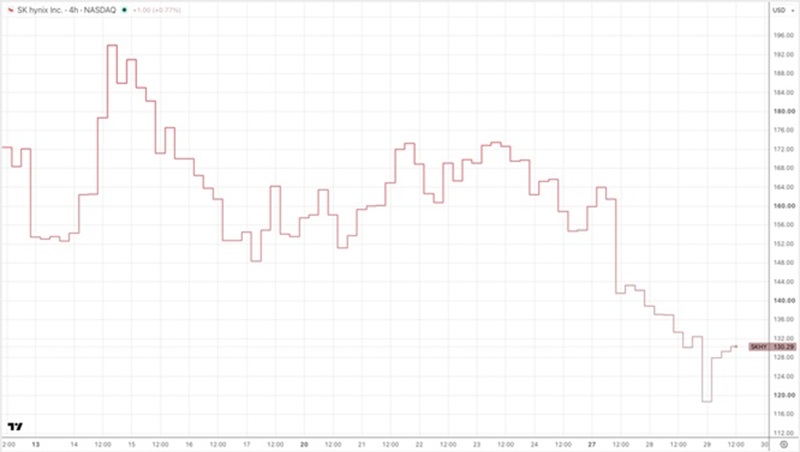
This reaction perfectly illustrates the current situation in the AI sector. Memory manufacturers’ stocks have grown significantly over the past two years, driven by the rapid adoption of Nvidia accelerators and explosive demand for HBM memory. As a result, investors began pricing in an almost ideal growth scenario, in which companies should not only deliver record results, but also constantly outperform increasingly ambitious analyst forecasts.
At the same time, SK hynix’s fundamental position remains exceptionally strong. The company has already started mass deliveries of HBM4 memory, plans to increase production volumes in the second half of the year, and has also begun shipping the first samples of the next generation HBM4E. Meanwhile, the company continues upgrading its NAND production lines. By the end of the year, 321-layer memory is expected to account for about half of the company’s total output.
Long-term contracts provide additional stability to the business. SK hynix has already signed around ten multi-year agreements to supply memory to its largest customers and continues negotiations with new ones. Such contracts help memory manufacturers reduce their dependence on the traditional cyclical nature of the industry, which has remained one of the main challenges of the DRAM market for decades.
The company’s balance sheet remains equally strong. By the end of the quarter, cash holdings exceeded $60 billion, while capital expenditures this year will reach $27.5 billion. These investments are aimed at building new facilities and further expanding production capacity, as management expects to maintain leadership in the most profitable segments of the memory market.
At the same time, the company is actively preparing for the next technological cycle. In the second half of the year, SK hynix plans to begin mass production of LPDDR6 memory for smartphones, laptops, and AI-enabled devices. The new memory generation will deliver roughly one-third higher bandwidth than LPDDR5X, while improving energy efficiency by more than 20% thanks to enhanced power management. As AI increasingly moves onto consumer devices, demand for such solutions could become another growth driver.
The market situation shows that memory prices remain high even despite China’s attempts to increase competition. Chinese manufacturer CXMT continues to expand DRAM production with government backing, yet memory modules based on its chips are priced similarly to, and in some cases even above, comparable products from Samsung and SK hynix. This suggests that pricing is driven less by production costs than by the persistent shortage of advanced memory chips and the industry’s limited production capacity.
As a result, the memory market remains one of the most attractive segments of the semiconductor industry, while simultaneously becoming increasingly demanding of its leaders. SK hynix continues to deliver record growth, actively invest in new technologies, and expand production, yet even that is no longer enough to satisfy investors. In today’s AI-driven market, companies are competing not only against rivals, but also against the market’s own high expectations.