

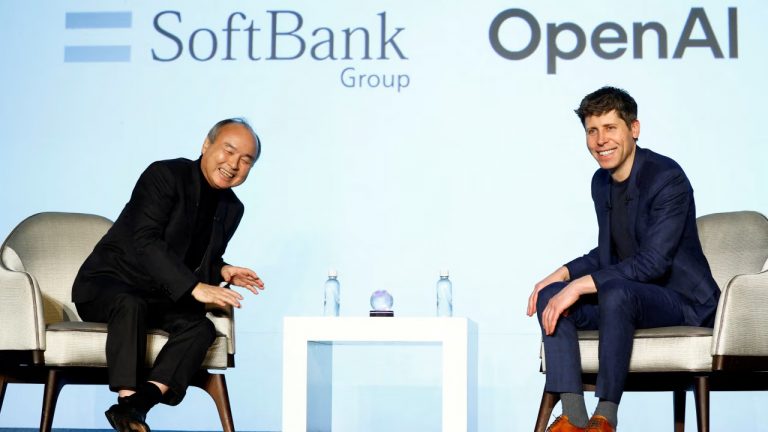
SoftBank Group Corp. is in advanced discussions with banks to secure a bridge loan of up to $40 billion, primarily to finance its deepening investment in OpenAI, according to a Bloomberg News report, citing people familiar with the matter.
The facility, which would mark SoftBank’s largest-ever borrowing denominated solely in U.S. dollars, is structured with a 12-month tenor and is being underwritten by four lenders, including JPMorgan Chase & Co. Talks remain ongoing, and terms could still evolve, the report noted. The loan comes on the heels of SoftBank’s completion of a $41 billion investment in OpenAI, finalized in December 2025, which has positioned the Japanese conglomerate as the AI startup’s largest financial backer with an approximately 11% ownership stake.
The commitment was first announced in March 2025, when SoftBank agreed to invest up to $40 billion in a for-profit subsidiary of OpenAI, structured as a combination of direct capital from SoftBank Vision Fund 2 (SVF2) and syndicated co-investments from third-party participants. The funding was executed in two closings. The first, in April 2025, involved $7.5 billion through SVF2. The second closing, completed December 26, 2025, added $22.5 billion from SVF2, plus an oversubscribed $11 billion from co-investors, bringing the total to $41 billion.
Register for Tekedia Mini-MBA edition 20 (June 8 – Sept 5, 2026).
Register for Tekedia AI in Business Masterclass.
Join Tekedia Capital Syndicate and co-invest in great global startups.
Register for Tekedia AI Lab.
This exceeded the initial $40 billion pledge, reflecting strong external demand and SoftBank’s confidence in OpenAI’s trajectory. SoftBank CEO Masayoshi Son has described the OpenAI bet as central to his “all-in” strategy on artificial intelligence, viewing the company as a linchpin in the emerging “Intelligence Revolution.” The investment aligns with Son’s long-term vision of AI as a transformative force, building on SoftBank’s earlier stakes in Arm Holdings (ARM), Alibaba (BABA), and other tech giants.
OpenAI’s latest funding round valued the company at $840 billion post-money, a figure that could climb to $1 trillion in an anticipated initial public offering (IPO) later in 2026, according to Reuters reporting from 2025. To fund the first tranche of the OpenAI investment, SoftBank reportedly relied on an $8 billion bridge loan, as it lacked sufficient cash on hand at the time.
Sources indicate the company may draw on up to $11.5 billion in undrawn margin loans backed by its stake in Arm Holdings to cover portions of the remaining commitment. This reliance on leverage has raised some investor concerns, with SoftBank’s credit default swaps (CDS) spreads widening in recent months amid broader market volatility in AI-related assets.

S&P Global Ratings has warned that SoftBank’s increasing leverage and concentration of assets around OpenAI could pressure liquidity metrics and credit spreads if market conditions deteriorate. The company’s debt-to-equity ratio has climbed in recent quarters, driven by aggressive AI bets, though strong performance from Arm (whose shares have risen 65% since its 2023 IPO) has provided a buffer.
Analysts at Jefferies noted in a February 2026 report that SoftBank’s finances remain “manageable” but emphasized the need for disciplined capital allocation to avoid overextension.
OpenAI’s IPO preparations are well underway, with the company raising $110 billion in its latest round from investors including SoftBank ($30 billion), Nvidia ($30 billion), and Amazon ($50 billion). The funds are earmarked for expanding AI research, data center infrastructure, and global operations. Reuters reported in January 2026 that OpenAI is targeting a $1 trillion valuation for its public debut, which would make it one of the most valuable listings in history, surpassing Saudi Aramco’s 2019 IPO.

SoftBank’s $41 billion stake, now valued at over $90 billion based on OpenAI’s latest post-money valuation, represents a substantial unrealized gain, underscoring the success of Son’s AI pivot after earlier Vision Fund setbacks. The bridge loan would provide immediate liquidity to fulfill commitments without liquidating other holdings, such as Arm shares, which Son has described as “core” to SoftBank’s portfolio.
The investment, however, has met some controversy. In 2025, MIT Sloan professor Michael Cusumano characterized Nvidia’s parallel $30 billion commitment as “kind of a wash,” noting the circular nature of AI investments where chipmakers fund model developers who, in turn, purchase massive volumes of GPUs. SoftBank’s loan-backed approach adds another layer of financial engineering to this ecosystem, potentially amplifying returns but also risks if AI adoption slows or valuations correct.
Market reaction to the Bloomberg report was muted Tuesday, with SoftBank shares dipping modestly in Tokyo trading amid broader Asia-Pacific weakness driven by Middle East tensions. Investors appear focused on SoftBank’s ability to manage leverage while capitalizing on OpenAI’s growth — especially with the IPO on the horizon.
The $40 billion facility, if completed, would yield the unprecedented scale of capital required to fuel the AI boom, and it underlines SoftBank’s willingness to leverage its balance sheet aggressively. It also highlights the symbiotic relationship between infrastructure providers like Nvidia and model builders like OpenAI, with SoftBank acting as a key financier, bridging the two.