

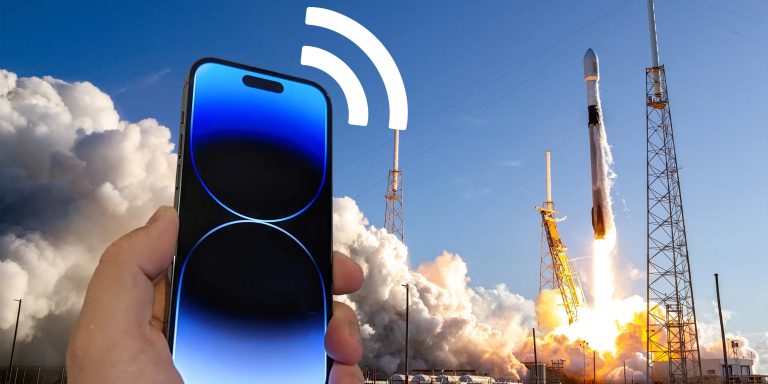
Elon Musk’s latest ambition could redefine the future of global communications. Reports that SpaceX has committed nearly $17 billion toward advancing direct-to-cell satellite technology have sparked intense discussions across the telecommunications industry.
The vision is simple yet revolutionary: enabling ordinary smartphones to connect directly to satellites in orbit, eliminating dependence on traditional ground-based cellular infrastructure.
Speaking about the initiative, Musk stated that the technology “will allow SpaceX to deliver high bandwidth connectivity directly from the satellites to the phones.” If fully realized at scale, this innovation could fundamentally reshape how humanity accesses the internet and mobile services.
For more than a century, the expansion of communication networks has followed a familiar blueprint. Governments and private companies built towers, laid fiber-optic cables, and expanded coverage incrementally from one geographic location to another.
Register for the next Tekedia Mini-MBA.
Register for Tekedia AI in Business Masterclass.
Join Tekedia Capital Syndicate and co-invest in great global startups.
The model transformed societies, enabling the rise of the digital economy, e-commerce, social media, and global information exchange. Yet despite massive investments, billions of people around the world still experience unreliable connectivity or remain entirely offline.
Remote villages, deserts, mountain regions, oceans, and disaster-stricken areas often suffer from weak or nonexistent network coverage because constructing terrestrial infrastructure in such locations is expensive and logistically challenging.
This has created a persistent digital divide, leaving many communities excluded from opportunities in education, healthcare, finance, and commerce. SpaceX’s direct-to-cell initiative seeks to address this problem from an entirely different perspective.

Instead of expanding communication networks from the ground upward, the company is attempting to build them from space downward. By deploying advanced satellites equipped with cellular capabilities, smartphones could potentially receive signals directly from orbit without requiring dedicated satellite dishes or specialized hardware.
The implications are enormous. Emergency communication could become dramatically more resilient.
During hurricanes, earthquakes, wars, or infrastructure failures, terrestrial towers are often among the first systems to collapse. A satellite-based network would remain largely unaffected by events on the ground, providing a critical lifeline for affected populations.
Direct satellite connectivity could eventually eliminate many coverage dead zones that plague existing mobile networks. Travelers crossing oceans, hikers in remote wilderness areas, and residents of isolated communities may gain continuous access to messaging, internet services, and emergency communications regardless of their location.

The technology also presents significant economic consequences for the telecommunications industry. Traditional telecom companies have invested hundreds of billions of dollars into building and maintaining cellular towers, fiber networks, and related infrastructure.
If satellite-based communication becomes sufficiently affordable and scalable, it could challenge the long-standing business model that has defined the industry for decades.
Delivering high-bandwidth internet directly from satellites to standard smartphones is an engineering challenge of extraordinary complexity.
Issues related to spectrum allocation, latency, satellite capacity, regulatory approvals, and international cooperation must all be addressed before the vision can be fully realized. Moreover, cellular towers are unlikely to disappear overnight.
Urban environments with dense populations still require massive data capacity that terrestrial infrastructure currently handles more efficiently. Instead, the immediate future may involve a hybrid model in which satellite networks complement traditional telecommunications systems, extending coverage where ground infrastructure is limited or unavailable.
The broader significance of SpaceX’s initiative cannot be understated. It represents a shift in thinking about connectivity itself. For generations, humanity built communication networks by conquering geography one tower at a time. Musk’s approach seeks to bypass geography altogether.
If successful, direct-to-cell satellite communication could mark the beginning of a new era in which access to information is no longer determined by physical infrastructure on Earth, but by constellations of satellites orbiting above it. In doing so, SpaceX may not merely improve global connectivity—it could fundamentally redefine it.