

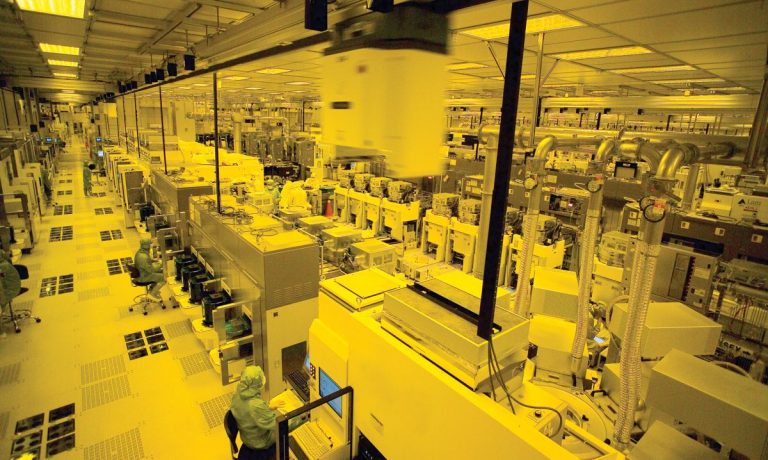
Taiwan’s United Microelectronics Corporation (UMC) has begun mass production of silicon photonics wafers at its manufacturing facility in Singapore, marking a significant step in the race to build the next generation of AI infrastructure as demand for faster and more energy-efficient data transmission accelerates.
The company, Taiwan’s second-largest contract chipmaker after TSMC, said Tuesday that the wafers are designed to meet surging demand for high-speed optical interconnects used in artificial intelligence clusters and hyperscale data centers, where the rapid movement of data has become as critical as computing power itself.
The milestone puts UMC in the position to participate in one of the semiconductor industry’s fastest-growing segments, as AI companies invest hundreds of billions of dollars in expanding data centers capable of training and running sophisticated models.
Register for the next Tekedia Mini-MBA.
Register for Tekedia AI in Business Masterclass.
Join Tekedia Capital Syndicate and co-invest in great global startups.
UMC said it worked with Singapore-based fabless semiconductor company SILITH Technology to move the silicon photonics platform from development to production in just 18 months, highlighting the industry’s urgency to commercialize technologies capable of addressing AI’s growing bandwidth bottlenecks.
The company also announced plans to make its proprietary 12-inch silicon photonics manufacturing platform available to customers by 2027, allowing chip designers to develop customized products using its fabrication process.
The announcement underlines how innovation in the semiconductor industry is increasingly focused not only on producing faster processors but also on improving how those processors communicate with one another.

As AI models continue to grow in size, traditional electrical connections between processors are becoming a major constraint on performance. Silicon photonics replaces conventional electrical signals with optical signals transmitted through light, enabling significantly faster data transfer while consuming less power and generating less heat.
The technology is becoming increasingly important for AI training clusters that can contain hundreds of thousands of GPUs operating simultaneously.
Without faster interconnect technologies, many of the performance gains delivered by next-generation AI chips risk being limited by the speed at which data can move between processors, storage systems and networking equipment.

That has made silicon photonics one of the semiconductor industry’s highest-priority technologies alongside advanced chip packaging and high-bandwidth memory.
Market researchers at Polaris Market Research estimate the global silicon photonics market will reach approximately $3.71 billion in 2026, supported by rapid growth in AI computing, cloud infrastructure, telecommunications and high-performance computing.
UMC’s investment also reinforces Singapore’s growing role as a strategic manufacturing base within the global semiconductor supply chain. The city-state has become an increasingly attractive location for advanced chip manufacturing thanks to its political stability, strong intellectual property protections, skilled workforce, and proximity to major Asian electronics supply chains.
The expansion comes as global semiconductor companies seek to diversify manufacturing footprints beyond traditional production centers amid rising geopolitical tensions and supply-chain disruptions.
Several major Taiwanese semiconductor firms have expanded operations in Singapore in recent years.
King Yuan Electronics has increased its presence in the country, while Vanguard International Semiconductor, backed by TSMC, recently partnered with Dutch chipmaker NXP Semiconductors to build a $7.8 billion wafer fabrication plant there.
The clustering of semiconductor manufacturers, suppliers, and design firms is gradually strengthening Singapore’s position as one of Asia’s most important chip production hubs outside Taiwan.
UMC’s manufacturing milestone comes as the company enjoys improving business conditions. Citi analysts recently upgraded their outlook for the second half of 2026, forecasting a 13% quarter-on-quarter increase in second-quarter revenue alongside a recovery in gross margins as semiconductor demand strengthens.
Recent operating results also point to improving momentum. UMC reported June revenue of NT$23.12 billion ($719.2 million), up 22.85% from a year earlier, while cumulative revenue for the first six months of the year increased 11.28%.
Despite the positive developments, UMC shares fell nearly 5% during Tuesday’s trading session in Taiwan before recovering part of the decline to close about 1.6% lower, suggesting investors may have been taking profits following recent gains or reacting to broader weakness across semiconductor stocks.
UMC’s latest investment shows that the AI boom is expanding opportunities well beyond companies that manufacture processors, with the race moving beyond chips to connectivity.
As hyperscalers, including Microsoft, Amazon, Meta and Google, continue investing heavily in AI infrastructure, demand is rising across the semiconductor ecosystem, from memory chips and advanced packaging to networking equipment and optical communications.
Analysts note that the industry’s next phase of growth will depend on technologies that allow vast numbers of AI processors to operate together efficiently. In that environment, silicon photonics is emerging as a foundational technology rather than a niche application, positioning manufacturers such as UMC to benefit from one of the fastest-growing areas of AI infrastructure.