

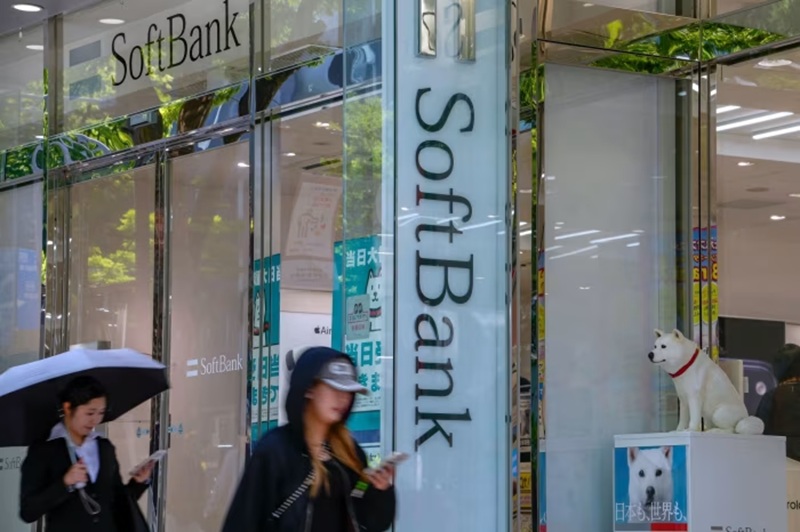
SoftBank Group Chief Executive Masayoshi Son has delivered one of his boldest forecasts yet on the future of artificial intelligence, noting that global investment in AI infrastructure will reach an unprecedented $5 trillion annually by 2040.
He also dismissed concerns about an AI bubble as a fundamental misunderstanding of the technology’s transformative potential.
The projection underscores the extraordinary scale of spending that leading technology companies believe will be required to build the computing infrastructure needed for advanced AI systems. Global technology firms are already committing hundreds of billions of dollars to AI data centers, semiconductors, power generation and networking equipment, fueling one of the largest capital expenditure cycles in modern technology history.
Register for the next Tekedia Mini-MBA.
Register for Tekedia AI in Business Masterclass.
Join Tekedia Capital Syndicate and co-invest in great global startups.
Speaking at SoftBank’s annual corporate conference in Tokyo on Tuesday, Son said annual AI investment would eventually reach 800 trillion yen ($5 trillion), arguing that the spending would be economically justified by AI’s contribution to the global economy.
“Every year $5 trillion, or 800 trillion yen, you might think that’s a lie, but I am confident that’s what it will cost,” Son said.
He predicted that by 2040, artificial intelligence could account for around 20% of global gross domestic product, making an annual investment of $5 trillion relatively insignificant in comparison.

“The business model will be viable because by 2040, if AI revenue makes up 20% of global GDP, spending 800 trillion yen a year is a rounding error,” Son said.
Son did not explain how SoftBank arrived at either the $5 trillion investment estimate or the projection that AI could generate one-fifth of global economic output.
A Forecast That Dwarfs Today’s AI Spending
Son’s projection indicates just how aggressively some technology leaders expect AI infrastructure spending to expand over the next 15 years.

Today, the world’s largest technology companies, including Microsoft, Amazon, Alphabet, Meta, and OpenAI, are already spending hundreds of billions of dollars annually building AI infrastructure. Industry estimates suggest hyperscale AI capital expenditure is expected to exceed $600 billion in 2026, meaning Son’s forecast implies annual investment would increase more than eightfold by 2040.
The spending would encompass far more than semiconductors. It would include AI data centers, networking equipment, advanced memory chips, specialized processors, robotics, electricity generation, cooling infrastructure and next-generation communications networks.
Recent developments across the industry support the broader trend of rapidly rising AI infrastructure investment. Memory manufacturers, including SK Hynix and Samsung Electronics, have warned that demand continues to outpace supply, while companies such as TSMC are expanding advanced chip packaging capacity to meet orders from AI chip designers like Nvidia.
At the same time, governments are becoming increasingly involved in AI infrastructure planning. New York recently became the first U.S. state to impose a temporary moratorium on large new data centers because of concerns over electricity demand, water consumption and environmental impacts, highlighting that power availability is emerging as one of the industry’s biggest constraints.
Son Rejects AI Bubble Concerns
Son also forcefully dismissed growing concerns that AI investment resembles previous technology bubbles.
“Asking if AI is a bubble is absurd. I don’t think people who ask that question know what AI is about,” he said.
His remarks come as investors increasingly question whether technology companies can generate sufficient returns to justify their unprecedented AI spending.
Several factors have fueled that debate in recent months. Semiconductor stocks have experienced sharp volatility as investors reassess the pace of AI infrastructure expansion, while concerns have emerged that some hyperscale cloud providers could eventually moderate capital expenditure after years of aggressive investment.
Questions have also been raised about whether enterprises are adopting AI applications quickly enough to generate the revenue needed to support massive infrastructure investments.
Son, however, argued that AI represents a fundamental technological transformation rather than a speculative investment cycle.
SoftBank Doubles Down On OpenAI
The speech supports SoftBank’s strategic shift toward artificial intelligence over the past two years. After rebuilding its balance sheet following losses linked to the Vision Fund portfolio, SoftBank has embarked on one of the industry’s most aggressive AI investment strategies.
The company’s highest-conviction investment is OpenAI.
Son said SoftBank’s cumulative investment in the ChatGPT developer is expected to exceed $60 billion before the end of 2026, making it one of the largest financial backers of the AI company as OpenAI expands its enterprise products, AI agents and computing infrastructure.
Beyond OpenAI, SoftBank has committed capital to robotics companies and AI infrastructure while participating in financing large-scale data center development. The strategy mirrors Son’s long-standing investment philosophy of identifying technologies he believes will reshape entire industries, an approach that previously produced one of the most successful venture investments in history through SoftBank’s early backing of Alibaba.
However, Son’s track record has also included notable setbacks, including SoftBank’s investment in WeWork, whose collapse became one of the highest-profile failures of the Vision Fund era.
Power Becomes The Next AI Bottleneck
One of the most striking elements of Son’s forecast centered on electricity demand. He predicted AI data centers would require 3 terawatts of generating capacity by 2040, equivalent to roughly 1.8 times current global electricity consumption.
The estimate lends credence to the argument that energy is rapidly becoming one of the industry’s biggest challenges.
Data centers already account for a growing share of electricity demand worldwide, with some forecasts suggesting they could consume around 11% of U.S. electricity by the end of the decade. Utilities, regulators, and governments are increasingly warning that existing grids cannot support the pace of AI expansion without major investments in new generation and transmission infrastructure.
Son said natural gas would likely serve as the primary energy source during the early stages of AI expansion before nuclear fusion eventually becomes commercially viable.
“This will initially be powered primarily by gas before nuclear fusion becomes the main energy source,” he said.
Weighing In On Musk’s Space Power Vision
Son also addressed Elon Musk’s proposal to power AI infrastructure using space-based solar energy.
“Will we use solar power in space as Elon Musk says? Maybe we will use both, but if you ask me fusion on earth will be the cheaper, cleaner energy source,” he said.
The comments are notable because they acknowledge that technology leaders are increasingly exploring unconventional solutions to AI’s growing energy demands.
Musk has argued that future AI infrastructure may rely on orbital solar power and eventually space-based data centers, leveraging SpaceX’s launch capabilities and satellite network. The concept has gained greater attention as governments begin imposing restrictions on terrestrial data center construction due to electricity constraints.
While Son expressed greater confidence in terrestrial nuclear fusion, his willingness to discuss space-based energy highlights how seriously industry leaders now view AI’s long-term power requirements.
Vision of An AI-Driven Economy
Son concluded by outlining an ambitious vision for society in 2040, one in which autonomous AI agents become the dominant participants in the digital economy.
He predicted there would be 100 trillion AI agents capable of making independent decisions, carrying out tasks, and communicating autonomously with one another.
“We will go from a human-centric world to an agent-centric world,” Son said.
“The age when humans are the highest life form on earth will end. For better or for worse, it will happen and it can’t be stopped.”
The remarks align with a broader industry shift toward “agentic AI,” with companies including OpenAI, Anthropic, Google and Microsoft increasingly focusing on autonomous AI systems capable of completing complex tasks with minimal human oversight.