


Exposing the structural shift from data extraction to trust economics in the modern digital enterprise
For over two decades, the modern consumer internet operated primarily under the economic doctrine of Surveillance Capitalism, a term popularized by Harvard professor Shoshana Zuboff. Under this paradigm, user behavior, personal telemetry, and private communications were routinely extracted, synthesized, and monetized without explicit, granular consent. Digital services were provided under the illusion of being “free,” while the true product was the behavioral modification of consumers driven by hyper-targeted advertising networks.
However, a structural breaking point has arrived. Consumers across the United States and globally are experiencing acute “Privacy Fatigue.” Driven by continuous, high-profile corporate data breaches, persistent cross-site tracking, intrusive third-party cookie monitoring, and identity theft risks, user sentiment has shifted from passive acceptance to active resistance.
In response, Trust Economics has emerged as a fundamental competitive moat. Modern consumers increasingly view privacy not as a mere legal compliance check or peripheral feature, but as a core product requirement. Companies prioritizing data sovereignty, zero-knowledge storage, and identity protection are successfully converting privacy into a lucrative, high-margin business strategy.
Privacy-Conscious Entertainment and Micro-Transactions
As global regulatory frameworks tighten and consumer awareness reaches maturity, the demand for identity preservation has expanded well beyond basic search engines and messaging tools into broader online entertainment ecosystems. Modern users are growing hesitant to hand over passport scans, utility bills, and social security numbers simply to access basic digital media, gaming, or micro-transaction services.
This shift is particularly evident in modern digital gaming and entertainment platforms. A quick look at industry benchmarks highlights how the best No KYC casinos leverage instant non-custodial wallet integration to let users interact online without submitting sensitive personal documents or identity records.
| Platform Archetype | Traditional Model | Privacy-First Model | Primary Business Benefit |
| Digital Gaming & Media | Mandatory KYC / Document Scans | Instant Non-Custodial Wallet Connect | Zero Identity Storage Risk, Minimal Friction |
| Messaging & Telecom | Phone Number / Identity Binding | Anonymous Identifiers / Sealed Sender | High-Retention Power Users |
| Web Browsing & Search | Third-Party Cookie Profiles | Contextual Ad Networks & Local Tokenization | Zero Liability for Cross-Site Breaches |
| Cloud Storage | Server-Side Data Indexing | Client-Side Zero-Knowledge Encryption | Reduced Infrastructure Security Overhead |
By shifting from centralized identity verification to decentralized, cryptographic validation, consumer platforms eliminate payment friction while establishing a new standard for operating micro-transaction systems without data exposure risks.
Core Technical Foundations: Zero-Knowledge Architecture & Cryptography
Building a viable business around digital anonymity requires a departure from traditional client-server architecture. The modern privacy-first tech stack rests on key cryptographic innovations:
Zero-Knowledge Architecture
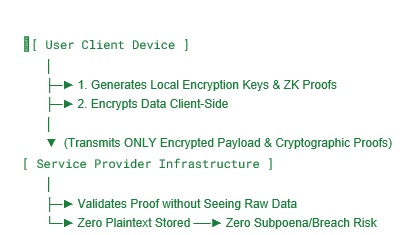
Systems are designed so that the service provider operates merely as a blind pipeline. In a Zero-Knowledge Architecture, data is encrypted on the client device prior to transmission. Consequently, even if a server cluster is fully compromised or subpoenaed by legal authorities, the service provider possesses zero access to plaintext user data.
Zero-Knowledge Proofs (ZKPs)
ZKPs enable one party to cryptographically prove to another that a statement is true without revealing any information beyond the statement’s validity. For instance, a user can prove they are over 21 years of age or possess sufficient balance for a transaction without revealing their exact birth date or total financial net worth.
?Decentralized & Self-Sovereign Identity (SSI)
SSI models leverage decentralized identifiers (DIDs) to return identity control to the individual. Rather than relying on centralized Single Sign-On (SSO) providers that track login histories across the web, users store verified credentials inside localized digital wallets.
Defense-in-Depth Identity Safeguards
- End-to-End Encryption (E2EE): Guarantees that only the communicating endpoints can decrypt payloads.
- Metadata Protection: Implements techniques like sealed senders and traffic padding to prevent third parties from deducing identity through transmission timing or packet sizes.
- Fingerprinting Protection: Neutralizes complex tracking techniques such as Canvas Fingerprinting, Audio Context Analysis, and IP-based geolocation profiling.
Case Studies: Platforms Leading the Privacy Revolution
Several digital platforms have proven that building products around strict data minimization can yield massive market valuations and loyal user bases.

?Productivity & Email: Proton
Switzerland-based Proton (encompassing ProtonMail, Proton Drive, Proton Calendar, and Proton Pass) has scaled to tens of millions of users. By enforcing end-to-end client-side encryption, Proton created a comprehensive alternative to enterprise productivity suites while proving that users are willing to pay a premium subscription fee for private cloud infrastructure.
Web Browsing & Search: DuckDuckGo and Brave Browser
As third-party cookies face widespread deprecation, alternative web portals have surged in popularity. DuckDuckGo delivers private search results without tracking query histories. Concurrently, Brave Browser blocks third-party trackers by default and replaces invasive tracking ads with an opt-in, privacy-preserving micro-reward ecosystem built on localized tokenomics.
Encrypted Messaging: Signal Messenger
Signal serves as the gold standard for secure communication, utilizing an open-source cryptographic protocol adopted by messaging giants worldwide. Signal operates under strict data minimization, holding zero metadata regarding who users speak to, when messages are sent, or what content is transmitted.
Anonymous Networks & VPNs: Tor Project & Logless VPN Providers
Network-level anonymity tools have transitioned from niche technical software to mainstream consumer staples. While the Tor Project utilizes multi-layered onion routing to obscure traffic origin, commercial VPN providers like Mullvad and IVPN have eliminated traditional user accounts altogether, allowing customers to generate random account numbers and pay via cash or privacy-focused digital currencies.
Sustainable Business Models: Monetization Beyond Data Extraction
A common myth in software development is that digital platforms require personal data extraction to remain financially viable. Modern enterprise architectures prove that Privacy-as-a-Service (PaaS) yields robust revenue streams through alternative economic mechanisms.
Ad-Free Subscription Models
Direct-to-consumer software billing eliminates the overhead of tracking scripts and third-party ad networks. Consumers increasingly demonstrate a willingness to pay recurring monthly subscription fees in exchange for guaranteed data sovereignty and an ad-free user interface.
Data Minimization as an Operational Cost Saver
Data storage and legal compliance carry substantial financial liabilities. Under frameworks like the GDPR, stored user data represents a legal exposure point. By adopting data minimization standards—collecting only what is strictly necessary to perform a function and purging it immediately thereafter—companies drastically reduce infrastructure costs and legal risk.
Differential Privacy for Analytics
Platforms seeking aggregate usage insights without infringing on individual user privacy leverage Differential Privacy. By introducing mathematical noise into dataset queries, organizations can analyze macro-level user trends, optimize performance, and detect bugs without compromising the identities of individual participants.
Navigating the Legal & Regulatory Landscape
The rise of privacy-first business architecture is further accelerated by an increasingly stringent global regulatory framework.
GDPR and ePrivacy Directive
The European Union’s General Data Protection Regulation (GDPR) set global precedents by introducing strict explicit consent requirements, hefty fines for non-compliance, and the formalization of the Right to be Forgotten (Data Erasure). Modern platform architectures must be engineered with automated data-purging capabilities to remain compliant.
CCPA / CPRA in the United States
In the absence of a single federal privacy law in the United States, state-level regulations led by the California Consumer Privacy Act (CCPA) and its amendment (CPRA) have established consumer rights around data opt-outs, access deletion, and non-retaliation. This fragmented landscape forces national enterprises to adopt baseline privacy standards aligned with the most restrictive state laws.
Evolving Compliance Standards: KOSA and the DSA
Emerging legislative initiatives, such as the Kids Online Safety Act (KOSA) in the US and the Digital Services Act (DSA) in the EU, push platforms toward increased algorithmic transparency, strict default safety settings, and heightened protection for sensitive user demographics.
Conclusion: Data Sovereignty as the Future of Digital Commerce
The historical paradigm of Surveillance Capitalism is increasingly yielding to a new economic reality. Consumers are no longer willing to trade their fundamental digital rights for basic software conveniences. Modern privacy breaches, regulatory pressures, and identity theft risks have transformed privacy from a passive administrative burden into a primary driver of consumer choice.
By deploying robust Zero-Knowledge architectures, utilizing cryptographic proofs, adopting strict data minimization policies, and implementing sustainable subscription or privacy-preserving payment rails, modern platforms are building resilient business models. As the market continues to evolve, data sovereignty will no longer serve merely as an alternative product category; it will define the baseline architecture of all successful digital enterprises.