

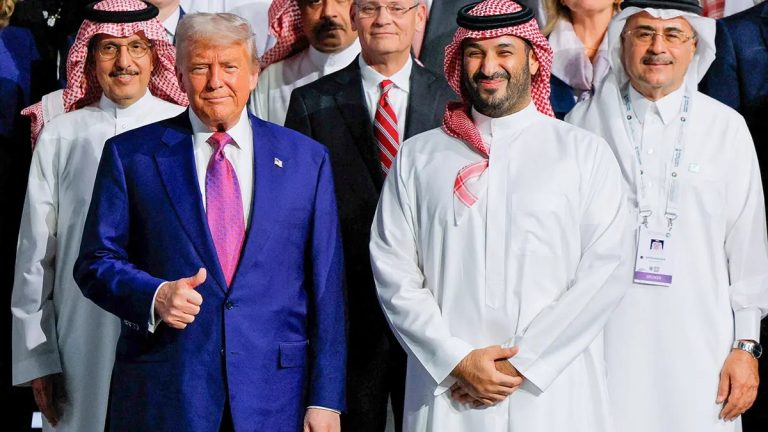
On May 13, 2025, the United States and Saudi Arabia signed a $600 billion investment deal, described as a “strategic economic partnership.” The agreement, announced during President Donald Trump’s Gulf tour, includes a $142 billion defense package for Saudi Arabia to purchase advanced U.S.-made weapons and services.
The deal also covers investments in energy, technology, AI, aerospace, and critical minerals, aimed at boosting U.S. economic growth. However, some reports suggest the total value of finalized deals may be closer to $283 billion, less than the $600 billion pledged by Saudi Crown Prince Mohammed bin Salman. The White House and Saudi state media have highlighted the agreement as a historic step to strengthen bilateral ties.
The $600 billion U.S.-Saudi Arabia investment deal, signed on May 13, 2025, carries significant economic, geopolitical, and social implications, while also highlighting divides in perception and impact. The deal promises to create thousands of American jobs, particularly in defense, technology, AI, aerospace, and energy sectors. The $142 billion defense package alone involves companies like Lockheed Martin and Boeing, boosting U.S. manufacturing and innovation.
Register for Tekedia Mini-MBA edition 20 (June 8 – Sept 5, 2026).
Register for Tekedia AI in Business Masterclass.
Join Tekedia Capital Syndicate and co-invest in great global startups.
Register for Tekedia AI Lab.
Saudi Arabia aims to diversify its oil-dependent economy under Vision 2030. Investments in AI, tech, and critical minerals align with this goal, enhancing its global economic competitiveness. The deal could stabilize energy markets by deepening U.S.-Saudi cooperation, but it may also intensify competition in tech and AI with other global powers like China.
The agreement solidifies the U.S. as Saudi Arabia’s primary strategic partner, countering China’s growing influence in the Middle East. It reinforces Saudi Arabia’s role as a key U.S. ally in countering Iran. The massive arms deal could escalate tensions with Iran and its proxies, potentially fueling an arms race in the Gulf. It may also affect U.S. relations with Israel, given Saudi Arabia’s push for a Palestinian state.
The deal signals a U.S. pivot back to the Middle East under the Trump administration, potentially at the expense of focus on Asia-Pacific or Europe. The $142 billion defense package equips Saudi Arabia with advanced U.S. weaponry, including fighter jets, missile defense systems, and cybersecurity tools, enhancing its deterrence capabilities. The deal ensures long-term U.S. military presence and influence in the Gulf, securing access to strategic bases and intelligence-sharing.

Saudi Arabia’s human rights record, including its involvement in Yemen and domestic repression, raises ethical questions about U.S. support. Critics argue the deal prioritizes profit over principles. While the deal includes clean energy initiatives, Saudi Arabia’s heavy reliance on fossil fuels and the environmental cost of arms production could undermine global climate goals.
The Trump administration and its allies view the deal as a triumph of economic diplomacy, strengthening U.S. industry and countering adversaries like China and Iran. They emphasize job creation and national security.
Progressive Democrats and human rights advocates criticize the deal for empowering Saudi Arabia’s authoritarian regime. They argue it risks entangling the U.S. in Middle Eastern conflicts and overlooks Saudi Arabia’s human rights abuses, such as the Yemen war and journalist crackdowns.
Some lawmakers may push to review or block parts of the arms deal under the Arms Export Control Act, citing Saudi Arabia’s use of U.S. weapons in Yemen. However, Trump’s veto power and Republican support could limit opposition. Polls (e.g., Pew Research, 2024) show mixed views on U.S.-Saudi ties. Many Americans support economic deals that create jobs but are wary of arming nations with questionable human rights records.

Saudi state media portrays the deal as a win for modernization, but public sentiment (hard to gauge due to censorship) may be skeptical of foreign influence or the pace of reforms under Vision 2030. U.S. allies like the UK and UAE may welcome the deal as stabilizing the Gulf, while rivals like China and Russia could see it as a challenge to their regional ambitions. Iran has already condemned the arms deal as destabilizing.
Some Global South countries view the deal as reinforcing U.S. dominance, potentially sidelining their own economic partnerships with Saudi Arabia. The deal pits economic pragmatism against moral concerns. Proponents argue that economic and security benefits outweigh ethical drawbacks, while critics warn that ignoring Saudi Arabia’s human rights record sets a dangerous precedent.
Reports suggest only $283 billion in deals are finalized, raising questions about whether the full $600 billion will materialize. The arms deal could either deter Iran or escalate conflicts, depending on how Saudi Arabia deploys its new capabilities. Congressional pushback or public backlash could limit the deal’s scope, especially if tied to Yemen or human rights concerns.
The U.S.-Saudi $600 billion investment deal is a high-stakes move with far-reaching economic and geopolitical benefits, but it deepens divides over ethics, human rights, and regional stability. It strengthens the U.S.-Saudi alliance and counters rival powers, yet risks entangling the U.S. in Middle Eastern conflicts and alienating critics at home and abroad. The deal’s success hinges on navigating these divides and delivering on its ambitious promises.