

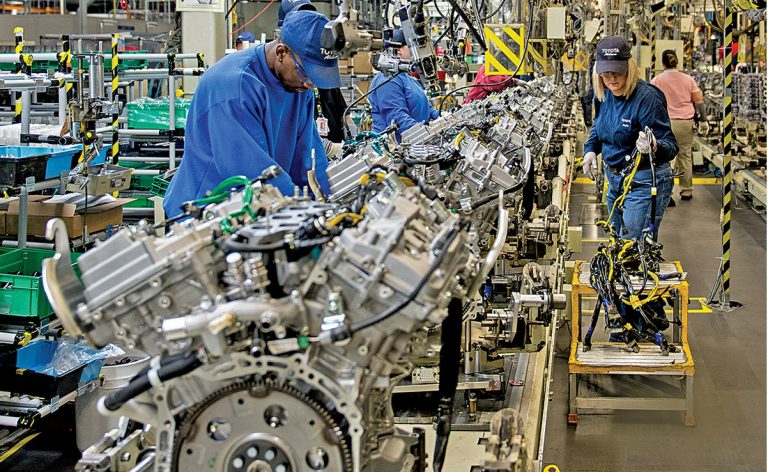
Toyota Motor will invest $3.6 billion to expand its manufacturing operations in Texas and relocate production of its Tacoma midsize pickup truck from one of its Mexican plants, a move that strengthens the automaker’s U.S. manufacturing footprint and positions it to capitalize on growing demand for pickup trucks and hybrid vehicles.
The investment will transform Toyota’s manufacturing campus in San Antonio, Texas, creating approximately 2,000 new jobs, adding a second vehicle assembly line, and nearly doubling the size of the facility by 2030.
Once the expansion is completed, annual production capacity at the plant will increase from about 200,000 vehicles to 350,000, making it one of Toyota’s largest production hubs in North America.
Register for the next Tekedia Mini-MBA.
Register for Tekedia AI in Business Masterclass.
Join Tekedia Capital Syndicate and co-invest in great global startups.
The announcement forms part of Toyota’s broader commitment to increase its U.S. investment by as much as $10 billion beyond previous plans through 2030, underpinning the company’s confidence in long-term demand for vehicles assembled in America.
The investment comes less than a week after the Trump administration confirmed it would not extend the current North American trade agreement with Canada and Mexico in its existing form, opting instead for annual reviews. That policy shift has increased attention on manufacturers with large production bases in Mexico, encouraging some companies to strengthen their U.S. manufacturing operations.
Toyota, however, stressed that the decision does not represent a withdrawal from Mexico.

A company spokesperson said Toyota will maintain its Mexican manufacturing operations as production of the Tacoma is gradually transferred from its Tijuana facility to Texas over the next four years.
The automaker will also continue producing the Tacoma at its plant in Guanajuato, Mexico, preserving an important part of its North American manufacturing network.
“This investment expands Toyota’s manufacturing capacity and complements our broader North American production network,” the spokesperson said.

The move represents a reversal of Toyota’s earlier manufacturing strategy. More than six years ago, the company announced plans to shift Tacoma production away from Texas to Guanajuato as it optimized production across North America. Now, changing market conditions, stronger demand for domestically assembled vehicles, and an evolving policy environment have prompted Toyota to significantly expand its U.S. production footprint.
The San Antonio facility currently manufactures the Toyota Tundra full-size pickup, including its hybrid version, as well as the hybrid Toyota Sequoia SUV. Toyota has already committed $531 million to construct a new rear axle manufacturing facility on the same campus, with production expected to begin later this year.
Combined with Monday’s announcement, the investments are expected to significantly increase the importance of the Texas operation within Toyota’s global manufacturing network.
Toyota Motor North America Chief Executive Officer Ted Ogawa said the expansion demonstrates the company’s long-term commitment to American manufacturing.
“Toyota’s continued investment in North America is a testament to our confidence in the region’s workforce, innovation and long-term growth potential,” Ogawa said.
“By expanding our San Antonio plant, we are deepening our commitment to American manufacturing, creating meaningful and sustainable jobs, while advancing our mission to deliver high-quality vehicles that meet the changing needs of customers today and into the future.”
Toyota has invested $8.3 billion in the San Antonio facility since construction began in 2003.
The latest investment also strengthens Toyota’s competitive position in the U.S. auto market. The Japanese manufacturer is steadily narrowing the sales gap with General Motors, the long-time leader in the U.S. market.
Toyota sold approximately 1.24 million vehicles during the first half of the year, a modest 0.5% increase compared with the same period in 2025.
General Motors, by contrast, reported a 6.8% decline in U.S. sales to approximately 1.34 million vehicles. If those trends continue, Toyota could move significantly closer to overtaking GM as America’s largest automaker by sales.
A major factor behind Toyota’s resilience has been its long-standing strategy of investing heavily in hybrid technology.
While many competitors shifted aggressively toward fully electric vehicles, Toyota continued expanding its hybrid lineup across multiple vehicle categories, arguing that hybrids would remain an important part of the market during the industry’s transition toward lower-emission transportation. That strategy has proven increasingly beneficial as consumer demand for hybrids has accelerated while growth in battery electric vehicle sales has moderated.
Toyota has also expanded its fully electric lineup, but unlike several rivals, it has maintained a balanced approach that includes gasoline, hybrid, plug-in hybrid, and battery-electric vehicles.
General Motors, meanwhile, invested heavily in fully electric vehicles while largely bypassing conventional hybrids, previously describing hybrids as a transitional technology.
The contrast has become more pronounced as buyers increasingly seek fuel-efficient vehicles without relying entirely on charging infrastructure. Beyond product strategy, Toyota’s latest investment reflects a broader reshaping of global automotive manufacturing.
Automakers are reassessing supply chains, production locations and investment priorities in response to evolving trade policies, geopolitical uncertainty and changing consumer preferences.
For Toyota, expanding production in Texas provides greater manufacturing flexibility, strengthens its presence in one of the world’s largest pickup truck markets, and solidifies its position in the United States at a time when domestic production is attracting renewed political and economic attention.
The investment also signals that North America will remain central to Toyota’s long-term growth strategy, even as the company continues operating an integrated manufacturing network that spans the United States, Canada, and Mexico.