

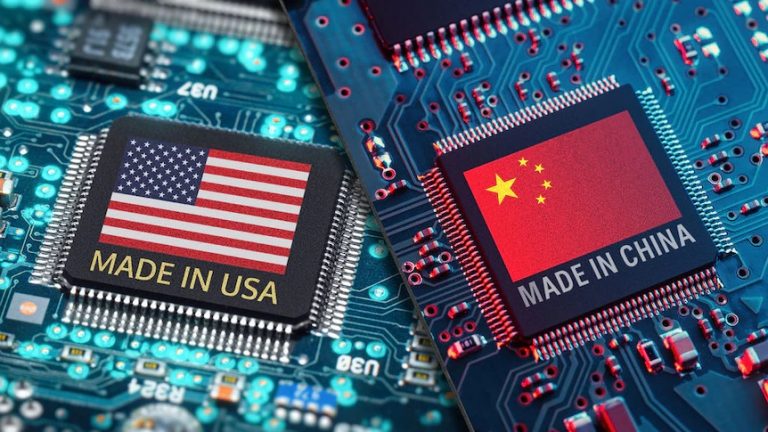
President Donald Trump’s administration said on Tuesday it plans to impose tariffs on Chinese semiconductor imports, citing Beijing’s “unreasonable” drive to dominate the global chip industry, while pushing the effective date of the action out to June 2027.
The tariff rate will be announced at least 30 days before it takes effect, according to a filing by the U.S. Trade Representative. The move follows a year-long investigation under Section 301 of U.S. trade law into China’s exports of so-called legacy, or older-generation, semiconductors to the United States. That probe was launched under the Biden administration and concluded that China’s industrial strategy in the sector harms U.S. commerce.
“China’s targeting of the semiconductor industry for dominance is unreasonable and burdens or restricts U.S. commerce and thus is actionable,” the U.S. Trade Representative said in a statement accompanying the decision.
Register for Tekedia Mini-MBA edition 20 (June 8 – Sept 5, 2026).
Register for Tekedia AI in Business Masterclass.
Join Tekedia Capital Syndicate and co-invest in great global startups.
Register for Tekedia AI Lab.
The delayed timeline appears calibrated to preserve the White House’s leverage while lowering the risk of an immediate escalation with Beijing. China has in recent months tightened export controls on rare earth metals, materials that are essential to the production of chips, electric vehicles, and a wide range of advanced technologies, and which China largely controls.
Beijing reacted swiftly to the announcement. The Chinese Embassy in Washington said it opposed any new tariffs and warned that turning technology and trade into geopolitical tools would hurt global supply chains.
“To politicize, instrumentalize and weaponize trade and tech issues and destabilize the global industrial and supply chains will benefit no one and will eventually backfire,” the embassy said in a statement to Reuters.

It added that China would “take all measures necessary to firmly safeguard our lawful rights and interests.”
U.S. officials have signaled that the delay is tied to broader negotiations aimed at easing pressure in other areas of the tech relationship. As part of talks with China to pause or soften rare earth export curbs, Washington has already postponed a rule that would have further restricted U.S. technology exports to subsidiaries of Chinese firms that are already on U.S. blacklists.
The administration has also launched a review that could open the door to the first shipments of Nvidia’s second-most powerful artificial intelligence chips to China, Reuters has reported. That possibility has triggered sharp unease among hardliners in Washington who argue that advanced AI hardware could bolster China’s military and surveillance capabilities.

Beyond the targeted action on legacy chips, the semiconductor industry is watching closely for the outcome of a far broader investigation under Section 232 of U.S. law, which allows tariffs on national security grounds. That probe covers global semiconductor imports and could extend to a wide range of electronic devices that contain chips, regardless of where they are assembled.
Such measures would potentially sweep in products from allies as well as rivals, adding another layer of complexity to global supply chains that are still adjusting to earlier rounds of tariffs and export controls. U.S. officials, speaking privately, have indicated that additional Section 232 tariffs may not be imposed in the near term, according to Reuters.
The latest move builds on earlier steps taken under President Joe Biden, who imposed an additional 50% tariff on Chinese semiconductors that took effect on January 1, 2025. Together, the actions underline the degree to which semiconductor policy has become a central pillar of U.S. economic and national security strategy.
The Trump administration seems to be keeping its options open for now: asserting its legal authority to act against China’s chip exports, while delaying enforcement to manage a fragile negotiation that has marked Beijing-Washington as one of the most consequential trade relationships in the world.