

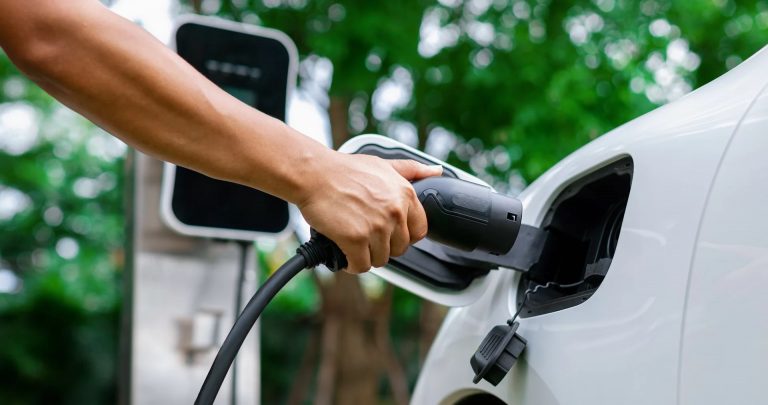
The Trump administration has formally lifted its freeze on $5 billion in electric vehicle (EV) charging infrastructure funding, ending a months-long political standoff that threatened to stall the U.S. EV rollout.
The money, part of the National Electric Vehicle Infrastructure (NEVI) program, had been held up since the early days of Donald Trump’s second term as part of a broader effort to halt or redirect federal climate and clean-energy spending.
The funds were originally approved under the Bipartisan Infrastructure Law in 2021 and designed to accelerate the construction of a nationwide EV charging network, a critical step toward supporting the country’s fast-growing fleet of electric cars. But early this year, the administration moved to suspend disbursement, citing the need to review whether the program aligned with its priorities.
Register for Tekedia Mini-MBA edition 20 (June 8 – Sept 5, 2026).
Register for Tekedia AI in Business Masterclass.
Join Tekedia Capital Syndicate and co-invest in great global startups.
Register for Tekedia AI Lab.
How the Freeze Unfolded
The freeze quickly became a flashpoint in U.S. energy policy. A coalition of states, many with aggressive clean transportation goals, sued the administration, arguing that it was unlawfully withholding funds appropriated by Congress. These states said the freeze risked stalling not only infrastructure projects but also EV adoption rates, warning that private-sector investment would slow if the federal government failed to provide the promised backbone network.
In June 2025, a federal judge sided with the states, issuing an injunction against the funding halt. The court ruled that the states were likely to succeed in their legal challenge, forcing the Department of Transportation (DOT) to resume disbursement.
DOT’s New Guidance — A Sharp Policy Turn
Transportation Secretary Sean Duffy, a former MTV personality and Republican congressman from Wisconsin, accused states of being too slow to spend the money. As of May, roughly 84% of the $5 billion remained unobligated, and only a few dozen chargers had been built nationwide.

The DOT’s newly issued guidance drastically rewrites the rules for accessing the money:
- Equity Requirements Removed — States no longer need to ensure a share of chargers are located in rural, disadvantaged, or underserved communities.
- Safety and Labor Standards Cut — The program no longer mandates strong labor protections, safety training, or high installation standards.
- Minority and Women-Owned Business Participation Dropped — States are no longer required to offer contract opportunities to these groups.
- Environmental and Consumer Protections Scrapped — Previous rules on environmental siting, consumer protections, and emergency evacuation planning have been eliminated.
The DOT framed these changes as a way to “streamline” deployment, but critics see them as a rollback of protections meant to ensure the transition to EVs is equitable, safe, and benefits a broader range of workers and communities.
Tesla and the Wider EV Market at Stake
The freeze — and the uncertainty it created — rattled the U.S. EV sector, which is still heavily led by Tesla. Tesla’s Supercharger network remains the gold standard in charging reliability, but the NEVI program was expected to help rival automakers catch up, building a more balanced and interoperable charging landscape.

Without the NEVI funds, Tesla’s competitive advantage could have grown even larger, as many smaller automakers and charging startups lack the capital to build expansive networks on their own.
Even with the funds now released, the administration’s changes may tilt the rollout toward more profitable, high-traffic corridors, often the focus of Tesla’s network, while leaving rural and underserved regions behind. That risks reinforcing the “charging gap” between urban and rural America, and between wealthy EV owners and those in lower-income areas.
With the legal fight settled for now, states are expected to move forward with project bids and construction under the revised rules. The big question is whether this accelerated approach will help the U.S. close its charging gap quickly enough to meet projected EV demand, or whether the loss of equity, labor, and safety provisions will undermine the long-term resilience and inclusivity of the network.