

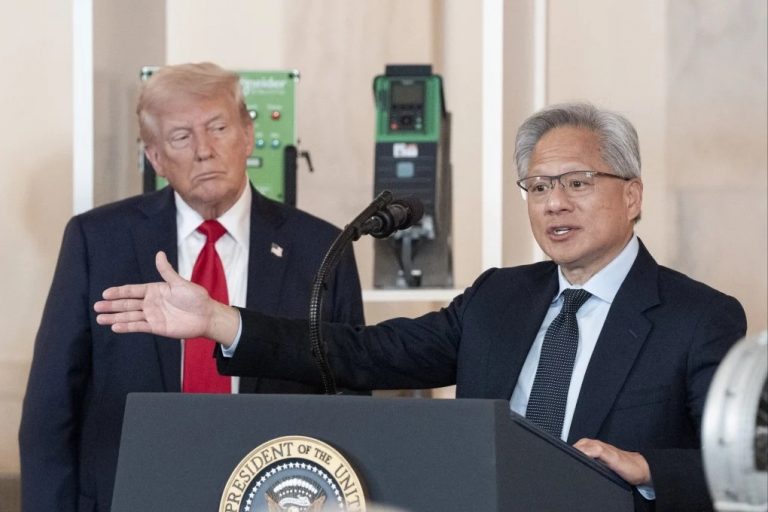
US President Donald Trump has confirmed that the FBI is investigating allegations involving Nvidia Chief Executive Jensen Huang and a Chinese businesswoman suspected of working for Beijing, adding a new dimension to a controversy that could complicate the chipmaker’s efforts to maintain access to China.
Trump said on Monday that he had spoken with Huang, who denied knowing that the woman was allegedly connected to Chinese intelligence. The president expressed confidence that the Nvidia chief would emerge from the investigation in good shape, but his comments confirmed that the allegations have attracted federal attention at the highest level.
“I was amazed,” Trump said of the reports. “I know the FBI is looking into it.” He added that Huang had told him he had no idea the woman was a spy.
Register for the next Tekedia Mini-MBA.
Register for Tekedia AI in Business Masterclass.
Join Tekedia Capital Syndicate and co-invest in great global startups.
The investigation creates a difficult situation for Nvidia, whose commercial interests in China have long been caught between Washington’s national security restrictions and Beijing’s ambition to develop a globally competitive artificial intelligence industry. The more serious question is whether Huang was targeted by a foreign intelligence operation. The broader concern for investors and policymakers is whether the controversy will lead to tighter scrutiny of Nvidia’s business relationships, chip distribution channels and access to the Chinese market.
Nvidia shares fell more than 4% on Monday after the company’s board announced an internal investigation into Huang being targeted by a foreign intelligence effort. The board’s announcement has placed the leadership of the world’s most valuable chipmaker under an unusual level of scrutiny, given Huang’s central role in its business and the wider AI investment boom.
Huang, 63, has acknowledged to Nvidia employees that he was unfaithful to his wife, although he did not disclose details of the relationship. The New York Times previously reported that he had a relationship with Alice Huang, an unrelated former executive of Singapore-based company Megaspeed, whom US authorities investigated and concluded was a Chinese intelligence asset.

The newspaper also reported that Trump had been briefed on the relationship and that Alice Huang was providing information to the Chinese government, but that the president had chosen not to act on the information. Trump did not provide further details about the FBI investigation on Monday.
China has rejected the allegations. Foreign Ministry spokesperson Guo Jiakun described the “so-called Chinese spy narrative” as a groundless accusation, slander, and smear.
The controversy could complicate Nvidia’s efforts to persuade Washington to permit more sales of advanced AI processors to China. Huang has been one of the most prominent advocates of maintaining access to the Chinese market, arguing that excluding American chipmakers would create opportunities for domestic Chinese competitors and weaken the US technology industry’s position.

That argument has become more difficult to advance as allegations involving a suspected Chinese intelligence asset bring greater attention to the relationships surrounding Nvidia’s international business.
The potential consequences extend beyond Huang’s personal circumstances. US policymakers have spent years tightening controls on advanced semiconductor exports to China, seeking to limit Beijing’s access to computing capacity that could support military applications and advanced AI development. Any suggestion that commercial relationships or third-party networks have been used to circumvent those restrictions is likely to intensify demands for stronger oversight.
Lawmakers and policy advocates told Reuters that the allegations could increase the likelihood of Congress passing legislation to further restrict China’s access to AI chips. House Democratic leader Hakeem Jeffries said Congress needed more answers and called for the House to pass an annual defense bill containing restrictions on chip sales to China.
That political response could create additional uncertainty for Nvidia’s China strategy. Even without evidence of wrongdoing by the company, the investigation may encourage lawmakers to demand stricter controls over distributors, cloud partners, and the final destinations of advanced processors. Such measures could increase compliance costs and make it harder for Nvidia to serve Chinese customers.
For Beijing, the controversy reinforces the vulnerability of China’s AI ambitions to decisions made in Washington. Chinese technology companies need access to advanced computing hardware to train and deploy increasingly capable models, but US export controls have made supplies of Nvidia’s most powerful processors uncertain. Further restrictions could accelerate efforts to replace American technology with domestic alternatives.
The backdrop has yielded a commercial dilemma for Nvidia. China represents a significant potential market for AI processors, but the company cannot pursue that opportunity independently of US national security policy. A deterioration in relations between Washington and Beijing could leave Nvidia with fewer opportunities to sell into China, while giving local chipmakers more room to compete.
The allegations also risk making Nvidia’s relationship with Chinese business partners a more sensitive issue for US regulators. The FBI investigation and the company’s internal review may therefore have implications beyond the question of whether Huang was personally targeted. Regulators could seek greater clarity about how Nvidia evaluates its commercial relationships and monitors the movement of its technology through international distribution networks.
Huang’s Influence Creates a Separate Governance Risk
The investigation has also drawn attention to Nvidia’s dependence on its chief executive. Huang is the company’s fifth-largest shareholder, with an approximately 3.6% stake, according to LSEG data. He also exercises considerable influence through an unusually flat management structure in which dozens of executives report directly to him.
Unlike Meta Platforms and SpaceX, Nvidia does not have a dual-class share structure that gives its founder majority voting control. Nevertheless, Huang’s influence over the company’s strategy, product direction and relationships with major customers makes his position difficult to separate from Nvidia’s wider business prospects.
His public profile has grown alongside the AI boom. In Asia, where Nvidia has a substantial commercial presence, Huang is treated as a celebrity by many technology enthusiasts. His frequent appearances with customers, developers and fans have helped make him one of the most recognizable figures in the global technology industry.
Bernstein analyst Stacy Rasgon described the importance of his role, saying: “Nvidia is not an ordinary company and Jensen is not an ordinary CEO; he is Nvidia, clearly sets the long-term strategy and direction, and pulls most of the company’s strings himself.”
That concentration of influence poses a succession concern for investors. Nvidia’s board has expressed confidence in Huang, and most analysts do not expect the investigation to force him out. However, any prolonged uncertainty surrounding the chief executive could affect investor confidence, particularly if it coincides with regulatory action or restrictions on the company’s China business.
Huang’s relationship with Trump adds another challenge. The president has repeatedly praised the Nvidia chief and awarded him the nation’s highest honour for scientific achievement in October. On the same day, Trump disclosed that he had bought up to $1.6 million and sold up to $1 million of Nvidia shares during the summer.
The close relationship between the two men has coincided with favorable policy developments for Nvidia, although the latest controversy could make the company’s engagement with Washington more politically sensitive.
Nvidia shareholders have already filed a proposed class-action lawsuit against Huang and the company, accusing them of defrauding investors by concealing his alleged ties to a suspected Chinese spy. The allegations in the lawsuit have not been established in court, and the filing adds a separate legal challenge to the FBI and board investigations.
For Nvidia, the central risk is that a controversy initially centered on Huang’s personal relationship develops into a broader examination of the company’s China operations. The outcome could influence not only the chief executive’s position but also the regulatory conditions under which American AI chipmakers compete in China.
Nvidia now faces the difficult task of protecting its commercial interests in both markets while demonstrating that its leadership and business relationships meet the scrutiny expected of a company at the center of a major national security debate.