

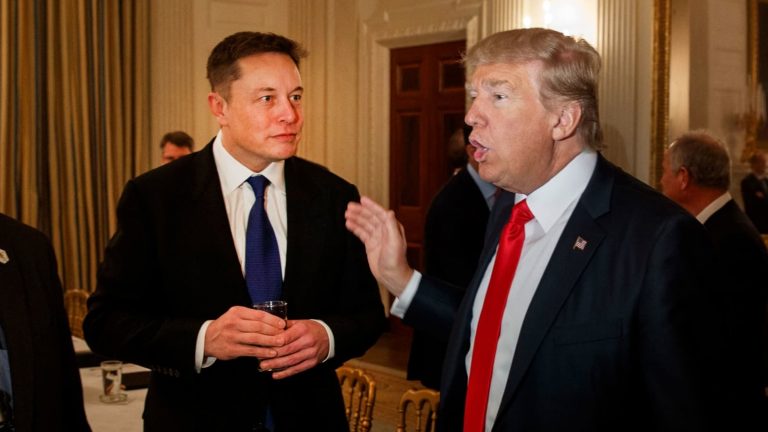
President Donald Trump on Thursday pushed back against growing speculation that he plans to dismantle federal support for Elon Musk’s companies, amid escalating tensions between the two high-profile figures and mounting challenges at Tesla.
In a post on Truth Social, Trump addressed claims that he wants to dismantle Musk’s business empire by stripping away government subsidies, calling such reports “not so.”
“Everyone is stating that I will destroy Elon’s companies by taking away some, if not all, of the large scale subsidies he receives from the U.S. Government,” Trump wrote. “This is not so! I want Elon, and all businesses within our Country, to THRIVE, in fact, THRIVE like never before! The better they do, the better the USA does, and that’s good for all of us.”
Register for Tekedia Mini-MBA edition 20 (June 8 – Sept 5, 2026).
Register for Tekedia AI in Business Masterclass.
Join Tekedia Capital Syndicate and co-invest in great global startups.
Register for Tekedia AI Lab.
The reassurance came amid a deepening fallout between the president and the Tesla CEO, triggered by Musk’s vocal opposition to Trump’s signature legislation—the “One Big Beautiful Bill Act” (OBBBA)—and inflamed by personal jabs, including Musk’s reference to Trump’s ties with convicted sex offender Jeffrey Epstein.
Once allies, Trump and Musk have turned into bitter critics of each other. Musk, who previously headed Trump’s so-called Department of Government Efficiency and donated hundreds of millions of dollars to his reelection campaign, has become increasingly critical of the administration’s policies.
Their feud intensified in June when Trump threatened to pull federal contracts from Musk’s companies, saying they “might be due for a review.” The remark rattled investors and analysts who flagged the heavy reliance of Musk’s ventures—especially SpaceX, Tesla, and xAI—on U.S. government support.

The move, which removes the $7,500 electric vehicle incentive effective September 30, is already reshaping the market, with Tesla scrambling to sell its inventory and American automakers bracing for a turbulent second half of the year.
Tesla reported $439 million in regulatory credit sales for Q2 2025, according to FedScout, but these revenues are declining as more competitors enter the EV space and as federal and state incentives become uncertain.
Since 2015, Tesla has earned $12.24 billion from selling these credits, largely tied to environmental mandates that require automakers to sell a minimum number of zero-emission vehicles or buy credits from companies like Tesla. These credits have been critical to Tesla’s profit margins, as they are pure revenue with no associated manufacturing cost.

The EV company warned customers on Wednesday that the expiration of federal EV subsidies and rising tariff costs would push it into “a few rough quarters.”
“Given the abrupt change, we have limited supply of vehicles in the US this quarter,” said Tesla CFO Vaibhav Taneja. “If you are in the US and looking to buy a car, place your order now as we may not be able to guarantee delivery orders placed in the later part of August and beyond.”
He made the comment during Tesla’s second-quarter earnings call on Wednesday, where the automaker posted weaker-than-expected results and warned of margin pressure ahead.
With the “OBBBA” legislation potentially eliminating or altering these subsidies, Tesla’s filing warned that “the loss of previously available tax credits and carbon offset mechanisms may further negatively impact our financial results.” The company also noted that “provisions of the OBBBA could affect battery cell expenses and impact costs for our consumers, negatively impacting demand.”
On top of that, Tesla’s gross margin has shrunk due to aggressive price cuts aimed at staying competitive in a crowded global EV market. Deliveries fell short of Wall Street expectations for the third consecutive quarter, and free cash flow slipped into negative territory.
The fallout extends beyond Tesla. SpaceX has received over $22 billion in government contracts since 2008, including work with NASA, the Air Force, and the Space Force. The Trump administration reportedly launched a review of those contracts, though The Wall Street Journal noted most were deemed “critical” and unlikely to be cut.
Meanwhile, Musk’s new artificial intelligence venture, xAI, on July 14, the Pentagon awarded contracts worth up to $200 million each to xAI and three other AI firms. But just days later, White House press secretary Karoline Leavitt hinted that federal agencies may be discouraged from working with Musk’s AI startup due to growing friction with the administration.
For Tesla, the expiration of federal EV benefits at the end of September, combined with inflationary pressure from tariffs and weakening demand, raises serious questions about its growth trajectory. The company is hinting that the worst may still lie ahead, and analysts are downgrading expectations for 2025.
At the heart of it all is a once-powerful alliance turned toxic. The Trump-Musk fallout is now spilling into boardrooms, government agencies, and investor forecasts, with Tesla bearing the brunt of the uncertainty. Despite Trump’s latest assurance that he wants Musk’s businesses to “thrive,” markets remain cautious.