

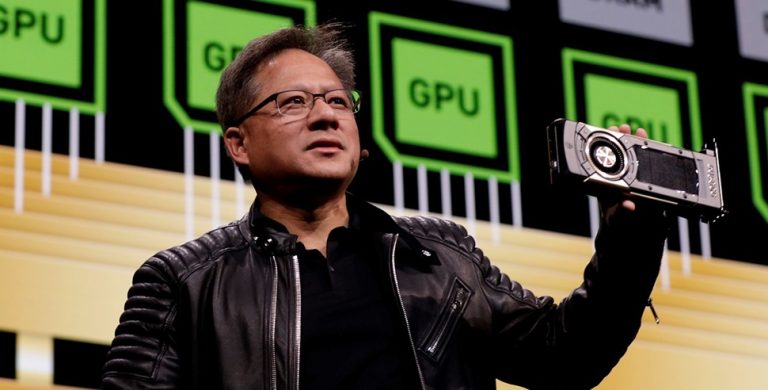
US President Donald Trump has suggested that former Apple chief executive Tim Cook should replace Jensen Huang as head of Nvidia, adding an unexpected political dimension to the leadership crisis at the world’s leading AI chipmaker.
“NOW THAT Nvidia CEO JENSEN HUANG, who has done a fantastic job, has resigned, there is only one man to take his place – TIM COOK of Apple,” Trump wrote on social media on Thursday. “A Legend replaces a Legend!” he added.
The suggestion came hours after Nvidia confirmed that Huang had resigned as president and chief executive, with its board accepting his departure on Wednesday. Chief Financial Officer Colette Kress has taken over as interim CEO while the company searches for a permanent successor.
Register for the next Tekedia Mini-MBA.
Register for Tekedia AI in Business Masterclass.
Join Tekedia Capital Syndicate and co-invest in great global startups.
Cook stepped down as Apple’s chief executive in September after 15 years in the role and now serves as executive chairman of the iPhone maker. His departure from day-to-day management at Apple has not been accompanied by any indication that he intends to take another chief executive position.
Trump’s endorsement nevertheless places one of the technology industry’s most prominent executives into the succession debate at Nvidia, where investors are concerned about the company’s ability to maintain its growth and leadership without Huang.
The president’s relationship with Cook has been shaped partly by Apple’s commitments to US manufacturing. Last year, Cook presented Trump with a custom US-made plaque mounted on a 24-carat gold stand to commemorate Apple’s American Manufacturing Program, following the company’s announcement that it would invest an additional $100 billion in domestic manufacturing.

Trump has maintained close relationships with major technology executives during his second term, using those connections to advance his administration’s priorities on investment, manufacturing and US technological competitiveness.
Trump had also maintained a close relationship with Huang, who became a regular presence in Washington as Nvidia sought greater access to the Chinese market for its advanced processors.
The president said on Monday that he had spoken to Huang about the allegations involving Alice Huang, a Chinese businesswoman whom US intelligence officials reportedly suspected of working for Beijing. Trump said Huang told him he had not known the woman was allegedly a spy.

According to a New York Times report published on Thursday, Trump called Huang on Tuesday and urged him to continue fighting to retain his position at Nvidia. The newspaper cited two people briefed on the conversation. The call reportedly took place a day before Nvidia’s board accepted Huang’s resignation.
The account suggests Trump had attempted to persuade Huang to remain in charge even as pressure mounted over the reported relationships and their potential implications for corporate governance and national security.
Huang’s departure followed reports of relationships with Alice Huang and Kimberly Powell, Nvidia’s vice president of healthcare. The allegations prompted questions about executive oversight and the company’s handling of internal reporting relationships. The FBI has reportedly been investigating the matter for at least a year.
However, the intelligence allegations involving Alice Huang have since become more contested. CNN reported that multiple sources in the US intelligence community said the information collected did not establish that she was acting as a Chinese spy. Some officials at the Office of the Director of National Intelligence reportedly described that characterization as “not entirely accurate and over-torqued”.
Officials at the CIA were also reportedly not convinced that the intelligence gathered, including intercepted communications, demonstrated that Alice Huang knowingly passed information to Beijing.
Those qualifications complicate the national security narrative that surrounded Huang’s resignation. They do not establish that the allegations were false, but they raise questions about whether the available intelligence justified the certainty with which the espionage claims were initially presented.
The unraveling controversy is impacting Nvidia’s leadership at a time when its relationship with Washington is important to its international business. Huang had repeatedly supported the administration’s agenda and lobbied for permission to sell advanced AI chips to Chinese customers within US export-control restrictions.
Nvidia Faces Pressure to Reconsider Its Decision
The reaction inside Nvidia suggests that Huang’s departure may not have ended the debate over his leadership. An internal post urging the company’s board to reinstate him has attracted more than 1,600 comments, with most respondents expressing support for his return, according to Wired.
The post called on the board to consider employee sentiment when assessing Huang’s departure. While the comments do not indicate the position of Nvidia’s entire workforce, they suggest that the decision has generated internal disagreement over the loss of a founder who shaped the company’s business and culture for more than three decades.
Huang co-founded Nvidia in 1993 and led its transformation from a graphics processor manufacturer into the central supplier of computing hardware for the AI industry. His influence extended beyond product development to long-term investment decisions, customer relationships and the company’s role in building global AI infrastructure.
That concentration of leadership has made succession difficult. Kress has taken over on an interim basis, but Nvidia has not announced a permanent replacement or identified a candidate with Huang’s combination of technical experience and industry influence.
The board now faces a difficult choice. Reinstating Huang could address concerns among employees and investors who view him as key to Nvidia’s future, but it would also require the company to resolve the governance questions that contributed to his departure. Retaining the current leadership transition would avoid an immediate reversal but leave Nvidia facing the challenge of replacing its most influential executive.
Trump’s endorsement of Cook adds visibility to the succession debate, but it offers no indication that Cook is available or interested in the position. Running Nvidia would also involve a different set of demands from overseeing Apple, particularly given the chipmaker’s leadership role in AI infrastructure, semiconductor supply chains and US-China technology policy.
The more pressing issue is whether Nvidia can restore confidence in its governance and leadership while maintaining its commercial momentum. The latest intelligence disclosures may also increase pressure for a fuller examination of the allegations that contributed to Huang’s exit.