

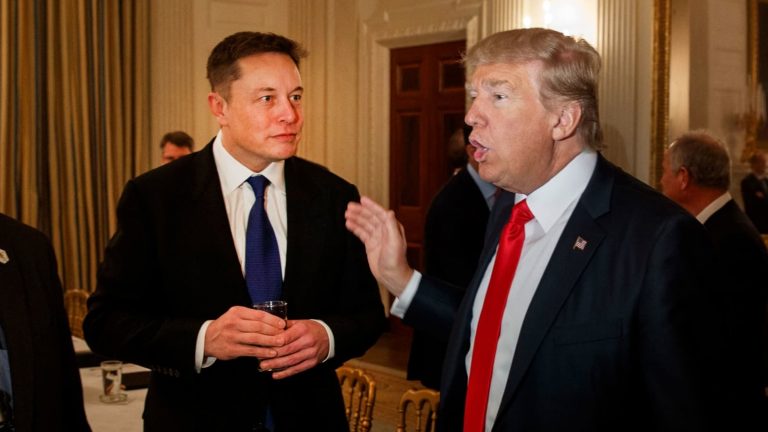
U.S. President Donald Trump is heading into one of the most consequential meetings of his second term with Chinese President Xi Jinping this week, accompanied by a powerful delegation of Wall Street and Silicon Valley executives.
Trump’s trip is also accompanied by mounting pressure at home to block Chinese vehicles from entering the American market.
The Trump-Xi summit comes at a pivotal moment for U.S.-China relations, with both governments attempting to stabilize ties strained by escalating battles over trade, artificial intelligence, export controls, industrial policy, Taiwan, and the Iran conflict.
Register for the next Tekedia Mini-MBA.
Register for Tekedia AI in Business Masterclass.
Join Tekedia Capital Syndicate and co-invest in great global startups.
According to a White House official, Trump’s delegation includes some of the most influential names in American business, among them Elon Musk of Tesla, Tim Cook of Apple, and Kelly Ortberg of Boeing. Also expected to participate are David Solomon, Stephen Schwarzman, Larry Fink, Jane Fraser, and Dina Powell McCormick from Meta Platforms.
The presence of executives spanning technology, banking, aerospace, and manufacturing highlights how deeply intertwined the American and Chinese economies remain, even as distrust intensifies.
The administration hopes the summit will generate fresh commercial agreements, large Chinese purchase commitments, and broader economic cooperation. Yet beneath the diplomacy lies growing anxiety in Washington that China’s industrial dominance, particularly in electric vehicles and advanced manufacturing, is becoming an existential threat to sections of the U.S. economy.

China’s EV Rise Alarms Washington
With Trump set to meet Xi this week, a broad coalition spanning the American auto sector, steelmakers, unions, and politicians from both parties is pressing him with one clear demand: keep Chinese cars out of the United States.
The intense lobbying campaign reflects rising fears that Chinese automakers, armed with enormous state support, unmatched manufacturing scale, advanced battery technology, and ultra-low pricing, could devastate domestic producers and suppliers if granted meaningful access to the U.S. market.
Executives and labor groups increasingly argue that China’s electric vehicle sector is no longer merely competitive but structurally capable of overwhelming rivals globally through aggressive overcapacity and pricing power.

“Chinese automakers are not normal market competitors. Their EVs are the product of decades of state-backed mercantilism designed to help China capture global leadership in advanced industries,” said ITIF vice president Stephen Ezell.
Chinese EV giants such as BYD, NIO, and XPeng have expanded rapidly over the past several years, helped by massive government subsidies, low-cost financing, vertically integrated supply chains, and dominant control over critical battery minerals and processing.
Industry executives warn that Chinese manufacturers are now capable of producing EVs at price points Western automakers struggle to match profitably.
“Once China’s subsidized firms are embedded in the U.S. market, the economic and national security damage would be far harder to reverse — and it would not be limited to Detroit,” Ezell added.
That concern extends far beyond Detroit.
Steelmakers, parts suppliers, and labor unions fear that a flood of low-cost Chinese vehicles could hollow out large parts of America’s industrial base, threatening jobs across manufacturing-heavy states already battered by decades of globalization.
The issue has become one of the few areas drawing unusually strong bipartisan consensus in Washington. Democrats aligned with organized labor and Republicans focused on industrial competitiveness increasingly agree that allowing Chinese EVs into the American market at scale could trigger severe political and economic consequences.
The debate reflects a broader shift in U.S. thinking about China. For years, Washington viewed economic integration with Beijing as mutually beneficial. Today, policymakers increasingly frame the relationship through the lens of economic security, industrial resilience, and technological competition.
AI, Chips, and Strategic Rivalry
Artificial intelligence and semiconductor controls are also expected to dominate discussions between Trump and Xi. The United States has spent years tightening restrictions on advanced chip exports to China in an effort to slow Beijing’s progress in frontier AI and military technologies.
The restrictions have heavily affected companies such as Nvidia, whose CEO Jensen Huang recently said the company’s direct AI accelerator market share in China had effectively collapsed to zero.
Washington has since adjusted some policies, allowing exports of modified lower-tier Nvidia chips tailored for Chinese customers. But analysts say those efforts have largely failed to restore momentum, as Chinese security concerns and Beijing’s push for technological self-sufficiency appear to have undermined confidence in relying on American AI infrastructure.
Chinese firms are increasingly turning toward domestic alternatives from companies such as Huawei, while Beijing continues pouring resources into semiconductor independence.
The result is a rapidly deepening technological decoupling between the world’s two largest economies. At the same time, many American companies remain heavily dependent on China.
Tesla’s Shanghai factory remains one of the company’s most important production hubs globally. Apple still relies extensively on Chinese manufacturing capacity even as it diversifies parts of its supply chain into India and Southeast Asia. Wall Street firms also continue viewing China as a major long-term growth market, even as geopolitical risks rise.
That tension defines the summit itself: American corporations still need access to China’s vast market and supply chains, while Washington increasingly views China as its primary strategic competitor.
Iran, Trade And Economic Diplomacy
The Iran war is expected to add another layer of complexity to the talks. China remains one of the world’s largest importers of Gulf energy and has carefully balanced its relationships with both Tehran and Washington during the conflict.
For the Trump administration, securing stability in energy markets has become increasingly urgent as prolonged tensions threaten global oil supplies, shipping routes, and inflation. The summit is therefore likely to mix traditional diplomacy with economic bargaining across multiple fronts simultaneously: trade access, technology restrictions, energy security, industrial policy, and geopolitical competition.
Trump’s decision to bring corporate leaders directly into the diplomatic process underlines his longstanding preference for transactional statecraft built around commercial leverage and business relationships.
Analysts say the trip may ultimately produce headline-grabbing investment deals, aircraft purchases, or AI-related agreements. But the deeper reality is that Washington and Beijing are now managing a far more adversarial economic relationship than at any point in decades.