

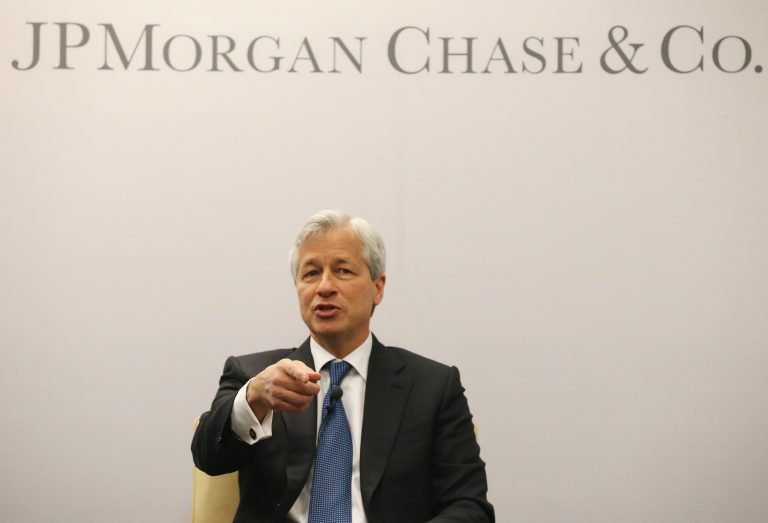
A JPMorgan Chase-led syndicate of banks sharply reduced its commitment to one of the largest publicly traded business development companies (BDCs) in the private credit space, just days before co-manager KKR stepped in with a substantial rescue package aimed at stabilizing the beleaguered fund.
FS KKR Capital Corp., co-managed by KKR and Future Standard, announced Monday that KKR would inject $150 million in new equity through cumulative convertible perpetual preferred stock and commit another $150 million via a tender offer to buy common shares at $11.00 each from investors seeking liquidity. The fund labeled these “Strategic Value Enhancement Actions.” In tandem, FSK’s board authorized a separate $300 million open-market share repurchase program, and KKR agreed to waive half of its incentive fees for the next four quarters.
These moves came after the JPMorgan-led group cut FSK’s senior secured revolving credit facility by $648 million (about 14%) on May 8, reducing total commitments to approximately $4.05 billion from $4.70 billion. Some lenders reportedly exited the syndicate entirely.
Register for the next Tekedia Mini-MBA.
Register for Tekedia AI in Business Masterclass.
Join Tekedia Capital Syndicate and co-invest in great global startups.
The amendment also raised interest rates (spreads) on the remaining facility for extending lenders and lowered the minimum shareholders’ equity covenant floor from roughly $5.05 billion to $3.75 billion. While this provides more cushion against defaults, it signals lenders’ concerns that asset values could decline further. JPMorgan acted as administrative agent, with ING Capital as collateral agent.
FSK has become a prominent symbol of strain in the private credit sector. Its shares have plunged nearly 50% over the past year and trade at a steep discount to net asset value (NAV). In March, Moody’s downgraded the fund’s ratings to junk status (Ba1 from Baa3), citing asset quality deterioration that outpaced peers, weaker profitability, and greater NAV erosion.
In the first quarter of 2026, FSK reported losses of $2 per share, totaling roughly $560 million, driving a roughly 10% decline in NAV. Non-accrual loans (those no longer generating interest income) rose sharply to 8.1% of the portfolio on a cost basis (4.2% at fair value) at quarter-end, up from 5.5% (3.4% at fair value) at year-end. Key problem credits include loans to software company Medallia and dental services provider Affordable Care.

“Our first quarter decline in net asset value was driven by investments which have impacted prior quarters, certain new non-accrual assets, and the impact of market-driven spread widening,” CEO Michael Forman and President Daniel Pietrzak said in the release.
However, they added a note of optimism: “We believe FSK’s current stock price underappreciates the long-term value associated with FSK’s investment portfolio and the KKR Credit platform.”
Software and related services remain the fund’s largest exposure, comprising 16.4% of the portfolio at year-end. Executives have conducted AI risk assessments across holdings, reflecting broader concerns about technology disruption in the sector.

The troubles have already forced distribution cuts. FSK reduced its quarterly dividend in prior periods, with the board declaring $0.42 per share for the second quarter—aligned with paying out 100% of GAAP net investment income. The stock has offered high yields (recently in the mid-teens) even after cuts, but at the cost of significant principal erosion for shareholders.
Investor frustration has escalated into legal action. A proposed class-action lawsuit filed in early May in Pennsylvania alleges that FSK and executives downplayed bad loans while promoting portfolio stability and attractive dividends. The suit covers investors who purchased shares between May 2024 and February 2026.
Stress Testing Private Credit
FSK’s challenges highlight vulnerabilities across the roughly $2 trillion U.S. private credit market, which expanded rapidly in a low-rate environment but now faces higher-for-longer interest rates, refinancing pressures, and sector-specific risks. The Financial Stability Board recently warned that the asset class remains untested in a severe downturn, pointing to leverage, liquidity mismatches in semi-liquid structures, interconnections with banks and insurers, and concentrations in areas like software.
Redemption pressures have mounted at some funds, with occasional gates or liquidations. FSK’s experience, banks tightening credit, ratings downgrades, heavy markdowns, and manager intervention, illustrate how liquidity and covenant relief can come at the price of higher costs and signaling further downside.
As a middle-market lender formed through a 2018 merger, FSK once ranked as the second-largest publicly traded BDC. It now confronts a painful transition: executives have signaled expectations of a smaller, better-positioned balance sheet over time. The fund maintains substantial liquidity, with cash and availability under financing arrangements, but faces over $2 billion in unsecured debt maturities in 2026–2027.
JPMorgan has taken broader defensive steps, including marking down private credit exposures on its own books, many tied to software firms potentially disrupted by artificial intelligence.
While KKR’s intervention and buybacks aim to restore confidence and narrow the share price discount, analysts expect sustained improvement to hinge on stabilizing the legacy portfolio and navigating an environment of elevated defaults and cautious bank lending.