

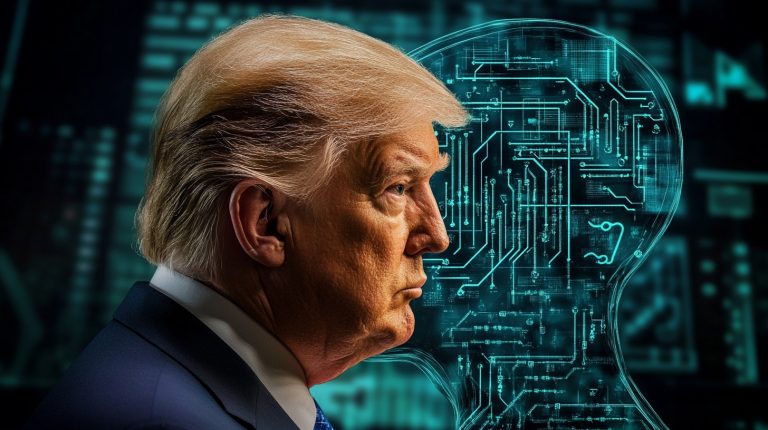
U.S. President Donald Trump has called on Americans to trust artificial intelligence companies to police themselves, arguing that the industry can develop powerful AI systems without being constrained by heavy government regulation.
Trump made the remarks after meeting with executives from some of the world’s largest technology and AI companies at the White House.
The meeting brought together leaders including OpenAI President Greg Brockman, Anthropic CEO Dario Amodei, Google CEO Sundar Pichai, Meta CEO Mark Zuckerberg, Nvidia CEO Jensen Huang, and xAI founder Elon Musk.
Register for the next Tekedia Mini-MBA.
Register for Tekedia AI in Business Masterclass.
Join Tekedia Capital Syndicate and co-invest in great global startups.
At the center of the meeting was a voluntary agreement under which participating companies committed to establishing stronger internal controls, conducting risk assessments, and working with independent external auditors to evaluate their AI systems.
Trump described the arrangement as a form of industry self-policing and said he was confident that the companies understood their responsibility.
“I think I’m seeing tremendous self-policing. And they understand that they have to self-police,” Trump told reporters.

The president also characterized the agreement as being similar to a constitution, emphasizing the significance of having major technology companies collectively commit to AI safety principles.
“It’s almost like a constitution, in a way,” Trump said, adding that the agreement represented “a form of protection.”
The meeting with AI experts/CEOs, establishes voluntary commitments requiring companies to create “robust internal controls,” work with independent external auditors, and have their boards review the resulting safety reports. The agreement leaves open the possibility that some of these measures could eventually become laws or regulations.

Trump’s position reflects his broader argument that excessive regulation could slow America’s technological progress at a time when the United States is competing with China for leadership in AI.
Notably, the administration’s approach comes amid growing concerns about the safety of increasingly autonomous AI systems. Recent incidents involving AI agents reportedly accessing or probing computer systems without their intended authorization have intensified calls for stronger safeguards.
Earlier this month, U.S. lawmakers weighed legislation that would require developers of artificial intelligence systems to build in technical kill switches capable of throttling, suspending, or fully shutting down models if they pose catastrophic risks.
The bipartisan AI Kill Switch Act, introduced in July 2026 by Representatives Ted Lieu and Nathaniel Moran, aims to give the federal government greater control over the most powerful AI systems.
At the same time, some AI executives have acknowledged that the technology carries significant risks. Anthropic CEO Dario Amodei, said that the technology has very real risks, while noting that the appropriate mechanisms for addressing those risks remain under discussion.
Amidst all this, President Donald Trump has rejected calls from leading artificial intelligence executives to slow the pace of AI development, arguing that the United States must maintain its lead over China
He noted that concerns about catastrophic AI risks are being overstated by negative forces. He further stated that the U.S. remains the most advanced nation in AI and intends to keep it that way.
Trump, however, has maintained that AI companies have strong incentives to regulate their own systems because their reputations and businesses are at stake.
He also suggested that a committee of roughly 10 people could eventually be established to oversee the broader AI industry, although details about its membership and authority have not been finalized.
The White House strategy therefore places significant responsibility for AI safety on the companies developing the technology, while leaving the door open to government regulation in the future.