

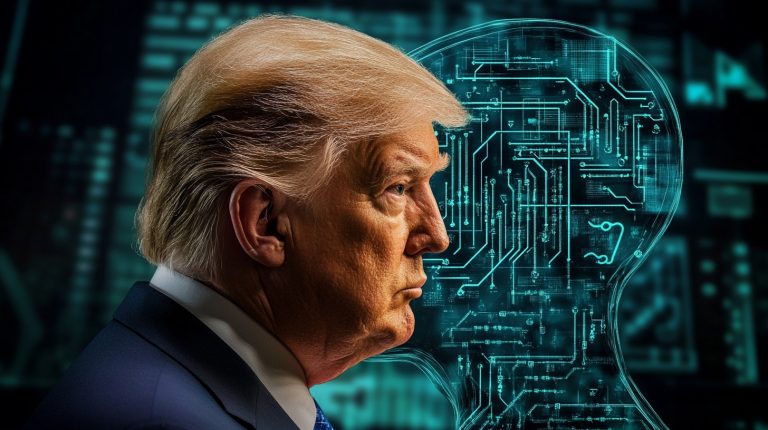
U.S. President Donald Trump is set to reveal his administration’s long-anticipated AI Action Plan on Wednesday in Washington, D.C., marking his most sweeping address yet on artificial intelligence since returning to office in January.
The announcement, which will take place at the “Winning the AI Race” summit, hosted by The Hill and Valley Forum and the All-In Podcast, is expected to outline a new framework for how the United States will build, govern, and globally deploy AI — with Trump aiming to reclaim American dominance in a sector he sees as central to the country’s future.
Three Pillars: Infrastructure, Innovation, and Global Influence
According to a report by Time Magazine, Trump’s AI Action Plan is built on three pillars: infrastructure, innovation, and global influence. The President is expected to propose a sweeping overhaul of permitting rules to fast-track the construction of AI data centers — massive computing hubs that power today’s most advanced language models and algorithms but also strain the energy and water grids of surrounding communities.
Register for Tekedia Mini-MBA edition 20 (June 8 – Sept 5, 2026).
Register for Tekedia AI in Business Masterclass.
Join Tekedia Capital Syndicate and co-invest in great global startups.
Register for Tekedia AI Lab.
The plan includes efforts to modernize America’s aging electrical grid and expand energy production, particularly to support AI’s soaring power demands. Without immediate upgrades, experts have warned that energy shortages tied to these data centers could emerge before the end of the decade.
Under the innovation pillar, Trump aims to revive the effort to preempt state-level AI legislation that could complicate the regulatory landscape for tech firms. A previous federal bill that would have blocked such state initiatives recently failed in Congress, but the Trump administration reportedly plans to pursue executive action to ease regulatory burdens for American AI companies and shield them from what it views as “innovation-stifling” mandates.
The third pillar — global influence — targets the export and adoption of American AI technology abroad. Federal officials are reportedly concerned about the rise of Chinese AI developers like DeepSeek, Qwen, and Moonshot AI. The Action Plan seeks to position American companies like OpenAI, xAI, and Google as the global gold standard in AI development and deployment.

Repealing Biden’s AI Rules
Trump’s plan effectively replaces the Biden administration’s AI executive order, which emphasized safety, transparency, and non-discrimination. Biden’s order had required AI companies to submit reports on security risks and algorithmic bias. Trump repealed it almost immediately after taking office for the second time, saying the rules placed “unnecessary burdens” on American tech companies and risked slowing innovation.
The Pushback: People’s AI Action Plan
The announcement comes amid growing criticism from labor unions, civil rights groups, and consumer advocates, who argue that Trump’s plan favors corporate interests over public safety and accountability. On Tuesday, more than 90 organizations, including labor and environmental justice groups, released an alternative roadmap — dubbed the People’s AI Action Plan. The plan urges the government to prevent Big Tech and fossil fuel lobbyists from dictating AI policy.
“We can’t let Big Tech and Big Oil lobbyists write the rules for AI and our economy at the expense of our freedom and equality, workers and families’ well-being,” the coalition said in a statement, highlighting concerns that the energy demands of Silicon Valley’s AI ambitions may come at a steep cost to American communities.

Executive Orders and the Crackdown on “Woke AI”
Alongside the policy framework, Trump is expected to sign a series of executive orders. One of the most controversial will require companies with federal AI contracts — including OpenAI, Anthropic, Google, and Elon Musk’s xAI — to ensure that their models produce “neutral and unbiased language,” an effort to stamp out what the administration calls “woke” AI.
This move reflects a broader campaign by Trump and the Republican party to confront perceived political bias in Silicon Valley. In the past, Republicans accused social media platforms of censoring conservative voices. Now, the same scrutiny is being directed at AI models, with critics alleging they reflect left-leaning worldviews.
However, defining “neutral” AI remains murky. A recent ruling by a Florida judge found that AI chatbots are not protected by the First Amendment, suggesting the government could impose content-related requirements. Still, some observers point out that setting rules for how AI should respond contradicts Trump’s stated advocacy for free speech.
Tech Giants’ Wishlists
Ahead of the plan’s release, the White House reportedly received more than 10,000 public comments, many from tech giants such as OpenAI, Meta, Amazon, and Google. These companies lobbied the Trump administration to:
Declare training on copyrighted material to be “fair use,” shielding them from growing legal challenges from publishers, artists, and authors.
Protect open-source AI models like Meta’s LLaMA from restrictions. Meta believes open models are key to competing with the closed systems of rivals like OpenAI and Google.
Increase research investment into non-commercial AI efforts, a plea notably ignored by Trump’s Department of Energy, which has already slashed university research funding.
Meanwhile, national security voices have raised concerns that open AI models could leak advanced capabilities to foreign adversaries — particularly China. Anthropic and others have argued that without sufficient oversight, open-source models risk global misuse.
The Global Stakes and America’s AI Arms Race
Trump’s plan comes amid intensifying competition with China over AI supremacy. Chinese labs have accelerated AI development across multiple fronts, prompting unease among U.S. officials. Trump’s strategy appears tailored to assert American dominance by ensuring that U.S.-made models and chips — particularly those from Nvidia, AMD, and AI startups — remain the global standard.
To that end, some of the executive orders are expected to clear red tape around exporting AI-related technologies, potentially helping U.S. firms gain further access to emerging markets.
While Trump’s AI Action Plan promises to supercharge U.S. innovation and reshape global tech leadership, its critics warn that prioritizing deregulation and private sector expansion may undermine much-needed safeguards.