

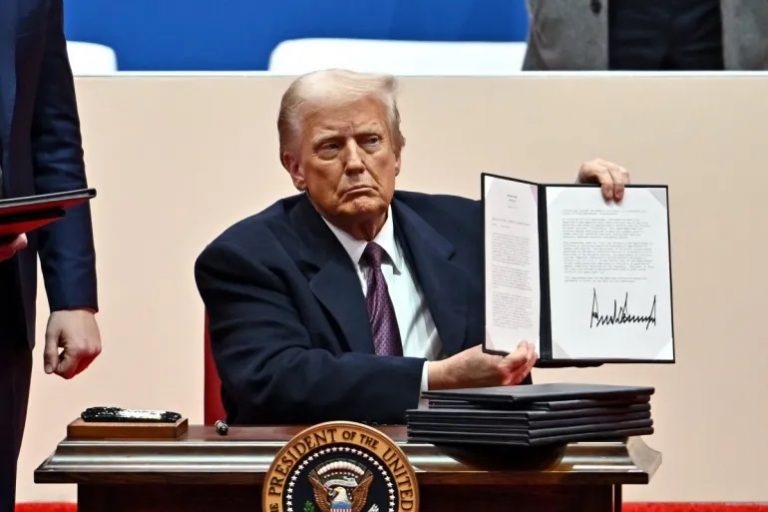
President Donald Trump signed an executive order aimed at preventing banks from discriminating against the cryptocurrency industry and other groups, addressing what his administration described as “debanking” practices.
The order prohibits federal regulators from using “reputational risk” as a justification for influencing banks to deny services to legal businesses, particularly targeting perceived bias against crypto firms and conservative-affiliated clients. It mandates investigations into whether banks have violated laws like the Equal Credit Opportunity Act, antitrust laws, or consumer protection statutes, with potential penalties including fines or consent decrees for violators.
The directive also addresses claims of “Operation Chokepoint 2.0,” an alleged coordinated effort under the Biden administration to pressure banks to sever ties with digital asset firms. This action builds on Trump’s earlier pro-crypto policies, such as a January 2025 executive order promoting digital asset innovation and banning Central Bank Digital Currencies (CBDCs) in the U.S.
Implications for Blockchain Technology
The August 7 order, combined with the January 23 order, emphasizes regulatory clarity for digital assets and blockchain technology. By establishing a President’s Working Group on Digital Asset Markets to propose a federal regulatory framework within 180 days, the administration aims to provide a stable environment for blockchain innovation.
Register for Tekedia Mini-MBA edition 20 (June 8 – Sept 5, 2026).
Register for Tekedia AI in Business Masterclass.
Join Tekedia Capital Syndicate and co-invest in great global startups.
Register for Tekedia AI Lab.
The orders explicitly protect fundamental blockchain activities such as self-custody, mining, and permissionless transactions. This fosters an environment where developers and companies can innovate without fear of regulatory overreach, potentially accelerating advancements in decentralized finance (DeFi), tokenized assets, and Web3 projects.
The policy aims to position the U.S. as a hub for blockchain innovation, countering restrictive regulations in places like China. This could attract global investment and talent to the U.S., enhancing blockchain research and development. The creation of a Strategic Bitcoin Reserve and a U.S. Digital Asset Stockpile, as outlined in a subsequent March 7, 2025, executive order, signals government recognition of cryptocurrencies like Bitcoin as strategic assets.
This move, capitalized with seized cryptocurrencies, could legitimize blockchain-based assets and encourage broader adoption of blockchain technology for secure, decentralized record-keeping. By treating Bitcoin as “digital gold” due to its scarcity and security, the government’s strategy may spur blockchain use in financial systems, reinforcing its role in global transactions.

The prohibition of CBDCs, citing risks to financial stability and individual privacy, prioritizes decentralized blockchain networks over centralized digital currencies. This could drive investment toward permissionless blockchains, as the policy encourages private-sector-led innovation over government-controlled alternatives.
While the orders promote innovation, experts caution that blockchain’s privacy benefits are not absolute, and misuse for illicit activities remains a concern. The administration’s focus on anti-money laundering (AML) measures and blockchain analytics tools may impose compliance requirements that could complicate development for smaller blockchain projects.
How Banks Are Likely to View Cryptocurrencies
Bank of America CEO Brian Moynihan’s statement, “If the rules come in and make it a real thing that you can actually do business with, you’ll find that the banking system will come in hard on the transactional side of it,” suggests banks are ready to engage with crypto as a legitimate payment form if regulatory clarity is provided. This indicates a shift toward viewing cryptocurrencies as viable financial instruments.

The rescission of the SEC’s Staff Accounting Bulletin 121 (SAB 121) on January 23, 2025, removes accounting burdens that deterred banks from offering crypto custody services. Previously, SAB 121 required banks to record customer-held crypto as liabilities, inflating balance sheets and complicating financial reporting. Its withdrawal signals banks can now more easily custody digital assets, potentially leading to broader crypto integration in banking services.
Banks are likely to explore crypto-related services like custody, trading, and payment processing, especially as stablecoin regulations solidify with the GENIUS Act (signed July 18, 2025), which mandates 100% USD or Treasury backing for stablecoins. This could normalize cryptocurrencies in traditional banking operations.
Large banks like JPMorgan Chase and Bank of America, which previously cited AML and financial risk concerns for debanking, may adopt a more open stance but will likely prioritize compliance to avoid penalties. The creation of a national digital asset stockpile and Strategic Bitcoin Reserve lends credibility to cryptocurrencies, potentially attracting institutional investors, including banks.
For banks, the order removes barriers to engaging with crypto, encouraging participation in custody, trading, and payment services, though compliance with AML regulations remains critical. While the policy shift is broadly positive for blockchain and crypto adoption.