

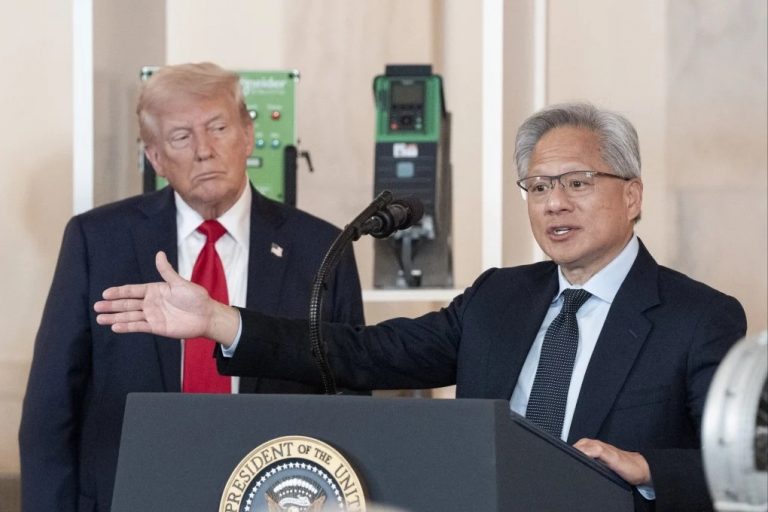
President Donald Trump’s investment accounts purchased shares in Nvidia, Palantir and Elon Musk’s SpaceX in September, around the time the companies secured major federal contracts and their executives met with the president, according to a newly released financial disclosure.
The 25-page filing details 751 purchases and sales with a combined reported value ranging from approximately $40.9 million to $148.1 million, based on a CNBC analysis. Purchases accounted for at least $29.2 million, while sales totaled at least $11.7 million. The disclosure provides broad transaction ranges rather than exact amounts, leaving the precise value of Trump’s holdings unclear.
The timing of several transactions has drawn attention because the companies operate in sectors where federal spending and government policy can have a direct impact on commercial opportunities. Palantir received two federal contracts worth a combined $42.5 million after Trump’s accounts bought its shares. SpaceX secured a $946 million expansion of its NASA contract between two reported share purchases, while Nvidia continued to feature in the portfolio as its then-chief executive, Jensen Huang, developed a close relationship with the president.
Register for the next Tekedia Mini-MBA.
Register for Tekedia AI in Business Masterclass.
Join Tekedia Capital Syndicate and co-invest in great global startups.
The transactions raise questions about the potential conflicts associated with a sitting president maintaining investments in companies affected by decisions made by his administration. Trump’s accounts reported more than 21,000 trades in 2025, compared with approximately 500 during his entire first term. Recent presidents have generally avoided holding individual stocks or placed their investments in blind trusts to limit potential conflicts of interest.
There is, however, no evidence that Trump directed the transactions or that the independent managers overseeing his investments had advance knowledge of government decisions.
White House spokesman Davis Ingle said the president’s portfolio was managed independently and that neither Trump nor his family had any input into investment decisions.

“All investment decisions are made entirely by independent managers,” Ingle told CNBC.
The White House has previously maintained that Trump and his family have no control over the trades. The Trump Organization has also said the arrangement is intended to avoid even the appearance of conflicts.
The timing of the Palantir transactions is particularly notable given the company’s extensive business with US government agencies. Its artificial intelligence software is used by military, intelligence, and civilian institutions, making federal contracts an important part of its commercial operations.

Trump’s accounts purchased between $15,001 and $50,000 in Palantir shares on September 2, followed by another purchase valued between $1,001 and $15,000 on September 9.
A week later, the Department of Housing and Urban Development awarded Palantir a contract with $10.4 million in initial obligations for an artificial intelligence system designed to oversee grants and detect fraud.
On September 29, the Department of Homeland Security awarded the company another software contract worth $32.1 million. The two awards brought the combined value of the contracts to approximately $42.5 million.
That same day, Palantir Chief Executive Alex Karp attended a White House meeting on artificial intelligence alongside Trump, Musk, Huang and other technology executives.
The sequence places the purchases shortly before the federal awards and a meeting involving the company’s chief executive. The disclosure does not establish that Trump or his investment managers knew about the contracts before they were announced.
SpaceX Trades Surrounded NASA Contract Expansion
Trump’s accounts also bought SpaceX shares and debt in September, with transactions taking place shortly before and after a major expansion of the company’s NASA contract.
On September 1, the accounts purchased between $100,001 and $250,000 in SpaceX debt carrying an interest rate of 5.35%. Eight days later, they acquired another block of shares valued between $1,001 and $15,000.
NASA announced on September 18 that it was expanding its SpaceX contract by $946 million, adding three astronaut missions to the International Space Station. The expansion brought the agreement’s total value to $5.92 billion. NASA had already signaled plans for additional missions in May.
On September 24, Trump’s accounts purchased another $15,001 to $50,000 in SpaceX shares. The transaction occurred on the same day Musk attended a White House state dinner for Chinese President Xi Jinping. The filing does not establish whether the purchase was made before or after the dinner.
The September activity followed a substantially larger investment in August, when Trump’s accounts bought between $1 million and $5 million in SpaceX debt. That purchase took place two days before Trump signed a policy aimed at expanding commercial space transportation.
SpaceX is a major contractor for NASA and the Pentagon, placing it among the private companies whose commercial prospects are closely connected to federal spending and government policy.
Nvidia Trades Too
The disclosure also records continued purchases of Nvidia shares as Huang’s relationship with Trump attracted attention.
Trump’s accounts made four Nvidia purchases in September, with a combined reported value ranging from $152,004 to $380,000. Two transactions on September 2 accounted for as much as $350,000. The accounts also sold between $1,001 and $15,000 in Nvidia shares on September 24, the day Huang attended the state dinner with Xi.
The September transactions bring the number of reported Nvidia trades by Trump’s accounts since his return to office in 2025 to at least 108. Their combined value ranges from $27.2 million to $97.9 million, according to CNBC’s analysis.
Huang’s relationship with the president has faced renewed scrutiny following a New York Times report that US intelligence officials warned Trump about the Nvidia chief’s relationship with a woman suspected of spying for China. Trump has denied receiving such a briefing. Huang resigned on November 12 following revelations about his personal relationships.
The latest disclosure adds to questions surrounding the president’s financial exposure to companies whose interests can be affected by federal contracts, trade restrictions and technology policy. It does not, however, establish that any of the transactions were influenced by confidential government information.
The September filing also shows substantial activity across other sectors, including consumer goods, retail, telecommunications and financial services.
The largest reported purchase was made on September 23, when Trump’s accounts acquired between $5 million and $25 million in shares of the Vanguard Dividend Appreciation ETF.
On the same day, the accounts sold between $1 million and $5 million each in Comcast, McDonald’s, Home Depot and Fidelity National Information Services. They also disposed of between $500,001 and $1 million each in Nike and Constellation Brands.
Among other purchases, the accounts acquired between $250,001 and $500,000 in TJX shares on each of September 15 and 16. They also bought Tesla shares through four transactions valued between $117,004 and $330,000 in total.
Smaller investments included purchases of shares in CoreWeave, Intel, Microsoft, and Apple.
The scale of the activity is notable not only because of the individual companies involved but also because of the volume of transactions reported during Trump’s second term. While the White House maintains that independent managers make all investment decisions, the portfolio continues to hold positions in businesses operating within industries subject to presidential influence, including artificial intelligence, defense, and commercial space transportation.
The disclosure provides a record of the transactions and their reported value ranges. It does not establish that Trump personally selected the investments, knew about upcoming contract decisions, or intervened in the award of government business.