

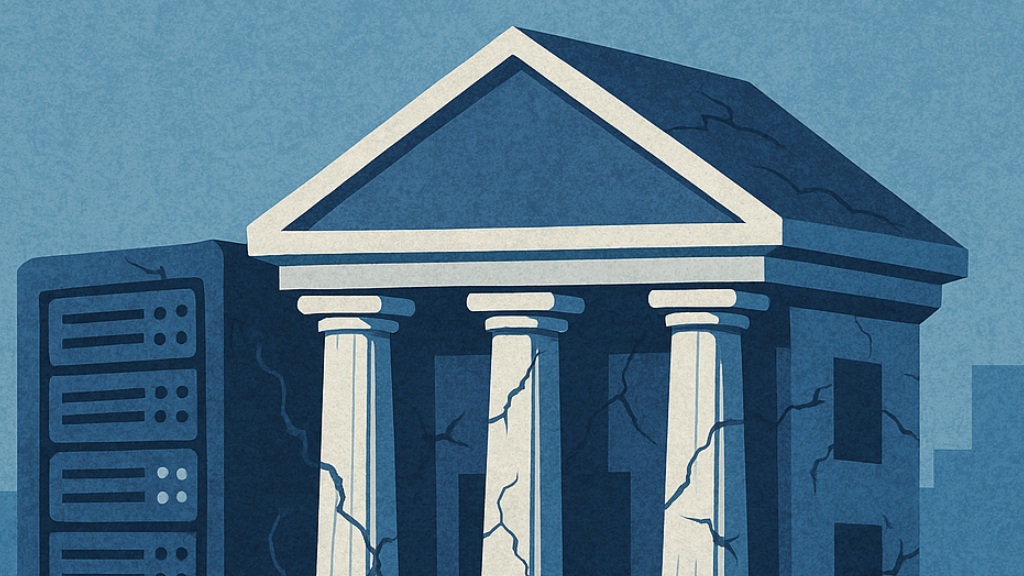
Most banking innovation over the past decade has been cosmetic, a sleeker mobile app layered over the same century-old fractional-reserve plumbing.
While digital banking has made payments faster and account management easier, the underlying financial system still relies on a fundamental imbalance: banks promise customers access to their money on demand while lending or investing much of the deposits they hold.
This structure, known as fractional-reserve banking, allows financial institutions to expand credit, finance economic activity and generate profits. However, it also introduces an inherent vulnerability.
Register for the next Tekedia Mini-MBA.
Register for Tekedia AI in Business Masterclass.
Join Tekedia Capital Syndicate and co-invest in great global startups.
Banks rarely maintain enough immediately available cash to satisfy every depositor simultaneously. Their business models depend on the assumption that customers will not all withdraw their funds at once.
That assumption becomes dangerous during periods of uncertainty. If depositors lose confidence and rush to withdraw money, banks can face liquidity crises, forcing them to sell assets, borrow emergency funds or seek government intervention.
Even institutions with valuable long-term assets can struggle when liabilities demand immediate payment. Bank runs, therefore, are not necessarily unexpected accidents but potential consequences of the structural mismatch between deposits and lending.

Stablecoins have emerged as an alternative for moving money across digital networks, but they do not necessarily eliminate the weaknesses associated with traditional banking.
Most stablecoins are backed by reserves consisting of cash, Treasury securities or deposits held with financial institutions. A token represents a claim supported by those underlying assets, rather than independently creating a new monetary settlement system.
Although stablecoins can enable near-instantaneous transfers around the clock, their reliability ultimately depends on the issuer’s reserve management, redemption policies, custodians and banking relationships.

They are effectively tokenized receipts for underlying value. If redemption becomes restricted, reserves are questioned or banking partners experience disruptions, the token may face liquidity or confidence challenges.
Blockchain technology can improve transferability, but it cannot automatically guarantee the safety of the assets backing a stablecoin. The argument for full-reserve banking takes a different approach.
Instead of lending customer deposits to finance other activities, a full-reserve institution seeks to maintain assets sufficient to cover deposit liabilities.
Wyoming has developed a regulatory framework for Special Purpose Depository Institutions, or SPDIs, designed to accommodate institutions that operate with full-reserve principles and provide digital-asset-related financial services.
Custodia Bank, a Wyoming-chartered institution, has positioned itself around this model, seeking to combine regulated banking with blockchain-based financial infrastructure.
The concept is to hold dollar assets securely while enabling more efficient transfers and settlement through digital systems. Unlike conventional banks that depend heavily on lending and maturity transformation, the full-reserve model emphasizes liquidity, custody and payment services.
The potential advantage is significant. If properly implemented, dollar settlement could become faster, more transparent and less dependent on intermediaries that introduce delays or counterparty exposure.
Blockchain transactions can provide verifiable records, while settlement mechanisms may reduce the time between payment initiation and finality. Immutability should not be confused with absolute legal finality, guaranteed redemption or protection against operational failures.
Full-reserve banking also has trade-offs. Restricting deposit-funded lending could limit credit creation, potentially increasing reliance on capital markets, other lenders or separately funded credit institutions.
Regulatory compliance, cybersecurity, liquidity management and operational resilience remain essential. Moreover, a Wyoming charter does not automatically mean every service offered by an institution is universally protected by federal deposit insurance.
The real innovation is not simply putting dollars on a blockchain. It is rethinking the architecture through which money is held, transferred and settled.
Whether full-reserve institutions can deliver a safer, more efficient alternative at scale will depend on regulation, transparency, technological reliability and public trust.
The future of banking may depend less on better apps and more on whether the underlying financial infrastructure can deliver money that is genuinely available, securely held and reliably settled when customers need it.