

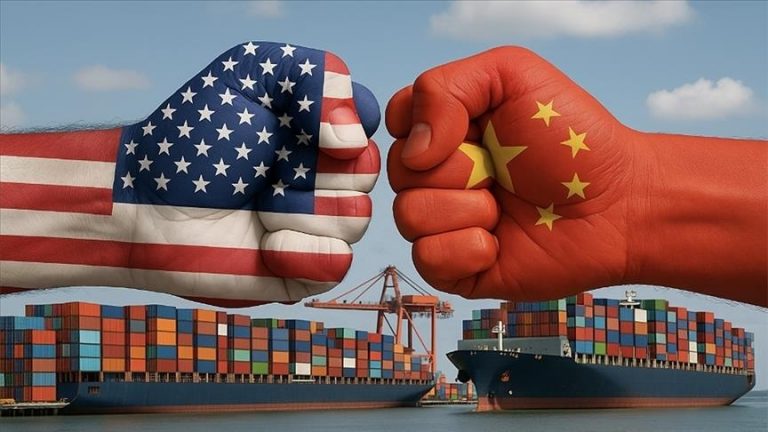
Washington says DeepSeek, Alibaba and other Chinese AI companies used American models to accelerate development, raising tensions ahead of planned U.S.-China talks
The U.S. government on Tuesday accused Chinese artificial intelligence companies of systematically copying technology from leading American AI firms, escalating an already contentious technology rivalry ahead of a planned meeting between the leaders of the world’s two largest economies later this month.
U.S. law enforcement and intelligence officials alleged that six Chinese AI companies, including DeepSeek, Moonshot AI and Alibaba, used a technique known as distillation to extract capabilities from U.S.-developed AI models and accelerate the development of their own systems.
Register for the next Tekedia Mini-MBA.
Register for Tekedia AI in Business Masterclass.
Join Tekedia Capital Syndicate and co-invest in great global startups.
Distillation is a legitimate AI development technique in which the outputs of a larger, more computationally expensive model are used to train a smaller model. The approach can reduce the cost and time required to develop new AI systems.
U.S. officials, however, accused the Chinese companies of using variants of American AI models in an aggressive and targeted manner to reproduce capabilities developed by U.S. laboratories.
“China-based AI companies are engaging in aggressive, malicious and targeted distillation activities at an industrial scale,” U.S. officials said in a joint statement.

The officials alleged that the companies targeted AI models developed by Anthropic, OpenAI and Alphabet’s Google, as well as technology associated with SpaceX. They said the activity was “likely with Chinese government awareness.”
The allegations add another layer to the increasingly broad U.S.-China technology confrontation, in which artificial intelligence has become strategically important to both countries.
U.S. officials said the alleged distillation activity not only lowers research and development costs for Chinese companies but could also strengthen China’s military and cyber capabilities, potentially creating applications that could be used against the United States and its allies.

The accusations come as the administration of President Donald Trump prepares for Chinese President Xi Jinping’s planned visit to the United States in late September. Washington and Beijing are also preparing for an AI safety dialogue expected to take place in mid-September, making the timing of the allegations particularly sensitive.
The two governments have attempted to maintain channels for negotiations even as disputes over tariffs, semiconductor technology, advanced computing and AI continue to complicate the relationship.
The U.S. previously made a similar accusation in April, underscoring how concerns about Chinese access to American AI capabilities have become a recurring element of the broader technology dispute.
Reuters reported on July 31 that Chinese military researchers had used outputs from leading U.S. AI models to train domestic AI systems and advance Chinese defense capabilities.
Distillation Becomes A New Battleground
The dispute highlights the growing importance of model distillation as AI developers look for ways to obtain sophisticated capabilities without bearing the enormous computing costs associated with training frontier models from scratch.
For Chinese companies, access to the outputs of highly capable American systems could potentially shorten development cycles and reduce the computing resources required to produce competitive models.
But the issue raises a different concern for U.S. AI companies: whether restrictions on access to advanced chips and computing infrastructure can prevent competitors from replicating capabilities indirectly through model outputs.
That could make AI controls increasingly difficult to enforce. Unlike physical semiconductors, model outputs can potentially be generated remotely and transferred digitally, creating new challenges for policymakers attempting to protect intellectual property and restrict the proliferation of advanced AI capabilities.
The U.S. allegations also come at a time when Chinese AI companies have demonstrated an ability to develop highly capable systems despite American restrictions on advanced semiconductor exports.
The resulting competition is now moving beyond the question of which country can build the most powerful models. It is becoming a contest over access to computing, proprietary data, intellectual property, model weights, semiconductor technology and the ability to deploy AI at scale.
The accusations could complicate efforts by Washington and Beijing to stabilize their broader economic relationship before the leaders’ meeting later this month. AI is already one of the most sensitive areas of the technology rivalry because advances in the field have potential commercial, military and cybersecurity applications.
Washington is therefore facing a difficult balance: preserving diplomatic channels with Beijing while attempting to prevent American AI capabilities from being transferred or replicated in ways U.S. officials believe could undermine national-security interests.
Beijing, meanwhile, has incentives to continue developing domestic AI capabilities as it seeks to reduce its dependence on American technology. The situation makes the dispute over distillation more than a disagreement over software-development practices. It is becoming part of a much larger struggle over technological leadership, economic competitiveness and national security.