

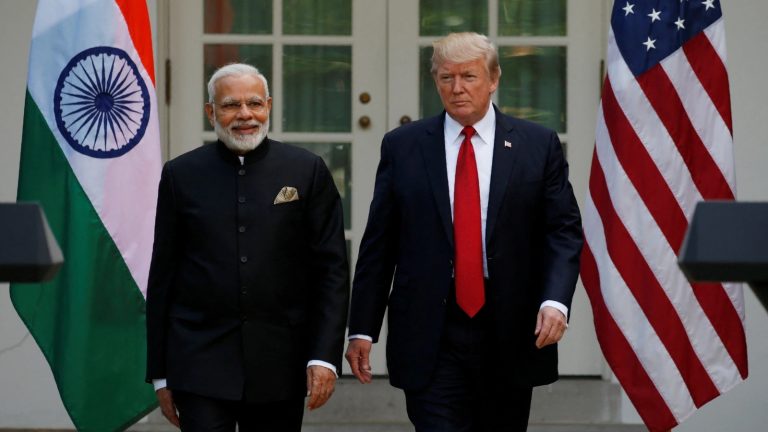
The interim pact not only lowers tariffs but links trade access to energy realignment, binding U.S.–India commerce to Washington’s broader strategy of squeezing Russia’s oil revenues.
The United States and India are moving toward formal implementation of an interim trade agreement that reduces U.S. tariffs on Indian goods to 18% and removes a 25% punitive levy previously imposed in response to India’s purchases of Russian oil.
The arrangement, expected to take effect in April pending formal notification from Washington, represents a recalibration of trade tensions while embedding energy geopolitics directly into bilateral commerce.
Register for Tekedia Mini-MBA edition 20 (June 8 – Sept 5, 2026).
Register for Tekedia AI in Business Masterclass.
Join Tekedia Capital Syndicate and co-invest in great global startups.
Register for Tekedia AI Lab.
President Donald Trump confirmed the tariff reduction earlier this month, stating that India had agreed to end its purchases of Russian oil and expand energy imports from the United States. He also indicated that India could buy crude from Venezuela as part of its diversification strategy.
India’s Commerce and Industry Minister Piyush Goyal said Friday that the U.S. is likely to issue a formal notification this month reducing its tariff on Indian goods to 18%, with the interim arrangement becoming effective in April. He added that a final trade agreement would be signed “sooner than later,” describing the remaining issues as limited to “a few tweaking points.” Trump has been invited to India by Prime Minister Narendra Modi in connection with that broader pact.
The interim deal reverses a period of escalating tariff friction. U.S. duties on Indian exports had climbed sharply under the administration’s broader trade agenda, at times incorporating punitive measures tied to energy policy. The 25% levy was directly linked to Washington’s position that purchases of Russian crude helped fund Moscow’s invasion of Ukraine.

Following Russia’s 2022 invasion, the United States and its allies imposed sanctions on Russia’s energy sector. India subsequently became the largest buyer of Russian seaborne crude, purchasing barrels at steep discounts. The shift frustrated Western governments, which argued that discounted sales were sustaining Russian state revenues.
Under the new framework, India has committed to diversifying its oil imports. U.S. officials have stated that the objective extends beyond India alone. “The United States doesn’t want anyone buying Russian oil,” a U.S. envoy said, describing India’s diversification as part of a broader energy realignment.
Energy Diplomacy and Venezuela’s Role
In parallel with the trade talks, Washington has explored facilitating Venezuelan crude exports to India as a substitute for Russian supplies. The U.S. granted licenses to trading houses Vitol and Trafigura to market and sell Venezuelan oil after the capture of Venezuelan President Nicolas Maduro and the negotiation of a supply arrangement with interim president Delcy Rodriguez.

This maneuver reflects a layered geopolitical calculus. By encouraging India to source crude from the United States and Venezuela, Washington aims to blunt Russia’s energy income while stabilizing supply for one of the world’s fastest-growing major economies. For India, diversification reduces exposure to secondary sanctions risk while preserving access to competitively priced barrels.
Energy trade thus becomes an enforcement mechanism embedded within tariff policy. The interim agreement links market access in goods to compliance with broader strategic objectives — a structural shift in how economic and security policy are intertwined.
Economic Implications for India
An 18% tariff level remains above traditional most-favored-nation rates but marks a significant reduction from prior punitive levels. For Indian exporters in sectors such as pharmaceuticals, textiles, engineering goods, auto components, and specialty chemicals, the clarity of a defined tariff band provides planning certainty after months of volatility.
The United States is India’s largest export market. Lower duties are expected to improve price competitiveness and support order flows, particularly for labor-intensive goods sensitive to marginal cost changes. Indian firms that had absorbed part of the tariff burden may regain margins, while U.S. importers could see moderated landed costs.
However, replacing discounted Russian crude with U.S. or Venezuelan oil could raise India’s average import bill depending on price spreads. Russian barrels had traded at deep discounts following sanctions. A narrower differential may compress refining margins or feed into domestic fuel pricing.
India’s policymakers are therefore balancing trade access gains against potential energy cost adjustments.
Implications for the United States
For Washington, the agreement serves multiple objectives. It lowers tariff friction with a major strategic partner while reinforcing pressure on Moscow’s energy revenues. It also underscores the administration’s approach of deploying tariffs as leverage to shape allied behavior.
Reduced tariffs on Indian goods could modestly ease input costs for U.S. manufacturers and retailers. Because tariffs are paid by U.S. importers at the border, a cut from higher punitive levels to 18% may mitigate inflationary pressures in certain categories, particularly consumer goods.
At the same time, the rollback trims potential tariff revenue compared to prior rates. The administration has repeatedly emphasized tariffs as a revenue source, but the interim deal signals flexibility when strategic priorities dictate.
However, officials on both sides describe the interim deal as a bridge to a broader bilateral trade agreement. Such a pact could address market access in agriculture, digital trade rules, services, intellectual property protections, and supply chain cooperation.
India has historically been cautious in full free-trade negotiations, prioritizing protection for agriculture and sensitive industries. The United States has sought deeper market opening and regulatory alignment. The reference to “tweaking points” suggests that politically sensitive sectors remain under discussion.
If finalized, a comprehensive agreement would formalize a deeper economic integration between two of the world’s largest democracies. It would also embed trade flows within a strategic framework shaped by energy security, supply chain diversification, and geopolitical alignment.