

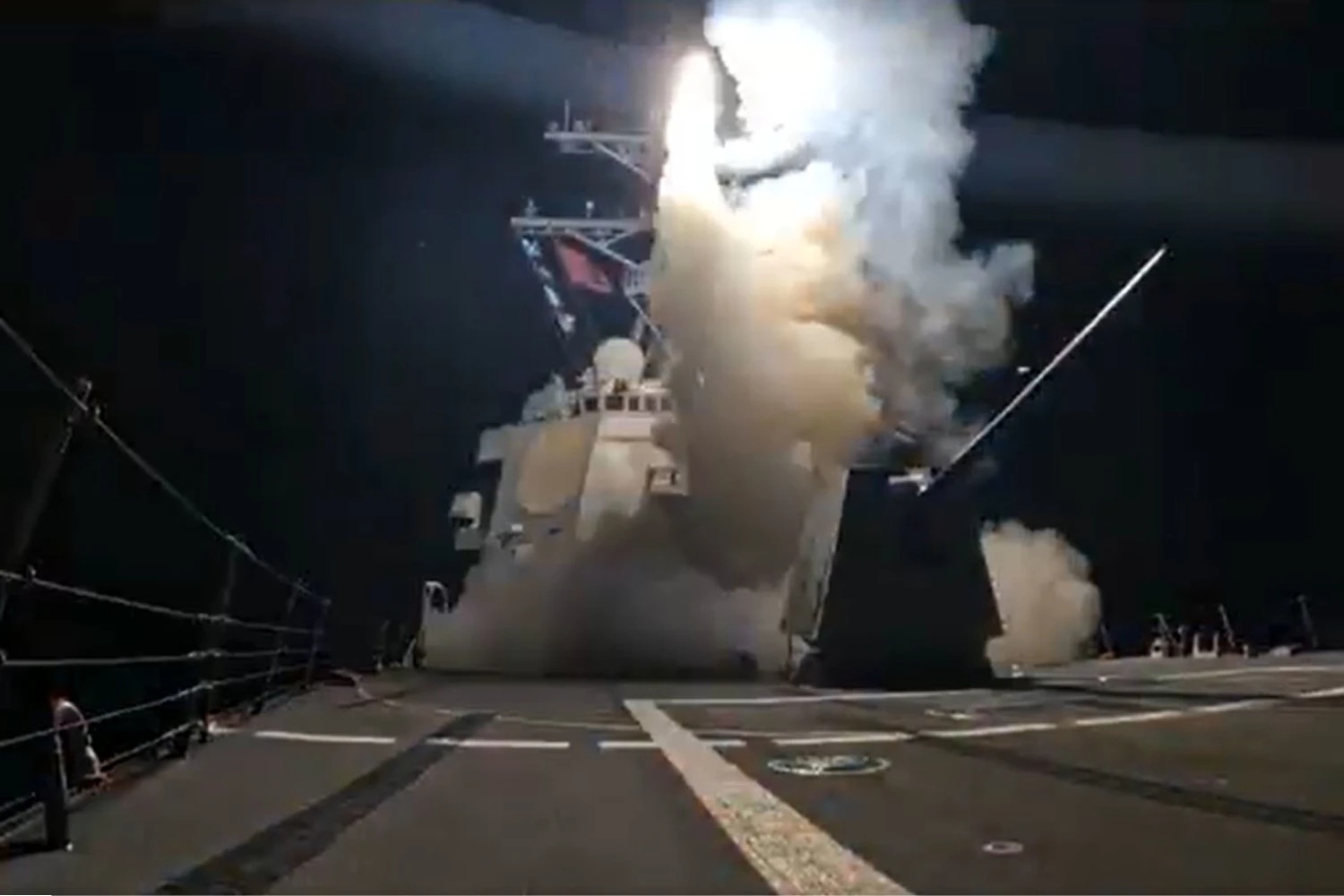
The United States has carried out a military strike targeting Islamic terrorists in northwest Nigeria, President Donald Trump said on Thursday, marking a rare publicly acknowledged U.S. military action in that part of the country and sharpening Washington’s focus on Nigeria’s security crisis.
“Tonight, at my direction as Commander in Chief, the United States launched a powerful and deadly strike against ISIS Terrorist Scum in Northwest Nigeria,” Trump said in a post on his Truth Social platform.
He said the fighters had “targeted and viciously” killed civilians, adding that the victims were “primarily, innocent Christians,” and claimed the scale of the killings had not been seen “for many years, and even Centuries!”
Register for Tekedia Mini-MBA edition 20 (June 8 – Sept 5, 2026).
Register for Tekedia AI in Business Masterclass.
Join Tekedia Capital Syndicate and co-invest in great global startups.
Register for Tekedia AI Lab.
Trump framed the strike as a response to earlier warnings he said he had issued to the group.
“I have previously warned these Terrorists that if they did not stop the slaughtering of Christians, there would be hell to pay, and tonight, there was,” he said.
The U.S. military’s Africa Command (AFRICOM), which oversees American operations on the continent, confirmed the strike in a separate statement on X. AFRICOM said the operation was carried out at the request of Nigerian authorities and resulted in the deaths of “multiple ISIS terrorists.” It did not provide further details on the exact location, the number of casualties, or the assets used in the strike.

The operation follows comments made by Trump weeks earlier, when he said he had ordered the Pentagon to begin planning for possible military action in Nigeria. Those remarks were linked to his administration’s public emphasis on alleged persecution of Christians in parts of the country, an issue Trump has repeatedly highlighted in statements and online posts.
In Washington, the issue of violence against Christians in Nigeria has been the subject of sustained discussion on Capitol Hill. Over the past months, U.S. lawmakers have held hearings and briefings examining reports of mass killings in central and northern Nigeria. This has led to the U.S. designating Nigeria as a “country of particular concern.”
Lawmakers have cited repeated attacks in rural communities, particularly in Plateau and Benue states, where armed groups have carried out raids that local leaders and church officials say have disproportionately affected Christian farming communities.

Nigeria’s government has pushed back against that framing, saying violence across the country is driven by a complex mix of insurgency, banditry and communal conflict, and that armed groups attack both Muslim and Christian communities. Nigerian officials have also said U.S. assertions focusing narrowly on Christian persecution overlook ongoing efforts by security forces to restore stability and protect freedom of worship in affected regions.
The U.S. strike also comes amid a tougher diplomatic posture from Washington. The U.S. State Department recently announced visa restrictions on Nigerians, adding to earlier restrictions imposed on those found to be involved in mass killings or violence against Christians, a move that underscored the administration’s willingness to pair security cooperation with targeted sanctions.
While U.S. forces have long supported Nigeria through intelligence sharing, training and limited counterterrorism assistance, direct American strikes inside the country are uncommon and politically sensitive. AFRICOM’s statement that the operation was conducted at Nigeria’s request suggests close coordination between the two governments, even as public narratives around the causes of violence continue to diverge.
The Nigeria government says President Bola Tinubu approved the US strikes. Foreign Affairs Minister, Yusuf Tuggar, said on Friday on Channels Television’s Sunrise Daily, that it was Nigeria that provided intelligence for the US.
“We spoke with US Secretary of State Marco Rubio twice: once 19 minutes before the strike and another time 5 minutes before it went on,” he said.
He explained that as a multi-religious country, Nigeria is working with partners like the US to fight terrorism and safeguard the lives and properties of Nigerians.
“Now that the US is cooperating, we would do it jointly, and we would ensure, just as the President emphasized yesterday before he gave the go-ahead, that it must be made clear that it is a joint operation, and it is not targeting any religion nor simply in the name of one religion or the other,” the minister added.
However, the U.S. strike has sparked debate over sovereignty. Some Nigerians have sounded alarm about the precedent set by foreign military action on Nigerian soil, even when carried out with Abuja’s consent. But others have countered that Nigeria itself has recently taken similar cross-border security actions. Early this month, Nigeria launched air strikes in neighboring Benin Republic, targeting coup plotters who attempted to take over government.