

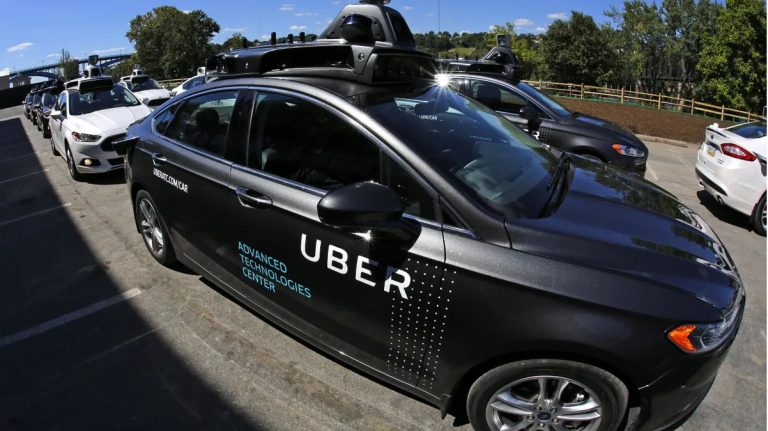
Artificial intelligence is already reshaping the ride-hailing business in a way that would have seemed futuristic only a few years ago: some Uber drivers are now relying on Tesla’s Full Self-Driving system to handle part of the driving task, and Uber’s chief executive is openly acknowledging it.
In remarks on Peter Diamandis’ Moonshots podcast, Uber CEO Dara Khosrowshahi said the company has “tens of thousands” of Teslas operating on its platform and confirmed that some drivers are using Tesla’s Full Self-Driving, or FSD, while transporting passengers.
“We’ve got tens of thousands of Teslas on our platform now,” Khosrowshahi said. “And some of our drivers use FSD. Sure. So we’ve got a lot of data. It’s a great car. It’s a safe car.”
Register for Tekedia Mini-MBA edition 20 (June 8 – Sept 5, 2026).
Register for Tekedia AI in Business Masterclass.
Join Tekedia Capital Syndicate and co-invest in great global startups.
Register for Tekedia AI Lab.
The disclosure offers a striking glimpse into how AI-assisted driving is quietly entering the mainstream ride-hailing economy, long before fully autonomous robotaxis become widespread. While Tesla markets FSD as an advanced driver assistance system rather than a fully autonomous platform, its growing use by Uber drivers effectively means passengers are already experiencing AI-assisted rides in human-supervised settings.
This is not, strictly speaking, illegal.
At present, there are no US laws that explicitly prohibit ride-hail drivers from using advanced driver assistance systems during trips, provided they remain fully attentive and retain control of the vehicle. Tesla itself states that active safety and driver-assistance features are designed to assist, not replace, the driver, and that the human behind the wheel remains responsible for safe operation at all times.

Uber’s own policy aligns with that standard. The company requires drivers using such systems to keep at least one hand, and normally both hands, on the steering wheel while the technology is engaged.
However, the development raises fresh questions about liability, safety, and public trust. Tesla’s driver-assistance systems have long been under legal and regulatory scrutiny. Several incidents involving Autopilot and FSD have intensified debate over whether the branding and real-world use of the technology outpace its actual capabilities.
Tesla has come under the National Highway Traffic Safety Administration (NHTSA)’s investigation following the growing number of crashes involving the EV maker’s vehicles.

One notable case cited in earlier reporting involved an Uber driver using Tesla’s FSD who crashed into an SUV while the system was active. That case underscores a central tension in the emerging AI mobility market: these systems are sophisticated enough to take over large portions of the driving task, but not advanced enough to absolve the human driver of responsibility.
For Uber, however, the shift is expected to evolve into its broader robotaxi strategy. Khosrowshahi’s comments indicate that Uber is treating today’s human-supervised AI driving as a bridge to tomorrow’s autonomous network.
He went further, saying Uber would welcome Tesla’s future robotaxis onto its platform once the company’s camera-only autonomous system is proven sufficiently safe for fully driverless deployment.
“When the day comes when those Teslas are safe enough with a camera-only approach, we’d love to have those Teslas on our platform as well,” he said.
This is consistent with Uber’s broader strategy of rebuilding its position in autonomous mobility through partnerships rather than in-house development. After exiting its own self-driving programme years ago, Uber has increasingly aligned itself with external autonomous vehicle players, including Waymo, Zoox, Pony.ai, and WeRide. More recently, it has expanded its ambitions through fresh robotaxi rollout plans in multiple global cities.
The company appears to be positioning itself as the distribution layer for whatever form autonomy ultimately takes, whether human-supervised Teslas today or fully driverless fleets tomorrow. That approach is commercially pragmatic. Uber no longer needs to win the technology race itself if it can remain the platform through which autonomous mobility is monetized at scale.
For Tesla, meanwhile, the development offers a preview of how its FSD ecosystem may evolve commercially beyond private ownership. Even before the company’s dedicated Robotaxi service achieves broad regulatory clearance, Tesla vehicles are already functioning as what some analysts describe as “proto-robotaxis” on platforms like Uber, where AI handles parts of the trip under human oversight.
The broader implication is that the line between assisted driving and autonomous ride-hailing is becoming increasingly blurred. Passengers booking an Uber may still see a driver in the front seat, but in a growing number of cases, AI is already doing part of the work.
That may be the most consequential transition underway for the ride-hailing industry: not the sudden arrival of driverless cars, but the gradual normalization of shared control between human drivers and machine intelligence.