

American businesses accelerated orders for Chinese goods in the weeks before President Donald Trump’s meeting with Chinese President Xi Jinping, signaling that companies were positioning for a period of greater stability in the US-China trade relationship after months of tariff uncertainty.
The increase in US-bound orders was described as a “surprise” by China Beige Book, a New York-based research firm that surveyed 1,296 Chinese companies between September 1 and 22. Its measure of US orders, calculated as the share of companies reporting an increase in orders minus the share reporting a decline, rose to 13 in September from 3 in August and minus 12 a year earlier.
Shipments to the United States increased on both a monthly and annual basis as China’s relative tariff position improved, China Beige Book said.
Register for the next Tekedia Mini-MBA.
Register for Tekedia AI in Business Masterclass.
Join Tekedia Capital Syndicate and co-invest in great global startups.
The data provide an early indication that American importers were responding to signs of a less confrontational trade environment ahead of the summit, with companies apparently willing to increase orders while the risk of another escalation in tariffs receded.
The improvement was not broad-based across China’s economy, however. Overall domestic and export orders remained below their levels a year earlier, while new orders weakened from August. The increase in US-bound orders appears to have been driven partly by the changing trade relationship rather than a broad acceleration in Chinese demand or global trade.
The increase in orders came as businesses prepared for what was expected to be a more stable outcome from Trump’s meeting with Xi in Washington. The two governments agreed to extend their trade truce by two months, to January. The arrangement keeps tariffs at lower levels, suspends restrictive controls on rare-earth exports and postpones higher port fees on ships.

Washington also reportedly planned to delay a threatened new round of tariffs related to China’s industrial overcapacity until at least after the summit, reducing immediate pressure on Chinese exporters. For companies that source goods from China, the combination of lower near-term tariff risk and improved access to critical materials creates an incentive to bring forward orders.
That does not mean the trade conflict has been resolved.
The effective US tariff rate on Chinese goods remains around 23%, according to Barclays, considerably higher than the average tariff the United States applies to other major trading partners. Companies therefore continue to operate with a materially higher cost of importing Chinese goods than before the trade conflict. The recent improvement is better understood as a reduction in uncertainty rather than a return to the pre-tariff trading environment.

That development matters for importers. Tariff uncertainty can make companies reluctant to place large orders because they cannot determine the final landed cost of goods several months ahead. A temporary truce provides greater visibility and can encourage businesses to rebuild inventories or increase purchases before the policy environment changes again.
The latest China Beige Book figures suggest that this behavior was already emerging before Trump and Xi met.
China’s Ports Offer Another Sign Of Recovery
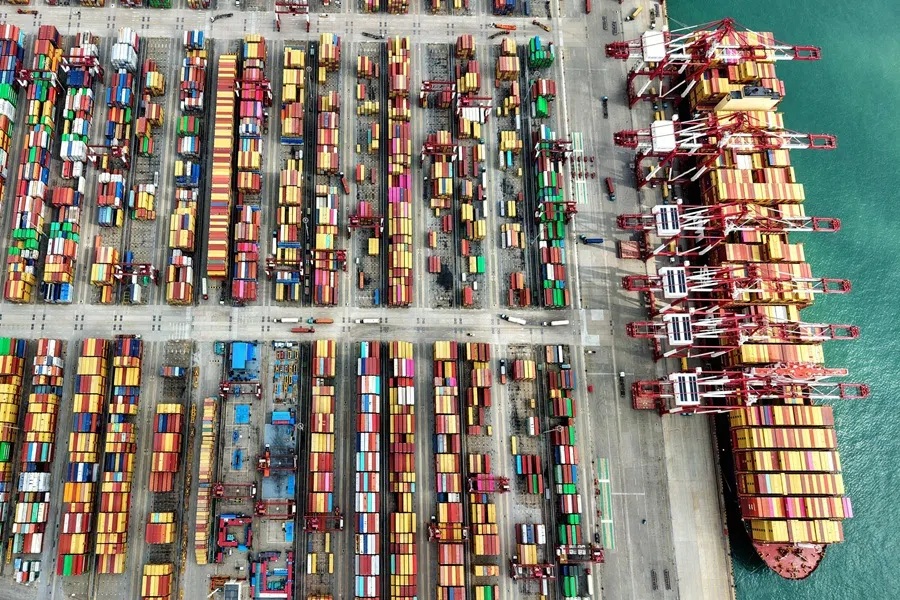
The increase in US orders coincided with other signs that trade flows were improving. Chinese ports recorded their busiest week on record in the run-up to the summit, according to recent official data. The surge provides another indication that international trade activity was strengthening as businesses anticipated a further easing in bilateral tensions.
The combination of stronger US-bound orders and elevated port activity suggests that the trade truce was having an effect on the physical movement of goods, even though China’s overall order environment remained weaker than a year earlier.
The data also illustrate how quickly businesses can respond when the perceived probability of further tariff escalation falls.
Companies do not necessarily need a permanent trade agreement to alter purchasing decisions. Even a temporary reduction in policy uncertainty can affect inventory planning, shipping schedules and procurement. That may be relevant for US companies with supply chains deeply tied to Chinese manufacturing.
However, the improved trade flows are taking place against a relationship that remains structurally difficult.
Following the extension of the truce, Eurasia Group raised its assessment of the prospects for continued stability in US-China relations to its highest level since Trump returned to office. The consultancy said the shorter-than-expected extension was unlikely, by itself, to trigger another escalation.
“Neither government has an interest in renewed escalation,” said Dan Wang, China director at Eurasia Group.
Wang said both sides were likely to continue pressing for near-term commitments that could preserve the fragile stability.
The next phase of negotiations is thus expected to focus less on headline tariff reductions and more on specific concessions. Washington is also expected to seek faster Chinese approval of rare-earth export licenses for US end users, as well as greater Chinese purchases of US agricultural products, Wang said.
Rare earths have become an important bargaining tool because China remains a major supplier of the minerals and processed materials required across advanced manufacturing, electronics, automotive production and defense industries.
For Beijing, the list of priorities is different. Wang said China would expect the White House to maintain its current pause on arms sales to Taiwan. That creates a familiar pattern in US-China negotiations: trade concessions are linked to issues involving technology, strategic materials and national security.
Companies Still Face Significant Uncertainty
Analysts believe that the increase in Chinese export orders should not be interpreted as evidence that businesses believe the trade conflict is permanently over.
The temporary truce has simply changed the immediate risk calculation. The 23% effective US tariff rate on Chinese imports remains substantial, while the two governments have yet to resolve fundamental disagreements over industrial capacity, technology controls, market access and national security.
The possibility of additional tariffs also remains an important risk for businesses. Any renewed escalation could quickly change procurement economics, particularly for companies operating on narrow margins or relying heavily on China-based suppliers.
For Chinese manufacturers, stronger US orders provide some relief, but the broader order data remain less encouraging. Domestic and export orders are still below last year’s levels, while September’s overall new-order reading weakened from August. That suggests the US market is currently performing as a relative bright spot rather than signaling a broad revival in Chinese manufacturing demand.
The timing of the increase also matters. Companies increased orders ahead of the summit, meaning some of the activity may represent precautionary purchasing rather than a sustained increase in underlying demand. If the truce continues, those orders could translate into more stable trade flows through the end of the year. If negotiations deteriorate, companies that increased purchases could instead find themselves holding larger inventories in a higher-tariff environment.
The Next Test Comes After Washington
The durability of the current improvement is expected to depend largely on what happens after the summit. Trump and Xi are expected to meet again at the APEC summit in Shenzhen in November, while another meeting could potentially take place on the sidelines of the G20 summit that the United States is scheduled to host in Miami in December. Neither meeting has been formally confirmed.
Those potential encounters would give both governments additional opportunities to negotiate beyond the current two-month extension. For businesses, however, the immediate priority is visibility. The September increase in US orders is believed to be an indication that American companies are willing to expand trade with Chinese suppliers when the risk of sudden tariff escalation falls.
The broader data show why that confidence remains limited. Chinese domestic and export orders are still below year-earlier levels, US tariffs remain well above those imposed on many other trading partners, and the underlying disputes between Washington and Beijing remain unresolved.
Therefore, the latest figures point to a tentative recovery in trade rather than a full reset. American importers appear to be taking advantage of a temporary improvement in the policy environment, while Chinese exporters are benefiting from renewed US demand.