

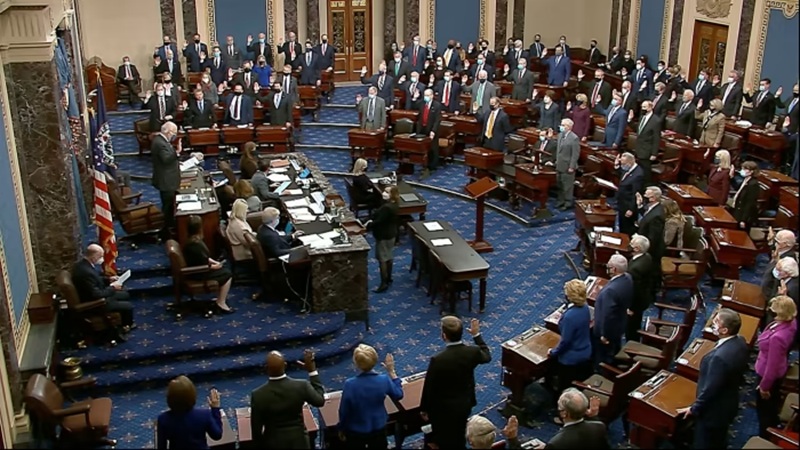
The US Senate passed the 21st Century ROAD to Housing Act in a strong bipartisan vote of 89-10. This sweeping legislation focuses on improving housing affordability and supply through measures like deregulation, expanding programs for affordable housing, and restricting large institutional investors; banning those owning 350+ single-family homes from buying more, with limited exceptions.
Notably, the bill includes an unrelated provision that imposes a temporary ban on the Federal Reserve issuing a central bank digital currency (CBDC, often called a “digital dollar”). The language prohibits the Fed (or any Federal Reserve Bank) from issuing or creating a CBDC—or any substantially similar digital asset—directly or indirectly through intermediaries, with the restriction lasting until at least the end of 2030.
This CBDC ban was added during negotiations and appears in just a couple of pages of the 300+ page bill. It reflects ongoing concerns from lawmakers especially Republicans, but with bipartisan support here about potential privacy risks, government surveillance, and financial control associated with a retail CBDC.
The provision has been floated in prior standalone bills; the House passed anti-CBDC measures before, but this marks a significant advancement by attaching it to must-pass housing legislation. The bill now heads to the House of Representatives, where it faces challenges. The House previously passed a narrower housing version, and some members particularly from the Freedom Caucus have pushed for a permanent CBDC ban rather than temporary.
Register for Tekedia Mini-MBA edition 20 (June 8 – Sept 5, 2026).
Register for Tekedia AI in Business Masterclass.
Join Tekedia Capital Syndicate and co-invest in great global startups.
Register for Tekedia AI Lab.
There are also reports of opposition to other provisions like the investor limits and broader political hurdles, including President Trump’s stated reluctance to sign unrelated bills without progress on voter ID requirements. This development is seen as a win for crypto advocates and privacy proponents, as it delays any potential US government-issued digital currency for years, potentially bolstering decentralized alternatives like Bitcoin.
Central Bank Digital Currencies (CBDCs), particularly a retail version like a potential “digital dollar” issued by the Federal Reserve, raise significant privacy risks due to their centralized nature and digital traceability. Unlike physical cash, which offers near-anonymous, untraceable transactions, CBDCs inherently create digital records of transactions, potentially linking them to individuals.
A CBDC could enable the central bank or government entities to collect extensive end-user data, including transaction histories, amounts, recipients, locations, and patterns. This aggregation raises concerns about state surveillance, where authorities could monitor everyday financial activities—such as purchases, donations, or political contributions—without warrants or oversight. Critics argue this could lead to profiling, suppression of dissent, or political weaponization of financial access, drawing comparisons to systems like China’s digital yuan.
CBDCs can be designed as “programmable,” allowing rules like spending limits, expiration dates, or restrictions on certain purchases. While proponents see this for policy goals, opponents view it as enabling government overreach, eroding financial freedom by dictating how individuals use their money.

Centralizing vast amounts of personally identifiable information (PII) and transaction data creates a high-value target for hackers, insiders, or nation-state actors. A breach could expose sensitive financial details, leading to identity theft, fraud, or blackmail. Even anonymized data might be re-identified when combined with other sources.
Loss of Anonymity Compared to Cash
Cash provides pseudonymity—no permanent digital trail ties transactions directly to individuals. CBDCs, especially account-based or blockchain-traced designs, reduce or eliminate this. Intermediated models via banks or wallets might use existing privacy frameworks, but direct central bank involvement still risks broader data access for anti-money laundering (AML) or compliance purposes.
Without strong safeguards, collected data could be shared across agencies, misused for non-monetary purposes, or abused in authoritarian scenarios. Even with rules, future policy changes could override protections, creating a “time-consistency” problem. Privacy risks depend heavily on architecture: Direct (one-tier) models give central banks full access, heightening concerns.

Intermediated models involve private entities, potentially leveraging existing privacy rules but adding data repositories. Central banks including the Fed emphasize balancing privacy with crime prevention, often proposing privacy-by-design, pseudonymity for low-value transactions, or privacy-enhancing technologies to limit data exposure. The Fed has noted any U.S. CBDC should be privacy-protected, intermediated, and identity-verified—but skeptics argue true cash-like anonymity conflicts with regulatory needs.
These concerns fueled the recent bipartisan push for the temporary CBDC ban in the 21st Century ROAD to Housing Act, reflecting fears that even well-intentioned designs could enable unprecedented financial control or erode civil liberties. Proponents of CBDCs counter that proper safeguards could minimize risks while offering benefits like faster payments and inclusion, but debates center on whether government-issued digital money inherently threatens privacy more than private alternatives.