

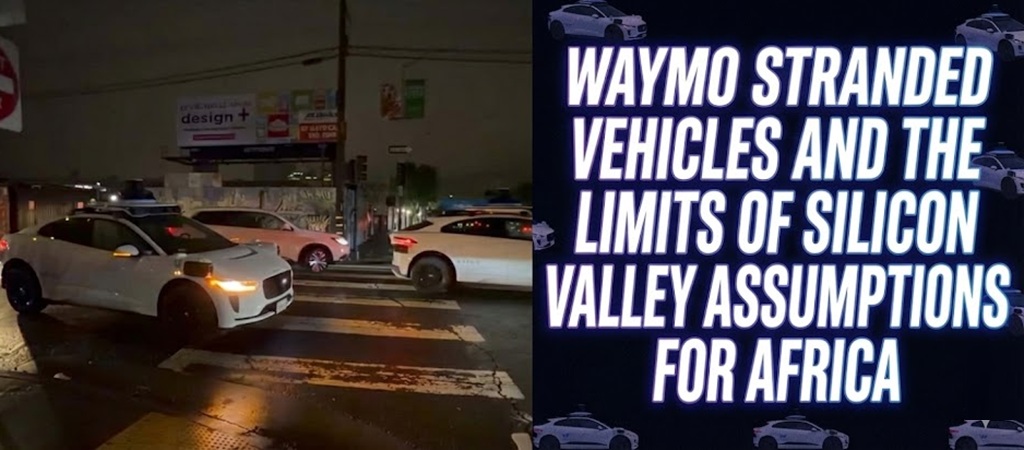
Good People, I have been reflecting on how Waymo, an Alphabet (Google) company, deployed driverless cars on American streets without fully modeling a basic but critical scenario: what happens during a power outage despite the billions of dollars spent on modeling, testing, and simulation over many years.
We all read how Waymo vehicles froze on the roads of California when parts of the state lost power. Specifically, a power outage in San Francisco caused significant disruption, immobilizing Waymo’s robotaxis as they encountered dark traffic signals. While Waymo has since indicated that it has enhanced its software and emergency protocols, one fundamental question remains unanswered: why was this scenario not modeled from the start?
This is where we begin to appreciate what many often criticize as European “overregulation.” When you examine what happened in San Francisco, you begin to see the value of regulatory regimes that insist on exhaustive edge-case analysis before large-scale deployment.
Register for Tekedia Mini-MBA edition 20 (June 8 – Sept 5, 2026).
Register for Tekedia AI in Business Masterclass.
Join Tekedia Capital Syndicate and co-invest in great global startups.
Register for Tekedia AI Lab.
Largely, Waymo and the American regulators that approved these vehicles for public roads without fully accounting for mass power outages have inadvertently delivered a lesson that African capitals must not ignore. Do not assume you are covered! Yes, I fully expect that in a few years, some showmen will begin importing these vehicles into Nigeria and other African countries. But without subjecting them to local scenario testing, the risks are enormous.
Losing power in America is an exception. Losing power in many African cities is the default state. So, if a system struggles under a rare condition in San Francisco, what happens when it is deployed in environments where that condition is routine? And beyond power outages, what other risk vectors, already overlooked in California, could cause catastrophic failure on African roads?
Technology does not travel well without context. And before we import the future, we must first verify it against our realities. I am now increasingly cautious about driverless cars because the recipes used to build them may not have been fully optimized, and yet humans are being asked to consume half-cooked meals. Africa cannot, and must not, default to Silicon Valley assumptions.

Comment on Feed
Comment: Perhaps they would have modeled for that if they were deploying in Africa. I’m sure power failure ranked very low in the risk assessment for San Francisco.
My Response: My understanding is that no one buys a car and permanently geolocates it. Are you suggesting that someone cannot purchase a car in the U.S. and decide to ship it to Nigeria without written and express approval from the manufacturer? If that were the case, what then happens to the entire used-car business?
More importantly, even if this scenario is considered low probability, it represents high risk, and high-risk scenarios should never be ignored. Imagine if a similar failure occurred at a rail crossing transporting hazardous chemicals. Yes, an entire community could be put in danger. Edge cases are not trivial when their consequences are catastrophic.

I am still expecting a valid reason from Waymo for ignoring this risk!
---
Connect via my
LinkedIn |
Facebook |
X |
TikTok |
Instagram |
YouTube
In America, the dollar is supreme. As long as there’s plenty dollar to be made, regulation becomes afterthought. If you ask too many questions bordering on safety and risk, you will be seen as enemy of innovation. For Africa, it is not clear how we can enter driverless conversation, the vehicle will certainly miss its way if it tries. Imported innovation rarely works well at scale, because the environment is a factor in every innovative endeavour. You cannot ignore the environment of operation.