

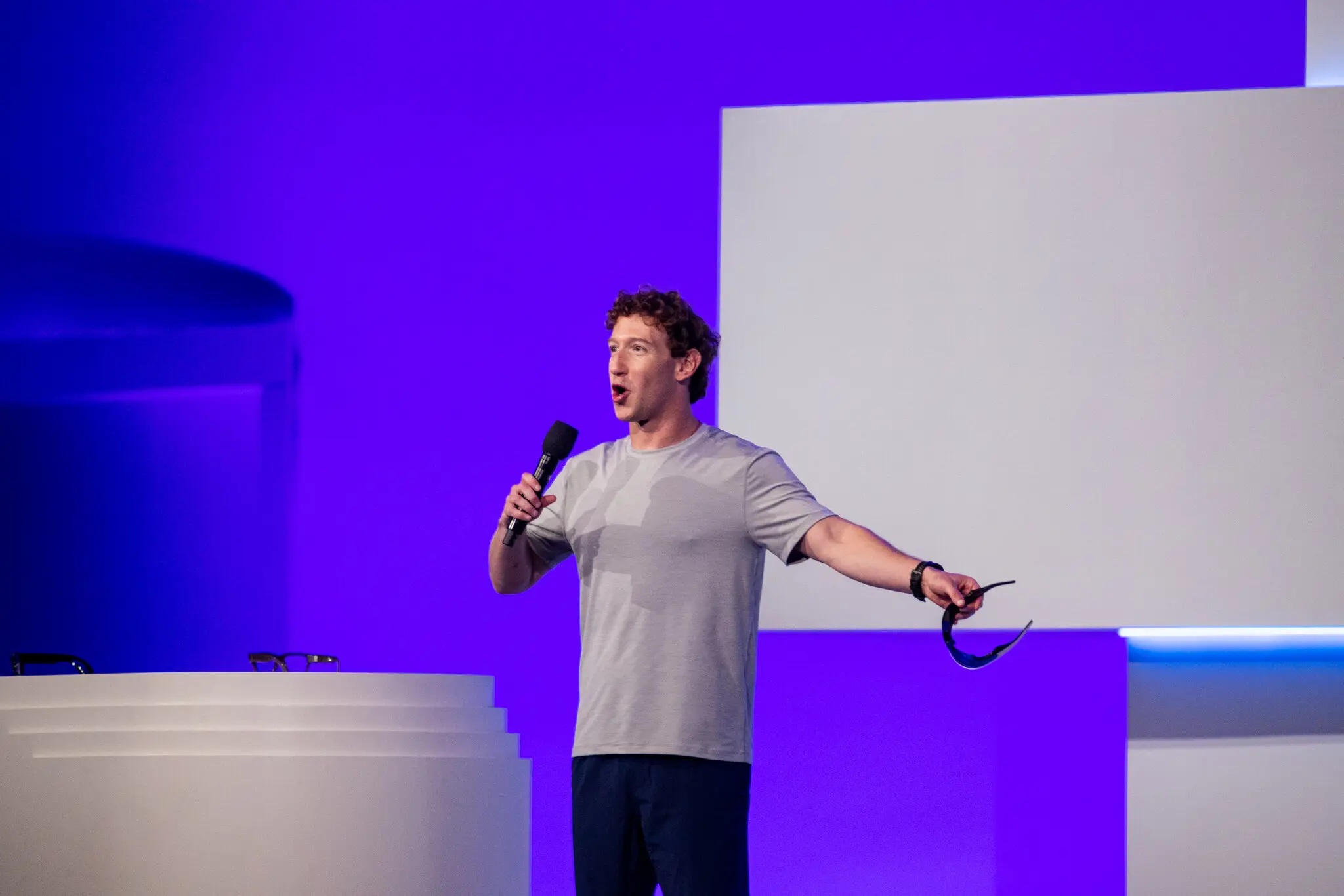
Mark Zuckerberg has declared that Meta has reached the “frontier” of artificial intelligence, placing it alongside leading labs OpenAI and Anthropic after the release of its new Muse Wonder models.
The Meta chief executive said the new system would allow much more sophisticated behaviours that are at the frontier of what is being done in the AI field.
Zuckerberg described the models as a major leap, which he said “Muse Wonder is a much larger and more advanced class of models that brings us to the frontier.”
Register for the next Tekedia Mini-MBA.
Register for Tekedia AI in Business Masterclass.
Join Tekedia Capital Syndicate and co-invest in great global startups.
Speaking on the launch, he said,
“It’s been just over a year since we started Meta Superintelligence Labs. Muse Spark was our first family of models, and now Muse Wonder is a much larger and more advanced class of models that brings us to the frontier.
“The new system is going to allow much more sophisticated behaviours that are at the frontier of what is being done in the AI field. Getting to this point both required a large amount of compute and investment, and a lot of very rigorous scientific work by the group working on it over an extended period of time.”

The announcement positions the release as progress toward “personal superintelligence for everyone,” building on work that began roughly 14 months earlier with a ground-up overhaul of Meta’s AI efforts.
Zuckerberg also rejected calls to slow the pace of development and committed the company to further large-scale investment.
He said Meta is already working on the next step up,” and model development will “probably feel like it’ll go quite a bit faster from here.

“I’m much closer to the belief that AI is a technology that can be engineered with normal guardrails and built responsibly than the anthropomorphic vision of AI, which is that it is just going to go do its own thing,” he said.
Meta introduced Muse Wonder and the more capable Muse Wonder Full as its most advanced models to date. The company says they deliver state-of-the-art performance on agentic tasks spanning personal and professional use cases, such as navigating insurance claims, interpreting lease agreements, handling financial or health information, and coding complete applications.
Meta claims the models outperform or match comparable systems from rivals, including Anthropic’s Claude Opus 5.5 and Fable 5.1 as well as OpenAI’s GPT-6 Astra, on selected technical benchmarks.
The models build on Meta’s earlier Muse Spark series and incorporate new capabilities designed for longer-running agent work. Active Memory allows the system to retain and retrieve relevant details across conversations, while Active Focus helps it persist toward a stated goal, recover from errors, try alternative approaches, and check in before taking significant actions.
Muse Wonder is available immediately to developers through the Meta Model API and Muse Code, with Muse Wonder Full limited to Muse Code subscribers. The models will soon power experiences in Meta’s Muse personal AI agent app, rolling out first to paying users.
The launch marks a significant milestone in Meta’s aggressive AI push. Over the past year, the company has poured resources into data centers, compute infrastructure, and high-profile talent, including the appointment of Alexandr Wang as chief AI officer following a major investment in Scale AI.
Zuckerberg has framed the effort around “personal superintelligence”—capable AI agents that empower individuals in everyday life rather than focusing primarily on enterprise automation. The Muse app itself has already become one of the most downloaded applications in the United States on both Apple and Android stores.
Zuckerberg signaled that Meta is already working on the next generation of models and expects development to accelerate. He downplayed concerns that rapid progress could lead to systems spinning out of human control, arguing that continued investment is necessary to deliver useful personal assistants that still lack sufficient common sense.
While Meta has published a Superintelligence Scaling Framework outlining its approach to responsible development, a fuller safety evaluation report for the new models is expected soon. The company is also preparing to compete more directly for enterprise customers by offering access to its strongest models on a commercial basis.
The announcement underscores how the AI race has intensified, with Meta positioning itself as a serious contender after a period of playing catch-up.
Whether independent evaluations fully validate the benchmark claims and how quickly the models translate into reliable real-world agent performance will shape the next phase of competition among the leading labs.
Looking Ahead
The Muse Wonder release marks Meta’s clearest claim yet to frontier status after a period of rebuilding. By focusing on long-running agents with reliable memory and sustained focus, Meta is targeting practical usefulness in both everyday life and professional workflows.
Whether the models deliver consistent real-world reliability beyond benchmarks will be tested as developers and users gain broader access in the coming weeks and months.