

Maximal Extractable Value (MEV) has recently gained attention in the cryptocurrency space. It refers to the ability of miners or validators to profit by controlling the order of transactions within a block. MEV is often considered a hidden cost that can affect users and raise concerns about fairness in the blockchain ecosystem.
While transactions await confirmation in the mempool, that is, a public queue before the transactions are added to the blockchain, miners or validators can influence which transactions are included and their order. This ability to manipulate transaction processing can lead to various revenue opportunities for those with block control.
Although MEV is often linked to Ethereum due to its advanced smart contracts, it can affect any blockchain, regardless of the consensus method. So, what is MEV, and how does it work? Let’s take a closer look.
Register for Tekedia Mini-MBA edition 20 (June 8 – Sept 5, 2026).
Register for Tekedia AI in Business Masterclass.
Join Tekedia Capital Syndicate and co-invest in great global startups.
Register for Tekedia AI Lab.
What is MEV?
A blockchain’s Maximum Extractable Value (MEV) is the amount of money miners or validators may extract by manipulating transaction arrangements within a block. This includes making the most of their capacity to reorder, include, or exclude transactions to increase their profit. MEV, in essence, allows block producers to earn extra profits beyond conventional block rewards and transaction fees by altering transaction processing.
History of MEV
Maximal Extractable Value (MEV) was earlier addressed in 2014 by the algorithmic trader Pmcgoohan as an opportunity for miners to profit from their control over transaction ordering. In 2019, Phil Daian and his team defined the phrase “Miner Extractable Value” in the “Flash Boys 2.0” publication, which detailed certain data concerning miners reordering transactions for profit. After Ethereum migrated to the Proof of Stake model in 2022, the term Maximization Extractable Value expanded to include validators with miners.
How Does MEV Work?
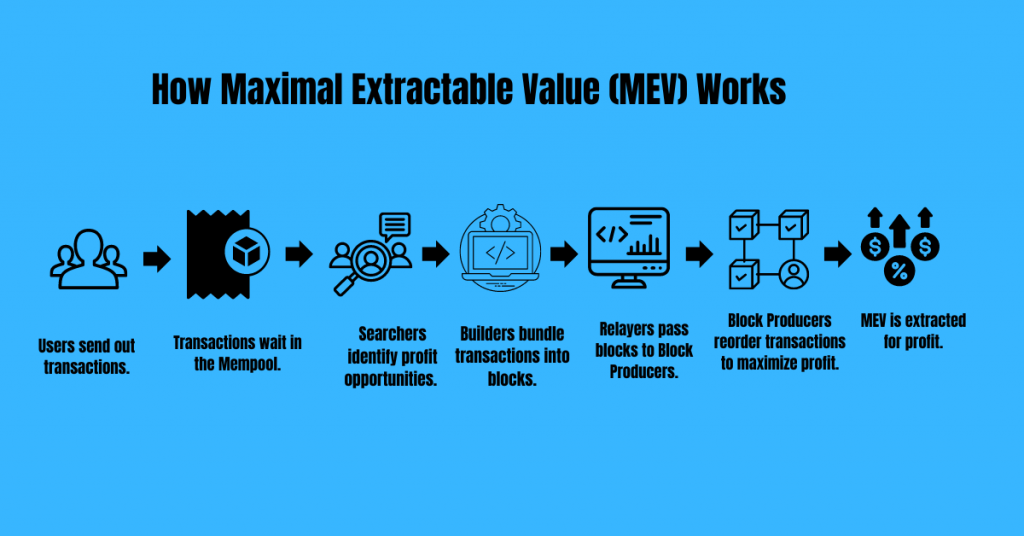
In order to understand how Maximal Extractable Value operates, you must first know how block producers play a role.

Block producers, which consist of miners in a Proof of Work system or validators in Proof of Stake, select transactions and sequence them within a block. They can reorder, include, or exclude transactions, which may create opportunities to extract additional value beyond standard fees. This ability allows them to profit from opportunities such as arbitrage or liquidation.
Searchers, who are mostly independent operators using sophisticated algorithms and bots, do identify these profit opportunities. To profit from transactions, they package them in bundles and send them to builders, who are responsible for aggregating these bundles into complete blocks. In some systems, particularly with Ethereum’s transition to PoS and Protocol/Builder Separation (PBS), builders pass these blocks to relayers. These relayers serve as intermediaries, passing blocks from builders to block producers, including validators in Proof-of-Stake (PoS) systems.
With Ethereum’s transition to PoS, validators now take on the role of block producers and must adapt to new mechanisms like PBS to manage MEV. This shift has propounded several innovations for MEV extraction and introduced a different dynamic in how transaction sequencing impacts value extraction. PBS differentiates between the activities of block production and transaction ordering. This minimizes the validators’ impact on MEV and makes the block production process more equitable and transparent.

Maximal Extractable Value (MEV) involves strategies that exploit network inefficiencies for profit. Here are some prominent MEV approaches:
Arbitrage
This tactic capitalizes on price discrepancies between markets. For instance, when a token is available at a lower price on one decentralized exchange (DEX) compared to another, bots can purchase it at a lower rate and then sell it for a higher price on a different exchange. This practice, though highly competitive, helps align token prices across exchanges.
Front-Running
In front-running, bots detect pending transactions in the mempool and execute their own transactions first to benefit from the anticipated price movement. For example, if a bot notices a big buy order coming through, it might place its own buy order with a higher gas fee to make sure its order is processed first, allowing it to benefit from the price change that follows.
Sandwich Attacks
This malicious strategy involves placing transactions before and after a target trade. For instance, if a large swap order is detected, a bot might purchase the token before the trade goes live to increase the price and sell it to the target trade at the inflated price. This exploits the slippage in the target’s transaction.
Liquidations
In DeFi lending, if the collateral backing a loan decreases in value and falls below the required threshold, the loan can be subjected to liquidation. MEV bots can identify such opportunities, purchase the collateral at a discounted price, and sell it for a profit after repaying the loan, similar to margin calls in traditional finance.
How to Protect Against MEV Attacks
While MEV attacks can occur, certain strategies can help to minimize the risks. Below are some of the ways to prevent MEV attacks:
MEV Auction Mechanisms
Adopt auction-based systems where participants bid for transaction placement. This method ensures that transaction inclusion rights are fairly distributed. This diminishes direct MEV extraction by promoting a more open and competitive process.
Protect RPC Endpoints
Send transactions through RPC endpoints that link to private mempools. This technique hides transactions from the public mempool, thereby shielding them from being detected and manipulated by search bots until they are finalized on-chain.
Private Transaction
Use services that allow you to submit transactions directly to miners, bypassing the public mempool entirely. This practice keeps transaction details confidential and prevents potential attackers from exploiting them before they are included in a block.
Slippage Controls
Implement rigorous slippage limits to restrict how much the trade price can vary from the initial expected price. This strategy helps reduce vulnerability to manipulation tactics like sandwich attacks, which exploit price changes to extract value.
Anti-MEV Features on DEXs
Use decentralized exchanges that have features to counteract MEV. Features such as transaction commitment schemes or novel ordering techniques can help prevent front-running and other forms of exploitation.
Protocol Upgrades
Support and integrate blockchain protocol tools aimed at reducing MEV opportunities. Upgrades that refine transaction ordering and block production can make it more challenging for MEV strategies to succeed.
What are the Advantages of MEV?
Maximal Extractable Value (MEV) offers several notable benefits to the blockchain despite its controversial flaw.
Firstly, MEV can increase market efficiency. Through the exploitation of price discrepancies and other opportunities, MEV helps to address inefficiencies in decentralized markets. This activity contributes to better resource allocation and more accurate pricing, ultimately improving the efficiency of blockchain networks.
Incentivizing liquidity provision is another advantage of MEV. In decentralized finance (DeFi), liquidity providers are rewarded, a process often influenced by MEV activities. This incentive structure boosts liquidity, making DeFi platforms more functional.
Furthermore, DEX arbitrage represents a positive application of MEV. Arbitrage bots exploit price differences across exchanges, stabilizing token prices and increasing market efficiency. This process benefits the ecosystem by ensuring more consistent pricing and enabling more participants to engage in arbitrage without incurring losses.
MEV can also improve blockchain security. The competitive environment it fosters among miners or validators to secure block production can strengthen overall network security. MEV facilitates rapid liquidations in DeFi lending, ensuring that lenders are repaid when collateral values fall, which helps maintain the stability of lending platforms.
What are the Disadvantages of MEV?
Maximal Extractable Value (MEV) poses significant drawbacks in blockchain. It often leads to unethical behavior, such as front-running and sandwich attacks, which exploit users by manipulating transaction prices to their disadvantage. This practice drives up transaction fees and reduces liquidity, making the network less efficient and more costly for everyone.
Additionally, MEV can lead to a concentration of wealth and power, undermining the network’s decentralization. In extreme cases, the potential for MEV to surpass block rewards may incentivize miners to reorganize previous blocks, leading to consensus instability and network integrity compromise.
Final Thoughts
Maximum Extractable Value (MEV) refers to the profit that miners or validators earn by controlling the order of transactions within a block on the blockchain. Although it could create incentives in decentralized finance, it is problematic due to higher transaction fees and unethical behavior. To tackle these issues, use safety tools such as MEV auction mechanisms, slippage control, private transactions, RPC endpoints, anti-MEV features, and protocol updates that achieve a healthy balance of MEV advantages and the need for a safe blockchain environment.