

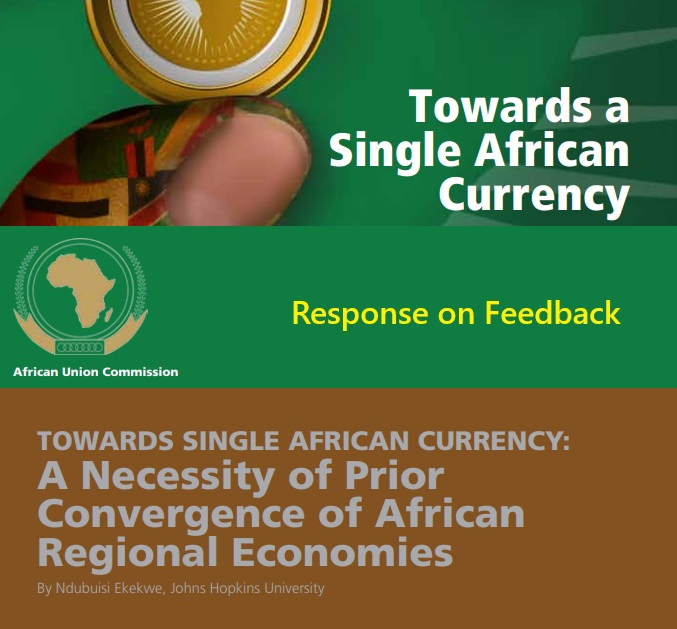
Great feedback continues to come on my thesis that a single African currency is an illusion, not a catalyst, for continental prosperity. During my doctoral work in banking and finance, I spent years studying currency systems and globalization. My conclusion remains unchanged:
A single currency in Africa will produce welfare losses because our economic architectures are deeply heterogeneous. And under a supranational central bank, the fiscally irresponsible big nations will inadvertently punish the smaller, more disciplined ones.
Take West Africa as a practical case. Nigeria’s economy is driven by crude oil, a commodity with a volatility cycle completely disconnected from what happens in Togo. If you force both nations under one currency, the supranational bank must prioritize shocks in Nigeria, not because it loves Nigeria more, but because the currency cannot survive if the largest economy collapses.
Register for Tekedia Mini-MBA edition 20 (June 8 – Sept 5, 2026).
Register for Tekedia AI in Business Masterclass.
Join Tekedia Capital Syndicate and co-invest in great global startups.
Register for Tekedia AI Lab.
In that moment, Togo becomes collateral damage. When oil prices fall, Togo will feel the pain of an oil crash it did not create. Contrast this with the Eurozone. Europe can run a single currency because its economies are comparatively homogenous, diversified, and productive. The European Central Bank can intervene uniformly because the economic baselines are aligned. Africa is far from that equilibrium.
And let us remember something that is often forgotten: Africa already has a single currency zone: CEMAC, the Economic and Monetary Community of Central Africa. Six nations use the Central African CFA franc. Yet, despite decades of monetary union, the development outcomes remain marginal because monetary integration without production capacity translates only to symbolic benefits, not transformative prosperity.
Over the years, I have written extensively on this subject for the World Bank and the African Union. One of those papers, still hosted on the AU website, provides deeper technical analysis:

Click to access 31782-doc-congress_article_volume_2.pdf
(Yes, before returning fully to electronics, I lived in the world of banking.)
But let me close with what I consider Africa’s real macroeconomic problem: we are urbanizing without industrializing. In the typical historical sequence, nations industrialize first, then urbanize. Africa is doing the reverse, and the imbalance weakens everything, from currency resilience to job creation. I discussed this in a Harvard Business Review piece.

So, Good People, the path remains clear: Production is the antidote. Productivity is the stabilizer. Innovation is the currency. Remove these pillars, and a single African currency, like the gold standard or Bitcoin treasury fantasies, will remain an illusion. QED.
---
Connect via my
LinkedIn |
Facebook |
X |
TikTok |
Instagram |
YouTube