

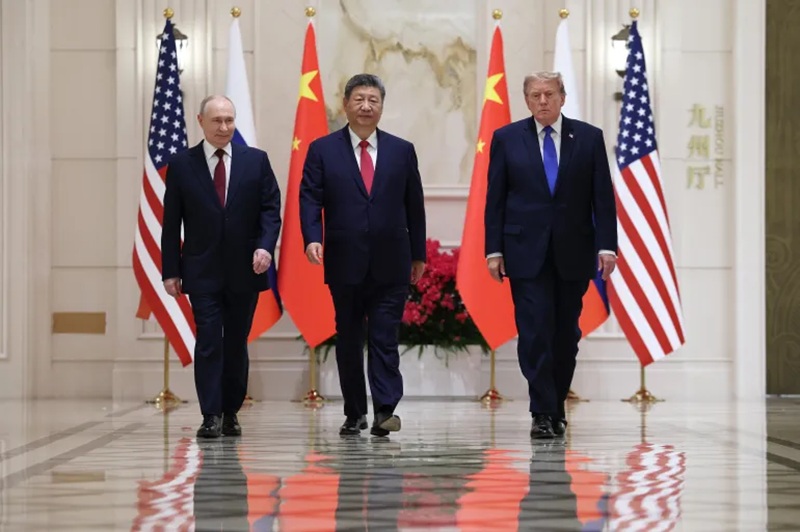
The reported historic trilateral summit involving Chinese President Xi Jinping, US President Donald Trump and Russian President Vladimir Putin in Shenzhen represents a potentially significant moment in global diplomacy.
Bringing the leaders of three of the world’s most influential powers together would carry enormous geopolitical symbolism, particularly at a time of heightened tensions over trade, security, energy, technology and the future of the international order.
But beyond a four-point declaration of world peace, the central question is whether the summit delivered tangible benefits to the three leaders or simply produced an ambitious diplomatic spectacle.
Register for the next Tekedia Mini-MBA.
Register for Tekedia AI in Business Masterclass.
Join Tekedia Capital Syndicate and co-invest in great global startups.
What Each Leader Gained
For Xi, the summit was arguably the clearest diplomatic victory. Hosting Trump and Putin together reinforced China’s image as a central power capable of convening leaders who increasingly challenge the traditional Western-led international system.
Xi positioned himself as the host and mediator, projecting stability and influence while allowing Beijing to shape the discussion around international institutions, energy security and nuclear risks.
The meeting also offered China an opportunity to demonstrate that it can engage Washington and Moscow simultaneously without appearing subordinate to either. Trump’s gains were less concrete but politically important.

Following domestic political setbacks, the summit offered him an opportunity to present himself as a global dealmaker willing to engage America’s rivals directly.
Trump praised the meeting, rating it 12 out of 10, and portrayed the gathering as historic. His administration could also point to the renewed commitment to dialogue over nuclear risks as a diplomatic achievement, even though no concrete arms-control agreement emerged.
However, the absence of measurable concessions from either China or Russia raises questions about whether the spectacle delivered meaningful American strategic benefits. Putin arguably emerged with the most immediate strategic benefit.

Russia’s president gained an opportunity to return to a high-profile international setting alongside the leaders of the world’s two other major nuclear powers, helping normalise his international standing despite Russia’s continued war in Ukraine and Western sanctions.
The summit also placed discussions about international legal institutions and state immunity on the agenda, subjects particularly relevant to Moscow amid international scrutiny.
Putin’s presence alongside Trump and Xi reinforced Russia’s claim that it remains a consequential global power rather than an isolated state. The declaration itself contained several potentially consequential commitments.
The three leaders agreed to pursue United Nations reforms, support increased production and supply of refined petroleum products, defend the principle of state immunity against what they described as abuses by international courts, and initiate dialogue on reducing nuclear risks and preventing proliferation.
Yet these commitments remain broad statements rather than operational agreements. There were no announced deadlines, enforcement mechanisms or detailed plans for implementation.
The declaration also omitted explicit references to Russia’s war in Ukraine and the conflict involving Iran, two major international crises that could have tested the leaders’ willingness to compromise.
The summit’s significance may therefore lie less in what the leaders agreed to do immediately than in the political message they delivered.
Three powerful nations are signalling a willingness to coordinate on reshaping international institutions, energy arrangements and the interpretation of international legal authority. That alignment could have implications for smaller countries, Western alliances and the future balance of global power.
Whether Shenzhen becomes a turning point or simply another carefully staged diplomatic gathering will depend on what follows. For now, Xi gained prestige.
Putin gained legitimacy and Trump gained the image of a president negotiating directly with global heavyweights. The world peace declaration may have been modest, but the political symbolism was anything but insignificant.