

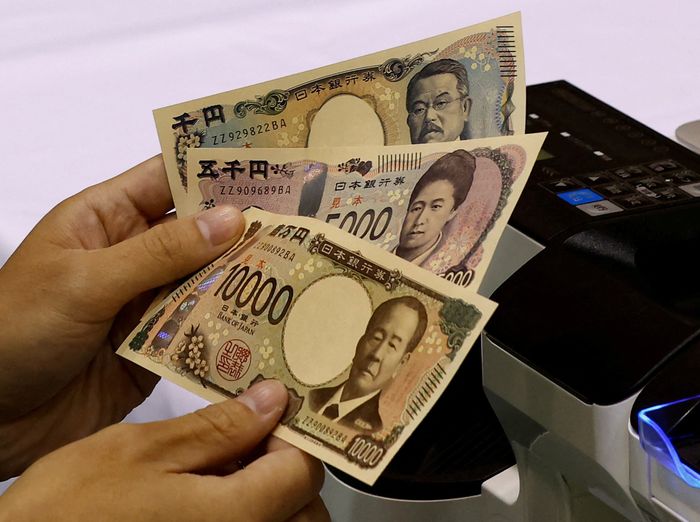
The Japanese yen weakened on Monday, falling 0.4% to 153.32 per U.S. dollar, following the release of meagre economic growth figures that underscored the challenges facing the government of Prime Minister Sanae Takaichi.
This came after the yen surged nearly 3% last week, marking its largest weekly gain in around 15 months, driven by investor optimism over Takaichi’s Liberal Democratic Party (LDP) election landslide.
Despite last week’s rally, Monday’s data revealed that Japan’s economy barely expanded in the fourth quarter of 2025, recording an annualized growth rate of just 0.2%. Economists said the sluggish expansion highlights structural challenges — including stagnant domestic consumption and a tight labor market — that could constrain the government’s ability to stimulate broader economic momentum.
Register for Tekedia Mini-MBA edition 20 (June 8 – Sept 5, 2026).
Register for Tekedia AI in Business Masterclass.
Join Tekedia Capital Syndicate and co-invest in great global startups.
Register for Tekedia AI Lab.
“After the election, the political dust may be settling a bit, for the near term at least, and we are seeing the yen increasingly becoming sensitive to data,” Reuters quoted Mohamad Al-Saraf, FX and fixed income associate at Danske Bank, as saying.
Bank of Japan (BOJ) Governor Kazuo Ueda and Prime Minister Takaichi held their first bilateral meeting since the election on Monday. According to Ueda, the discussion was a “general exchange of views on economic and financial developments,” with no specific requests on monetary policy made by the prime minister.
The BOJ’s next policy meeting is scheduled for March, with market participants assigning around 20% probability for a rate hike. Economists have largely predicted that the central bank will wait until July before any additional tightening.

In December, the BOJ raised its key rate to 0.75%, the highest level in 30 years. Yet this remains well below interest rates in most major economies, contributing to a weaker yen and making the currency highly sensitive to both domestic data and foreign capital flows. Past periods of yen underperformance have even prompted direct interventions by the government and central bank to stabilize the currency.
U.S. Dollar and Fed Rate Speculation
Meanwhile, the U.S. dollar remained broadly steady on Monday, with the U.S. Dollar Index inching up 0.1% to 97.06, after falling 0.8% last week. The stability reflects investor confidence in the Federal Reserve’s measured approach following lower-than-expected January inflation data, which has reignited speculation that the central bank could cut interest rates later this year.
Money market traders are pricing in 62 basis points of rate easing across 2026, implying two quarter-point cuts and about a 50% chance of a third. Analysts predict the first reduction will likely occur in June, with the market assigning over an 80% probability to a 25-basis-point cut.

“The markets are flirting with pricing in a third cut,” said Kyle Rodda, senior financial analyst at Capital.com.
The lower inflation reading also influenced the U.S. Treasury market. The two-year Treasury yield, which closely tracks expectations for Fed policy, fell to its lowest level since 2022 on Friday, while the 10-year yield dropped by 4.8 basis points.
Global Currency Movements
Other major currencies showed mixed movement on Monday:
- Euro: Slightly down 0.1% at $1.1854.
- British Pound: Eased to $1.3638.
- Swiss Franc: Marginally weaker at 0.7694 per dollar, with investors wary of intervention from the Swiss National Bank to curb appreciation.
- Australian Dollar: Firmed 0.1% to $0.7076, just below last week’s three-year high of $0.71465.
- New Zealand Dollar: Flat at 0.6037 ahead of the Reserve Bank of New Zealand’s policy meeting, where rates are widely expected to be held steady.
Liquidity is expected to remain thin through Monday, as markets in the U.S., China, Taiwan, and South Korea are closed for holidays. Analysts cautioned that volatility could return once trading resumes in full.
Yen Sensitivity and Global Implications
The combination of political shifts, weak domestic growth, and global monetary trends has made the yen increasingly data-sensitive, according to analysts. While Takaichi’s LDP victory initially boosted sentiment and prompted speculative inflows into Japanese assets, underlying economic stagnation has tempered the currency’s gains.
The yen’s performance also highlights Japan’s broader structural challenges, including an ageing population, low consumption, and dependence on external trade, which continue to influence investor perceptions. Meanwhile, the U.S. dollar’s relative stability and expectations for Fed rate cuts suggest that capital flows may continue to favor the U.S., potentially pressuring the yen further in the coming months.
“The market narrative is shifting from election optimism to economic fundamentals, and for the yen, that means heightened sensitivity to every data release,” said Al-Saraf.
As central banks globally navigate inflation, growth, and policy coordination, the yen-dollar exchange rate has become a key indicator of investor sentiment toward Japan’s economic trajectory and broader risk appetite in the foreign exchange markets.