DD
MM
YYYY

PAGES

DD
MM
YYYY

spot_img

PAGES

Home Blog

How to Schedule Hands-Free PC Maintenance with Advanced SystemCare 19 AutoCare

0

To maintain a Windows PC to ensure it is fast and secure, regular maintenance is needed. There are junk files which are built up daily, the startup programs are built quietly, and the traces of privacy are built up in the background. The problem? The majority of users do not even perform cleanups regularly.

And that is where Advanced SystemCare 19 Free comes in. This potent PC cleaner has the best AutoCare technology, which means that you can set up an automatic maintenance schedule so that your system cleans itself, optimises, and protects itself automatically.

The following provides the full instructions on how to configure PC maintenance automatically with Advanced SystemCare 19.

Step 1: Launch and Turn on AI in Intelligent AutoCare
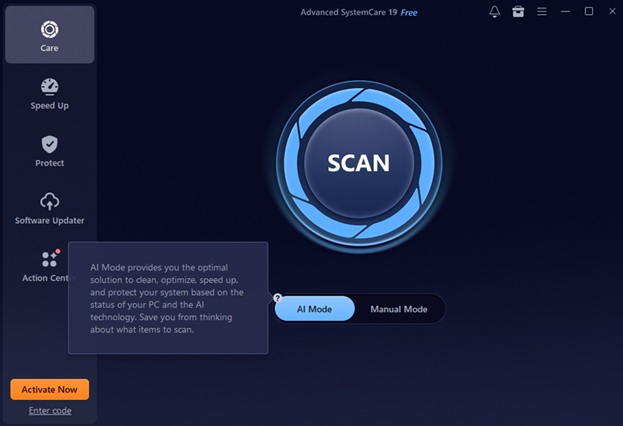
Install Advanced SystemCare 19 and then run the program. The central place of automated maintenance is AI Mode. Rather than a laborious process of choosing each clean-up action option by hand, AI Mode applies AI to your system habits and performance indicators to answer the question: what are the best clean-up actions?

To program hands-free cleaning:

  1. Switch to AI Mode.
  2. Enable AutoCare in the Setting.
  3. Automatically turn on the cleaning schedule (daily, weekly or idle system).

AI Mode is also smart and sensitive to:

  • Eliminating junk files (junk in the Microsoft Store)
  • Privacy trace cleanup
  • Registry cleanup
  • Spyware scanning

AutoCare in version 19 optimises the management of startup items and services as never before, which makes the background cleaning smarter and more efficient.

Step 3: Let the System Perform Automatic Scanning
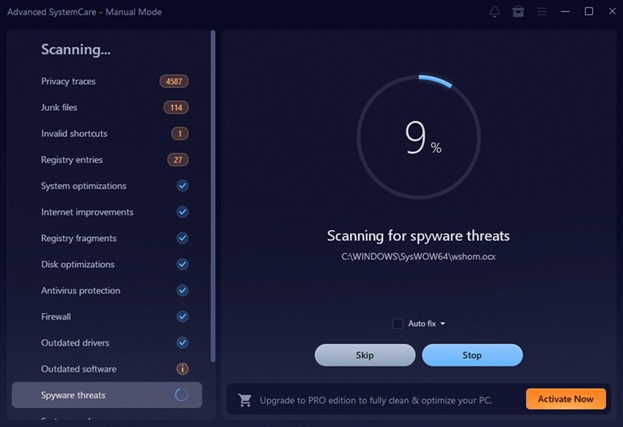
After the addition to the schedule, Advanced SystemCare will start scanning automatically at the time of your choice or at idle times of your computer. When used in the automatic scans, it verifies:

  • Temporary and copy files.
  • Obsolete system data
  • Browser traces
  • Hidden spyware
  • Performance bottlenecks

This PC cleaner has greatly enhanced the Junk file Clean module, which in turn works to remove all obsolete data and brings back the valuable hard disk space immediately without affecting your work.

Since the software operates in the background, you are able to concentrate on your other activities as the software works.

Step 4: Automatic Userless Correction
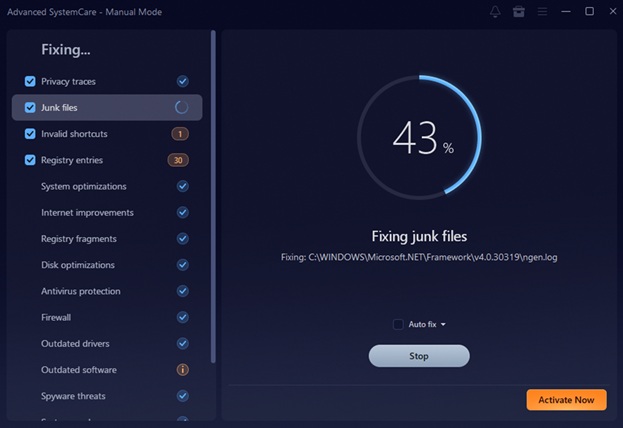
On completion of scanning, AutoCare then automatically goes ahead to correct identified problems according to your preset preferences.

It can automatically:

  • Remove junk files
  • Repair registry errors
  • Clear privacy traces
  • Block potential threats

AutoCare does not require constant confirmation in spite of the manual cleanups. It carries out real-time optimised safe repairs.

This is a completely hands-free system which keeps your PC clean even when you leave, remembering to run the maintenance yourself.

Step 5: Validate Maintenance Completion.
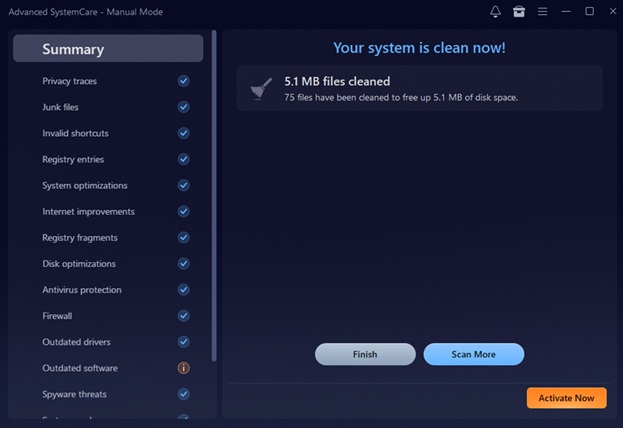
Advanced SystemCare checks in on clean-up by ensuring that the issues identified have been resolved.

You’ll notice:

  • Quick system responsiveness.
  • More available disk space
  • Fewer background slowdowns

Automatically with AutoCare on, this happens automatically and on the schedule that you determine – that is, performance is consistent without any additional work.

Step 6: Sum up Performance Reports
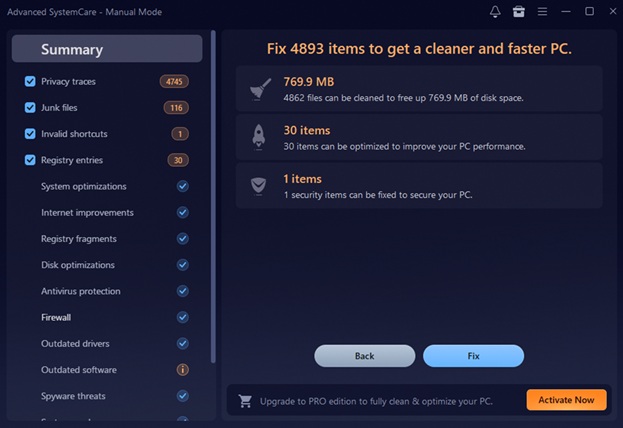
The Summary part gives a clear understanding of:

  • Amount of junk removed
  • Startup items optimised
  • Privacy traces cleared
  • Security Boboos corrected.

These reports will make you realise the optimal improvements each automated session will provide.

Advanced SystemCare 19 guarantees that it is transparent with maintenance being hassle-free.

Step 7: Combine AutoCare with Speed Optimisation
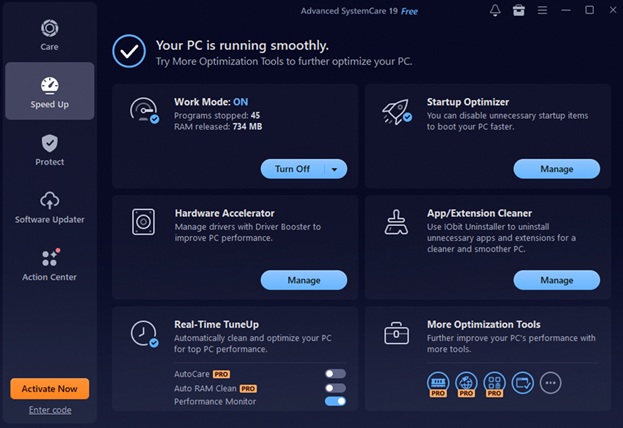
Whereas AutoCare does cleaning, its Speed Up module further improves the performance.

It includes:

  • Improved Startup Optimisation.
  • Background process management.
  • Live monitoring of the resources.

Enabling you to turn off all that you do not really need at startup, your PC starts quicker and runs better.

The increased Startup Optimization of this Windows cleaner deals with more startup entries and services than previous versions; it ensures that there is a visible performance improvement.

Step 8: Energise Protection: Maintenance
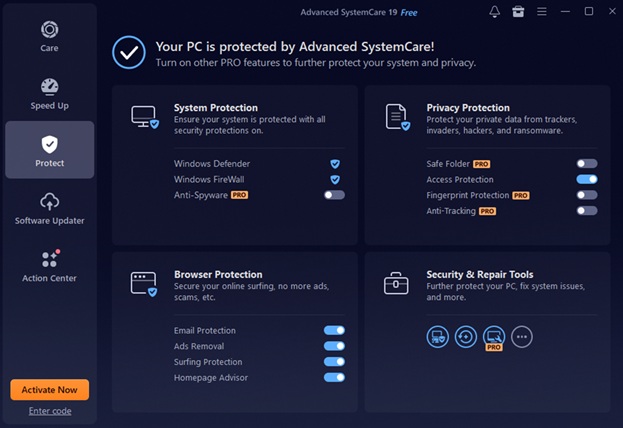
Without security, performance is insignificant. Advanced SystemCare 19 incorporates protection aspects into its automatic maintenance system.

The Protect section contains:

  • Extended Anti-Spyware Database.
  • Strengthened Privacy Sweep
  • Surfing Protection Database Made Large.
  • SAFE Folder anti-ransom virus.

Privacy Sweep supports more applications and browsers by obliterating more digital fingerprints so that your online identity stays safe.

Collectively, these capabilities enable AutoCare to not only have speed but also security.

Step 9: Automatic Software Updates
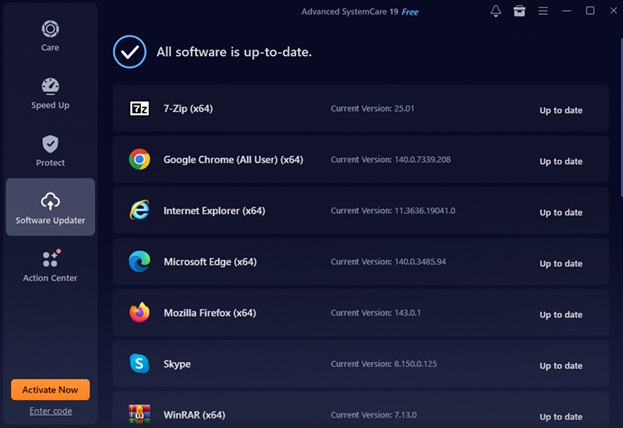
Old software can result in vulnerabilities and instability of performance. Advanced SystemCare 19 has an improved Software Updater that is able to update more popular AI tools and Microsoft Store apps.

By allowing automatic updates:

  • The security vulnerabilities are phased out in a short time.
  • The compatibility problems are minimised.
  • System stability improves

This guarantees that your PC is automated and secure.

Step 10: Improve Maintenance using 20+ Practical Tools
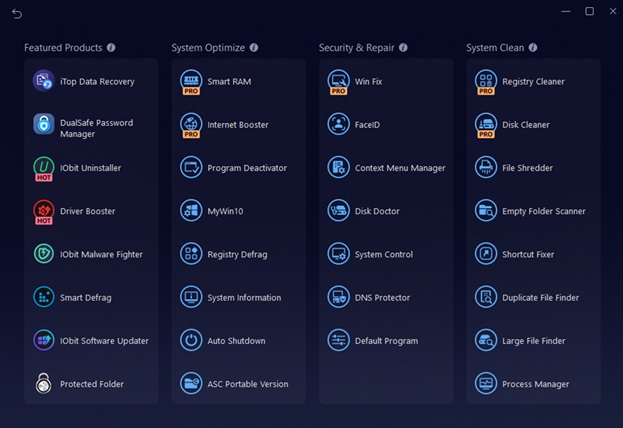
Advanced SystemCare is not limited to cleaning, as it has over 20 powerful utilities.

Notable tools include:

  • Smart RAM – Clean up unused memory automatically.
  • Internet Booster – Tunes network settings.
  • Win fix- Glasses, the universal windows repair.
  • FaceID – Recognises malicious use.
  • Big Files Finder – Finder of the large files available.
  • DNS Protector – Avoids malicious DNS modifications.

These tools are useful in supplement to the AutoCare, where you can automate almost every facet of PC optimisation and protection.

 Conclusion

One of the easiest ways of ensuring that your Windows system remains fast, clean and safe is to plan hands-free maintenance with Advanced SystemCare 19. With AI Mode and AutoCare, your personal computer automatically cleans, optimises, and scans without the need to get into the computer manually.

Startup optimisation, better junk files remover, safer file indexer, web-based proactive privacy sweeps, and more, Advanced SystemCare 19 is an Einstein solution to keep a computer running at its best.

In case you are interested in having such a good all-in-one PC cleaner that can automatically clean up PC clutter in your computer, but protect your data as well, then Advanced SystemCare 19 Free is a smart, efficient and painless way of keeping your system running fast each and every day.


Major Exchanges

0

Cryptocurrency exchanges function as the fundamental structure of the digital asset market because they enable users to conduct efficient cryptocurrency transactions through their trading platforms. Digital currency exchanges have developed into advanced financial centers because of the increasing demand for digital currencies which enables them to provide multiple services beyond basic trading functions. The major exchanges require users to learn about their structural design and different exchange types and specific operational capabilities in order to succeed in digital asset trading.

The cryptocurrency market divides its exchanges into two primary exchange types which are centralized exchanges and decentralized exchanges. Centralized exchanges function through companies which serve as intermediaries to connect buyers with sellers. The three platforms which dominate the market include Binance and Coinbase and Kraken because they offer users high liquidity and simple operation and advanced trading features. The exchanges offer several trading tools which include margin trading and futures contracts and staking options and educational resources which help new traders learn about the platform.

Centralized exchanges provide their main benefit through their easy-to-use interfaces, which enable new users to access their services. The platform provides its users with both fast transaction processing times and dedicated customer support, which surpasses the offerings of decentralized platforms. Centralized exchanges handle more trades than other exchanges, which results in improved price stability and quicker order processing. Users need to place their trust in these platforms because they must deposit their funds, which creates risks from hacking and regulatory problems and possible financial mismanagement.

Decentralized exchanges enable users to conduct transactions through blockchain technology and smart contracts which eliminate the need for a central governing body. Uniswap, SushiSwap, and PancakeSwap serve as popular examples of decentralized exchanges which users can access. Users maintain complete ownership of their assets because they can conduct transactions from their personal wallets without needing to send their assets to a centralized platform.

Users who want to remain anonymous and maintain control of their information find decentralized exchanges more attractive because these platforms do not need users to undergo complete identity assessment procedures. The system results in greater difficulties for new users who want to operate decentralized exchanges. The system experiences two main problems because it requires users to complete verification before they can start trading. The system experiences two main problems because it needs users to go through verification before they can start trading.

The fee structure of major exchanges stands as a crucial element for their operations. The centralized exchanges impose trading costs for their users together with fees for depositing and withdrawing funds plus charges that apply to premium functions. The platform charges which users face depend on their trading activity during a particular period. The decentralized exchanges impose network (gas) fees together with a tiny percentage charge for liquidity providers which varies based on current blockchain congestion levels.

Security remains a critical concern across all types of exchanges. Centralized exchanges safeguard their users through various security measures which include two-factor authentication (2FA) and cold storage for funds and insurance policies. The historical record demonstrates that even major exchanges remain susceptible to cyberattacks despite their implemented security measures. Decentralized exchanges experience a reduced risk of major security breaches because of their distributed design yet they still face risks from smart contract vulnerabilities and user phishing attacks.

Regulation is another factor shaping the landscape of major exchanges. Governments worldwide are developing new regulations to implement oversight for cryptocurrency trading activities. Centralized exchanges must follow these regulations because they require users to undergo Know Your Customer (KYC) verification. The system improves transparency while decreasing unlawful operations although it may drive away users who want to keep their information private. Decentralized exchanges operate within a regulatory framework that offers both chances and dangers to their business model.

The major exchanges add new financial services to their platforms which they started doing during the past few years. Users can receive rewards through staking programs which allow them to keep their holdings while the platform delivers lending and borrowing services together with NFT marketplaces and payment solutions. The cryptocurrency market tracks increasing demand for financial systems that operate as complete solutions through its expansion into various financial services.

Every investor and trader needs to assess their own requirements together with their trading background to select the most suitable exchange. Centralized exchanges attract beginners because their systems are easy to use and provide customer assistance, whereas experienced users prefer decentralized platforms which allow them to control their assets. Users frequently combine both exchange types to maximize the advantages provided by each system.

Digital asset industry development will lead to more significant exchange influence which will determine future financial systems. The system will receive upgrades which will enhance its security features and scalability performance and user interface design. Investors need to understand major exchange operations because these exchanges represent the first step toward acquiring knowledge about crypto market investment.

Okomu Oil Palm Cements Market Leadership with Record 2025 Profits as Revenue Climbs 52% on Strong Volumes and Pricing Power

0

The Okomu Oil Palm Company Plc has delivered another standout performance, posting audited full-year 2025 results that underscore its entrenched position as one of Nigeria’s two largest palm oil producers alongside Presco Plc.

Pretax profit surged 69.26% to N90.6 billion from N53.5 billion in 2024, while post-tax profit rose 45.03% to N57.9 billion. Revenue expanded 52.18% to N198.1 billion from N130.2 billion, fueled by higher sales of palm oil, rubber, and processed products amid firm domestic demand and improved international pricing.

Domestic operations in Nigeria generated N172.6 billion of the total, reflecting Okomu’s deep roots in the local market, while exports contributed N25.5 billion—evidence of the company’s growing global footprint even as it prioritizes supply to Nigerian refiners and manufacturers.

Okomu has maintained its leadership in Nigeria’s palm oil market and broader agricultural sector through decades of disciplined plantation development, operational efficiency, and strategic diversification. Established in 1976 as a federal government pilot project in Edo State, now Nigeria’s leading palm oil-producing region, accounting for roughly 12% of national output, the company was privatized in 1990 and has since scaled to become a benchmark operator.

It controls approximately 19,000 hectares of mature oil palm and over 7,300 hectares of rubber plantations, supported by two high-capacity mills capable of processing more than 80,000 tons of crude palm oil (CPO) annually. In 2025, the company benefited from continued yield improvements, with fresh fruit bunch (FFB) output rising through better extraction rates (around 24%) and third-party purchases from outgrowers, helping it capture a meaningful share of the country’s 1.57 million tons of total palm oil production.

What sets Okomu apart is its vertically integrated model: owning the full value chain from planting to milling and marketing allows it to control quality, reduce intermediary costs, and respond quickly to market shifts.

The company’s long-standing technical partnership with Socfin has brought international best practices in agronomy, while ongoing replanting programmes, such as the hundreds of hectares renewed each year, ensure long-term productivity gains.

Analysts have consistently highlighted Okomu’s superior margins and cash discipline compared with peers, driven by these efficiencies even as raw material costs climbed 30.47% to N29.5 billion (largely from plantation upkeep of N10.9 billion) and employee benefits rose to N31.03 billion amid operational scaling and a 50% staff salary adjustment in prior years.

Sustainability and community engagement have also been central to Okomu’s resilience. As an RSPO member, the company integrates environmental safeguards, while its inclusive smallholder model partners with thousands of nearby farmers to secure additional FFB supply and boost rural livelihoods. Corporate social responsibility spending supports education, skills training, and infrastructure in 29 neighboring communities, reinforcing social license to operate in a sector often challenged by land-use tensions.

These efforts have helped Okomu navigate macroeconomic headwinds—naira volatility, inflation, and high energy costs—better than many peers, turning currency gains (N8.7 billion in realized forex income, 69.53% of other income) into a competitive edge.

On the cost front, the company absorbed increases in raw materials, depreciation (N21.9 billion), finance costs (N4.6 billion), and other expenses (N34.7 billion), offset partly by a N1.7 billion fair value gain on biological assets. Income tax of N32.6 billion left post-tax profit at N57.9 billion.

The balance sheet remains solid: total assets grew to N138.8 billion, led by property, plant and equipment of N61.8 billion, while liabilities rose to N90.04 billion, with trade payables at N14.5 billion. Shareholders’ equity stood at N48.8 billion, with retained earnings of N48.9 billion.

In reward for shareholders, the board approved a final dividend of N15 per 50 kobo share, payable May 26, 2026, to those on record as of April 27, 2026. When combined with interim payouts, the full-year distribution reaches an attractive N55 per share, continuing Okomu’s reputation for generous returns.

Market reaction on the Nigerian Exchange has been subdued in the immediate aftermath, with the stock holding steady at N1,765.00. Yet the longer-term picture tells a different story: year-to-date gains of 61.19%, with more than 19 million shares traded, reflect sustained investor conviction in Okomu’s fundamentals.

In a sector still struggling to meet domestic demand, Okomu’s track record of consistent volume growth, margin expansion, and export diversification positions it as a cornerstone of national agribusiness strategy.

Brent Spot Cargoes Stay Above $124 as Physical Oil Market Signals Ceasefire Has Not Solved Supply Crisis

0

The sharp fall in oil futures following the U.S.-Iran ceasefire has offered financial markets a measure of relief. But the physical crude market is telling a far more troubling story.

While June Brent futures settled at $94.75 per barrel on Wednesday, the spot price for physical Brent cargoes scheduled for delivery within the next 10 to 30 days stood at $124.68, according to S&P Global data. That leaves a striking premium of nearly $30 per barrel over the futures market, a gap that underscores how severely the five-week war has disrupted actual oil flows.

This divergence between paper and physical markets is one of the clearest signals yet that the ceasefire, while positive for sentiment, is not enough to immediately repair the deep logistical damage inflicted on global energy supply chains.

The spot price had already fallen by $19.75 after the two-week ceasefire agreement, suggesting that traders of physical cargoes have acknowledged some reduction in immediate escalation risk. Yet the fact that it remains so far above the June contract points to a market still pricing in sustained tightness in prompt supply.

This is not a routine market dislocation but a reflection of the difference between expectation and reality. Futures prices capture what financial traders believe oil may be worth weeks or months from now. Spot cargoes reflect what refiners, utilities, and large buyers must pay today to secure real barrels moving on real ships.

That distinction is now central to understanding the oil market. As Amrita Sen, founder of Energy Aspects, put it, the physical market reflects “the reality on the ground and the high seas.” Her assessment is blunt: “It’s a complete mess.”

According to Sen, Middle East producers have shut in roughly 13 million barrels per day of production as tanker traffic through the Strait of Hormuz collapsed during the conflict. That is an extraordinary volume by any standard and equivalent to a material share of global daily supply.

Even if the ceasefire holds, restoring that production is not a matter of days. A large part of the problem is maritime. Tankers that would normally be lifting crude from the Gulf have been rerouted, with many vessels now heading toward the United States to load an alternative supply. Repositioning those ships back to the Middle East could take until June, according to Sen.

Oil markets do not normalize the moment a ceasefire is announced. Physical supply chains operate on shipping schedules, insurance clearances, loading slots, and refinery demand cycles. Once disrupted, the system takes weeks or even months to rebalance. That is why the spot market remains under acute pressure even as futures have fallen sharply.

Amena Bakr, an OPEC and Middle East specialist at Kpler, offered an equally sobering assessment, warning that hundreds of millions of barrels have effectively been taken off the market during the war.

Her estimate that it could take as long as five months to restore capacity reinforces the market’s continued backwardation and the steep premium on prompt cargoes.

She told CNBC, “It is contingent on how long this ceasefire lasts” and whether it evolves into a broader peace agreement.

That conditionality is what markets are now pricing. The futures market is betting that the ceasefire reduces the probability of prolonged disruption. The spot market is saying the disruption is already here.

Persistently elevated prompt crude prices will continue to feed into refined products, particularly diesel, jet fuel, and shipping fuels. Europe, already facing high industrial energy costs, remains particularly vulnerable.

Earlier this month, Sen noted that diesel prices in Europe were approaching $200 per barrel equivalent, suggesting that downstream inflationary pressures are still intense even as benchmark futures retreat.

That has direct implications for global inflation, transportation costs, and central bank policy.

A lower June futures price may improve market sentiment, but if physical cargoes remain elevated, businesses and consumers will continue to feel the effects through freight, manufacturing, and pump prices.

The longer-term production outlook also remains constrained. Kuwait Petroleum Corporation has already warned that full restoration of Gulf output could take three to four months.

Chief executive Sheikh Nawaf al-Sabah said: “We have resilient reservoirs that bring out quite a bit of production immediately — within a few days. The bulk of it will come within a few weeks, and then the full production will come within three or four months.”

That timeline broadly aligns with what physical markets are now implying.

Practically, Wednesday’s $124.68 spot reading is the market’s way of saying that geopolitical headlines may have improved faster than the energy system itself. The ceasefire may have stopped the immediate escalation. It has not yet restored the barrels.

Sigenergy Targets $562m Hong Kong IPO as Energy Storage Boom Meets Regulatory Crosswinds

0

Shanghai-based Sigenergy is seeking to raise HK$4.40 billion in Hong Kong, betting investor appetite for clean-energy infrastructure remains strong even as Beijing’s tougher scrutiny of red-chip structures threatens to slow the city’s IPO pipeline and reshape deal-making across Chinese listings.

China’s Sigenergy Technology is pressing ahead with a sizeable Hong Kong listing that will test both investor appetite for the fast-growing energy storage sector and the resilience of the city’s IPO market under tightening mainland regulatory oversight.

The Shanghai-based company is seeking to raise about HK$4.40 billion, or roughly $561.6 million, through the sale of 13.57 million H shares priced at HK$324.20 apiece, according to its filing with the Hong Kong Stock Exchange. Trading is scheduled to begin on April 16 under the stock code 6656.

The offering arrives at a delicate moment for Hong Kong’s capital markets. After a strong start to 2026, the city’s IPO pipeline is now facing fresh uncertainty following Beijing’s heightened scrutiny of so-called red-chip listings, a structure long used by China-linked companies incorporated offshore.

That broader policy backdrop gives Sigenergy’s flotation significance beyond the company itself.

Unlike red-chip issuers registered in jurisdictions such as the Cayman Islands or other offshore financial centers, Sigenergy’s mainland corporate base may make it comparatively less exposed to the current regulatory bottleneck. That could help position the company as one of the deals likely to proceed while other candidates are forced into legal restructuring or listing delays.

Reuters reported last month that Chinese regulators have asked some overseas-incorporated firms to re-domicile back to mainland China before pursuing Hong Kong listings, a process that bankers say could delay deals by at least six months and, in some cases, derail them altogether.

This matters to investors on two fronts. First, regulatory tightening could reduce the near-term supply of new listings, potentially supporting valuations for companies that do make it to market. Second, it introduces execution risk across the IPO pipeline, making structure, domicile, and compliance history more important screening factors than in previous cycles.

In Sigenergy’s case, the core investment thesis rests less on legal structure and more on the global growth story in energy storage.

The company develops smart storage systems, including battery products, inverters, and energy management software for residential and commercial users. That places it squarely in one of the fastest-expanding segments of the clean-energy ecosystem, where demand is being driven by solar adoption, grid instability, peak-load optimization, and electrification trends.

Energy storage has become a strategic market globally as households, factories, and utilities seek to manage intermittent renewable power and rising electricity costs. Investors have increasingly favored companies with vertically integrated offerings that combine hardware with software-driven energy management, an area where Sigenergy appears to be positioning itself.

The company said proceeds will be used to expand production capacity, deepen research and development, and strengthen its sales and service network, signaling a scale-up phase rather than a liquidity event for existing shareholders.

Institutional investors in Hong Kong’s market have recently shown a stronger preference for growth capital raises tied to industrial expansion, particularly in sectors aligned with China’s strategic priorities, such as new energy, semiconductors, and advanced manufacturing.

The presence of CLSA, the international platform of CITIC Securities, among the joint sponsors adds further weight to the transaction, particularly in a market where sponsor quality and execution credibility have become more scrutinized by both regulators and institutional buyers.

More broadly, Sigenergy’s IPO could serve as a barometer for risk appetite toward China’s clean-tech names. A strong book build and healthy aftermarket performance would reinforce the view that sector fundamentals can still attract capital even amid regulatory noise around listing structures.

A weaker debut, by contrast, may suggest that investors are becoming more selective, focusing on profitability visibility, overseas expansion potential, and margin resilience in a highly competitive battery and storage market.

Hong Kong’s IPO market remains active despite the scrutiny. Reuters reported that first-quarter fundraising in 2026 rose sharply year-on-year, underlining that capital remains available, but investors are increasingly discriminating between structurally straightforward deals and those carrying regulatory overhang.

However, while Sigenergy is making a bold move, it appears to be entering the market at a moment when thematic demand for clean energy remains strong, but where the rules of access to capital are changing just as quickly as the technologies the sector is built on.