

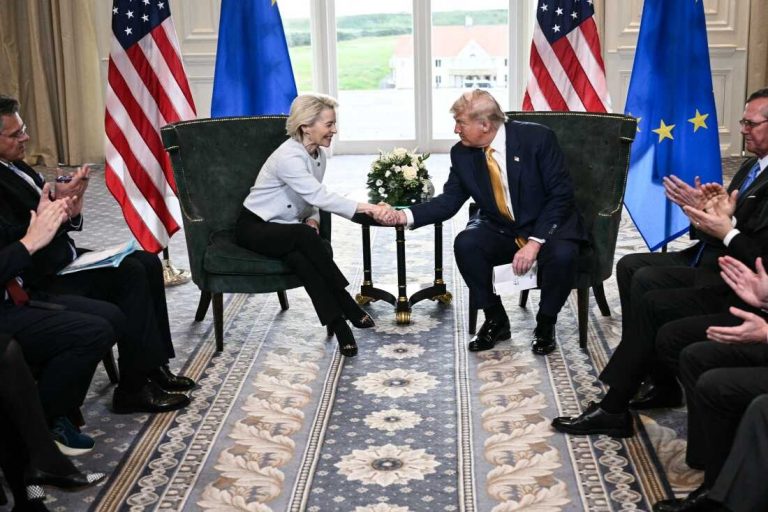
The United States and the European Union finalized a framework trade deal, announced by U.S. President Donald Trump and European Commission President Ursula von der Leyen at Trump’s golf course in Turnberry, Scotland.
The agreement, locked in on August 21, 2025, aims to avoid a trade war and rebalance the economic relationship between the two blocs, which account for nearly a third of global trade. The U.S. will impose a 15% tariff on most EU exports, including autos, pharmaceuticals, semiconductors, and lumber, significantly lower than the threatened 30% rate.
The EU will eliminate tariffs on all U.S. industrial goods and provide preferential market access for U.S. seafood and agricultural products. U.S. tariffs on EU cars and car parts (currently 27.5%) are expected to be reduced once the EU introduces legislation to cut tariffs on U.S. goods, potentially within weeks.
Register for Tekedia Mini-MBA edition 20 (June 8 – Sept 5, 2026).
Register for Tekedia AI in Business Masterclass.
Join Tekedia Capital Syndicate and co-invest in great global startups.
Register for Tekedia AI Lab.
The EU committed to purchasing $750 billion in U.S. energy (liquefied natural gas, oil, and nuclear products) over three years, averaging $250 billion annually, and investing $600 billion in U.S. strategic sectors by 2028. Additionally, the EU will buy $40 billion in U.S.-made AI chips and significant amounts of U.S. military equipment.
However, critics argue these figures are ambitious and legally non-binding, as the EU cannot directly control private sector investments. Both sides agreed to address digital trade barriers, with the EU confirming it will not adopt network usage fees. They will also negotiate rules of origin to ensure benefits accrue to both parties and consider cooperation on steel and aluminum markets to address overcapacity through tariff quotas.
U.S. farmers, ranchers, and energy firms stand to gain from increased exports and investments. EU automakers, aviation, and semiconductor sectors avoid harsher tariffs, but the German automotive industry faces challenges with the 15% tariff costing billions annually. EU exporters generally face higher costs, potentially impacting competitiveness.

European leaders like German Chancellor Friedrich Merz and French Prime Minister François Bayrou have expressed concerns, with France calling it a “dark day” for the EU, citing a lack of reciprocity. Environmental groups warn the deal’s focus on fossil fuels could undermine EU climate goals. Contradictory claims between the U.S. and EU on details, such as pharmaceutical tariffs, have caused confusion, and the deal’s implementation depends on EU legislative processes and further negotiations.
The deal is seen as a compromise to avoid a more damaging trade war, but its asymmetry and long-term impacts remain contentious, with ongoing negotiations needed to finalize details. The EU’s commitment to purchase $750 billion in US energy (LNG, oil, nuclear) over three years and $40 billion in AI chips boosts US energy and tech sectors.
Tariff-free access for US industrial goods, seafood, and agricultural products enhances US export competitiveness, particularly for farmers and ranchers. The 15% US tariff on most EU exports (e.g., autos, pharmaceuticals, semiconductors) increases costs for EU exporters, potentially reducing their competitiveness.
German automakers, facing billions in annual tariff costs, are particularly affected, though reduced US tariffs on EU cars (from 27.5%) offer some relief. The deal’s focus on bilateral trade may divert flows from other partners, impacting global supply chains. The EU’s tariff cuts on US goods could pressure other trading blocs (e.g., China, UK) to negotiate similar deals.

The EU’s $600 billion investment pledge in US strategic sectors by 2028 strengthens US industries like tech, energy, and defense. However, as these commitments are non-binding, actual investment may fall short, creating uncertainty. EU industries, particularly in Germany and France, face higher costs and potential job losses due to US tariffs.
In the EU, higher tariffs on exports may raise prices for US-bound goods, potentially increasing costs for European consumers if companies pass on losses. In the US, tariff reductions on EU goods could lower prices for consumers, particularly for cars and pharmaceuticals, though the extent depends on final agreements.
The deal is a political win for President Trump, reinforcing his “America First” agenda by securing favorable terms for US industries. It could bolster his administration’s support among farmers, energy producers, and tech firms, especially ahead of future elections.
Critics, including labor unions and environmental groups, may oppose the deal for its focus on fossil fuels and lack of worker protections, potentially fueling domestic debates. The deal has sparked divisions within the EU. France and Germany, key economic powers, have criticized its asymmetry.
This could strain EU unity, as smaller member states may benefit more from US market access. The European Commission’s ability to deliver on non-binding investment pledges depends on member state cooperation, risking further political friction if targets are unmet.
The deal strengthens the US-EU economic alliance, potentially countering China’s influence in global trade. By prioritizing US energy and tech, the EU reduces reliance on Chinese chips and Russian energy, aligning with Western strategic goals. However, the deal’s focus on bilateral benefits may alienate other partners, like the UK or Canada, and could complicate WTO compliance.
The EU’s commitment to buy $750 billion in US fossil fuels (LNG, oil) undermines its climate goals, drawing criticism from environmental groups. This could weaken the EU’s global leadership on climate policy and strain relations with green-leaning member states. Increased US LNG exports enhance EU energy security, reducing dependence on Russian gas.
The deal strengthens US economic and geopolitical leverage while offering the EU tariff relief and market access at the cost of significant concessions. It stabilizes transatlantic trade but risks internal EU divisions, climate setbacks, and global trade disruptions, with long-term outcomes dependent on implementation and further negotiations.